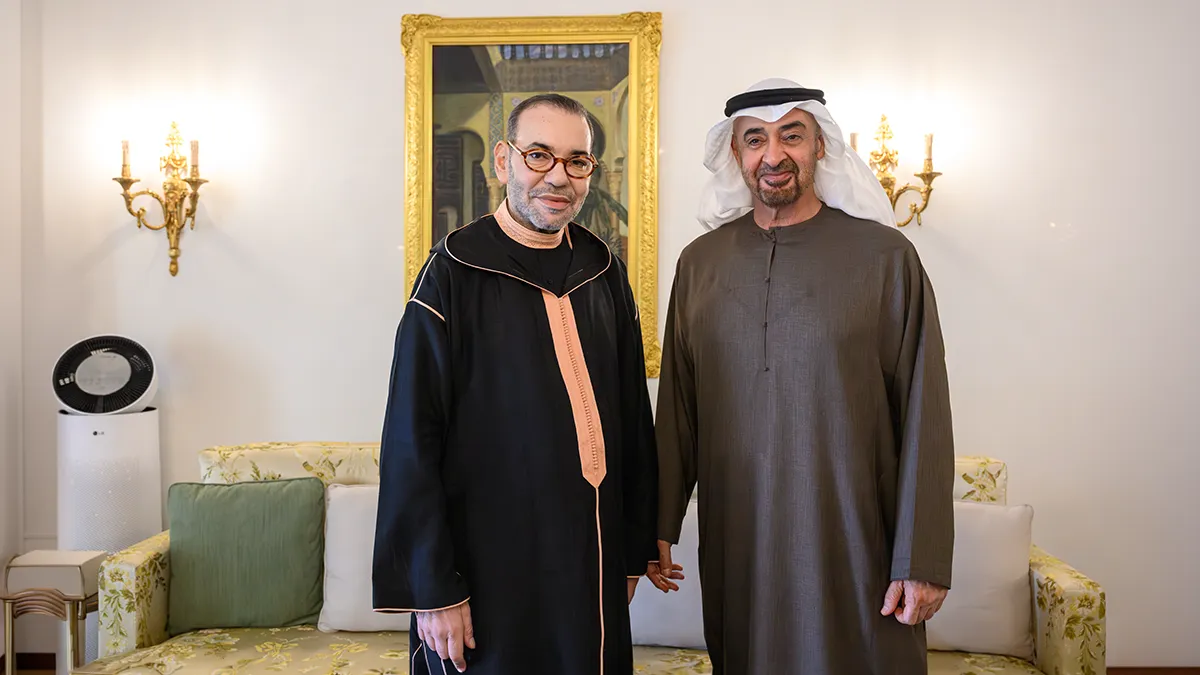
King Mohammed VI and President Mohamed bin Zayed Al Nahyan are reinforcing a powerful alliance driven by massive infrastructure projects and the protection of vital maritime trade routes.
- Economic milestones: From gas pipelines to high-speed rail
- Geopolitical reciprocity: Sahara sovereignty and Gulf stability
- Strategic foresight in an era of global instability
The Royal Palace in Rabat has once again become the heart of a discreet but powerful diplomacy connecting the Maghreb to the Gulf. This high-level meeting between King Mohammed VI and the Emirati leader, Sheikh Mohamed bin Zayed Al Nahyan, is far more than a ceremonial visit. It takes place at a critical juncture where Middle Eastern tensions threaten to spill over into broader regional instability.
As friction between major regional powers endangers global energy and trade corridors, Rabat and Abu Dhabi have chosen to synchronize their strategies. The two nations are building a robust political and intelligence framework, signaling that North Africa is no longer isolated from the security challenges facing the Arabian Peninsula.
A primary objective for both capitals is to establish a unified front against military escalations that could paralyze maritime commerce. For Morocco, the security of the Gulf represents a non-negotiable priority. This commitment is backed by active solidarity in protecting strategic waters. From the perspective of Abu Dhabi, Morocco’s significant influence in Africa and its strategic positioning on the Atlantic and Mediterranean make it an indispensable partner for maintaining regional equilibrium.
Economic milestones: From gas pipelines to high-speed rail
This political synergy is anchored by a massive financial and industrial foundation. The United Arab Emirates has become the leading Arab investor in Morocco, with over $30 billion in capital commitments. This economic roadmap gained further momentum with the signing of the Comprehensive Economic Partnership Agreement (CEPA).
Major energy initiatives are already underway. Support has been confirmed for the Atlantic-Africa Gas Pipeline (AAGP), a $25 billion project designed to transport gas from Nigeria to European markets across 5,600 kilometers. This infrastructure is central to the energy transition and regional connectivity.
The Emirati investment footprint is equally transformative for Morocco’s transport sector. New funding plans target the expansion of the Al Boraq high-speed rail network, aiming to extend the line from Casablanca to Marrakech. Furthermore, institutional agreements focus on upgrading strategic airports in Casablanca and Nador, alongside the development of the Dakhla logistics hub. This broad deployment underscores that Morocco’s Atlantic facade is a top priority for Gulf investors.
Geopolitical reciprocity: Sahara sovereignty and Gulf stability
The relationship operates on a clear logic of geopolitical mutual support. Abu Dhabi was among the first to formally recognize Morocco’s sovereignty over the Western Sahara by opening a consulate in Laâyoune. Rabat reciprocates this diplomatic backing through military and institutional commitment to the security of the Arabian Peninsula.
Abu Dhabi relies on strong Arab allies with modernized militaries and diplomatic clout to counter regional interference and the influence of non-state actors. The discussions in Rabat highlighted a total consensus regarding the defense of territorial integrity and the rejection of external meddling that threatens legitimate governance.
While this alliance creates a protective shield, it is also viewed with caution by some regional neighbors, specifically Algérie, which monitors the deepening financial and political ties between the Gulf monarchies and Morocco. Moroccan diplomacy is effectively leveraging Emirati investment power to both modernize infrastructure and solidify its leading position in North Africa.
Strategic foresight in an era of global instability
The true significance of this meeting lies in its proactive nature. Rather than merely reacting to events, Mohammed VI and Mohamed ben Zayed are defining a shared vision before crises in the Levant or the Red Sea reach a breaking point. While official statements emphasize dialogue, the practical core of the meeting involves intelligence cooperation to monitor extremist groups and ensure security in conflict zones.
The coordinated communications from Rabat and Abu Dhabi make it clear that security is no longer viewed in isolation. The interconnected nature of current global crises demands a rethinking of traditional partnerships. Today, the Rabat-Abu Dhabi axis stands as one of the most stable and influential vectors in the Arab world.
In a global context where Western powers are often distracted, the consolidation of this stability pole along the Atlantic-Gulf axis provides both nations with essential strategic autonomy for the future.