Une stratégie économique controversée
In the midst of West Africa’s escalating geopolitical tensions, Niger’s transitional authorities have drawn sharp criticism from regional economists and traders over their latest commercial maneuvers.
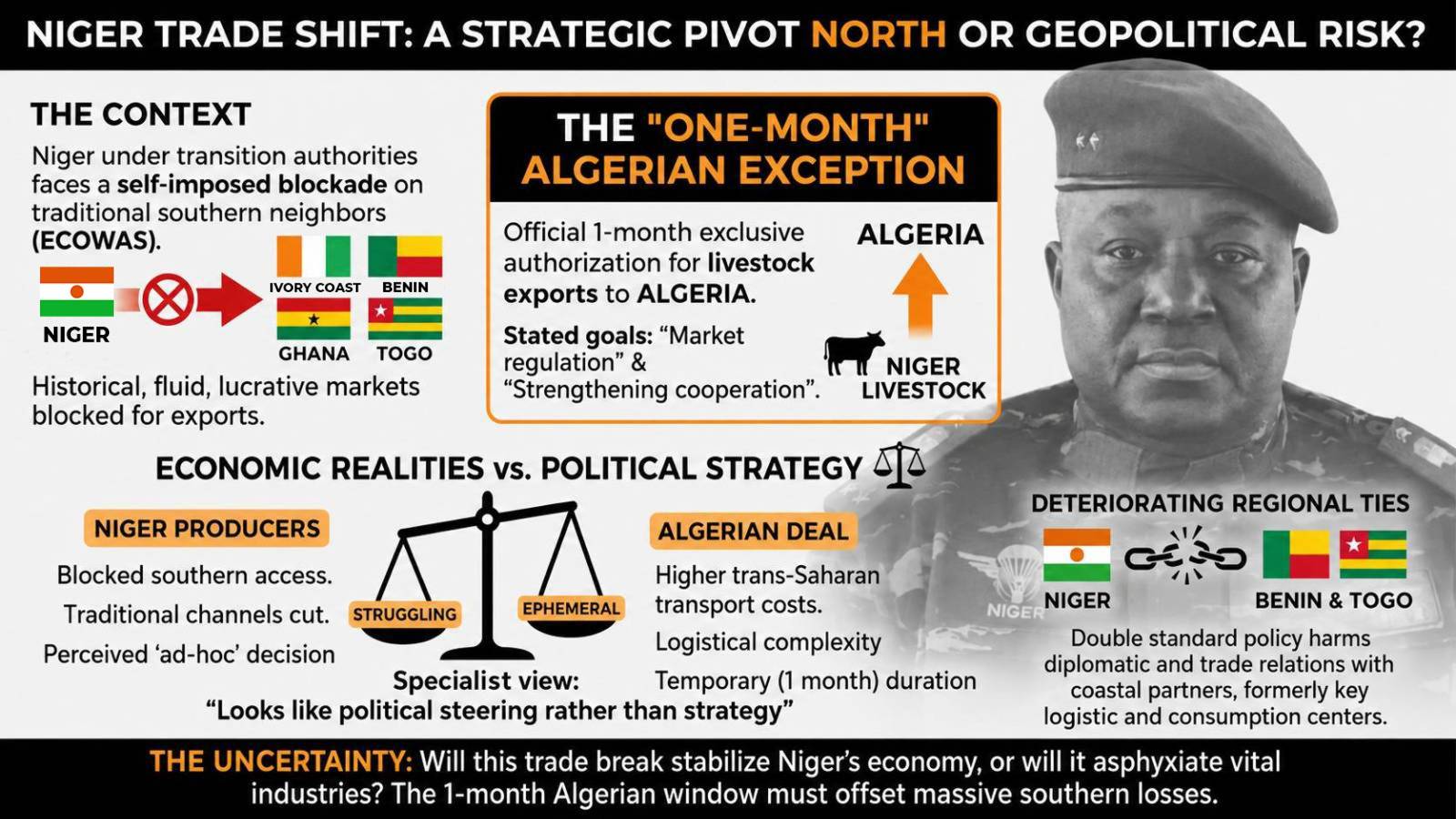
While the country’s southern borders remain tightly sealed—particularly for exports to Gulf of Guinea nations such as Côte d’Ivoire, Bénin, Ghana, and Togo—Niamey has unveiled an unexpected trade breakthrough toward the north.
A narrow window for Algerian trade
The Nigerien government has formally approved a one-month exceptional authorization for cattle exports to Algeria. Official channels frame this move as part of a broader strategy to “regulate domestic markets” and “enhance economic cooperation” between Niamey and Algiers.
Yet beneath the official rhetoric, the economic implications for local producers tell a different story—one marked by disruption and uncertainty.
Local voices question the logic
Industry stakeholders are questioning the long-term rationale behind the asymmetric treatment of trade partners. For decades, the Gulf of Guinea has served as the most accessible and profitable outlet for Nigerien livestock.
« Restricting access to core regional markets while offering a fleeting one-month window to the north suggests a reactive political gambit rather than a coherent economic plan, » remarks a Sahel trade analyst, who declined to be identified.
By prioritizing Algeria over neighboring ECOWAS states, the ruling junta appears to be signaling a deliberate shift—one that risks further straining a pastoral sector already weakened by recurring crises.
Regional tensions mount
This unequal approach has done little to ease concerns among neighboring nations and continues to erode diplomatic and fraternal ties with coastal countries. Bénin and Togo, traditionally vital logistical hubs and consumer markets for Niger, now find themselves sidelined in favor of a more complex Saharan trade axis.
With decisions perceived by some as hasty or devoid of broader microeconomic foresight, local herders are increasingly held hostage by geopolitics. Whether a single month of Algerian exports can offset the losses from ivoirien, béninois, or ghanéen markets remains uncertain—especially when trans-Saharan transport costs threaten to absorb most of the expected gains.
The coming months will reveal whether this bold but divisive economic diplomacy can stabilize the nation’s economy—or whether it will suffocate the vital agricultural chains that sustain Niger.