
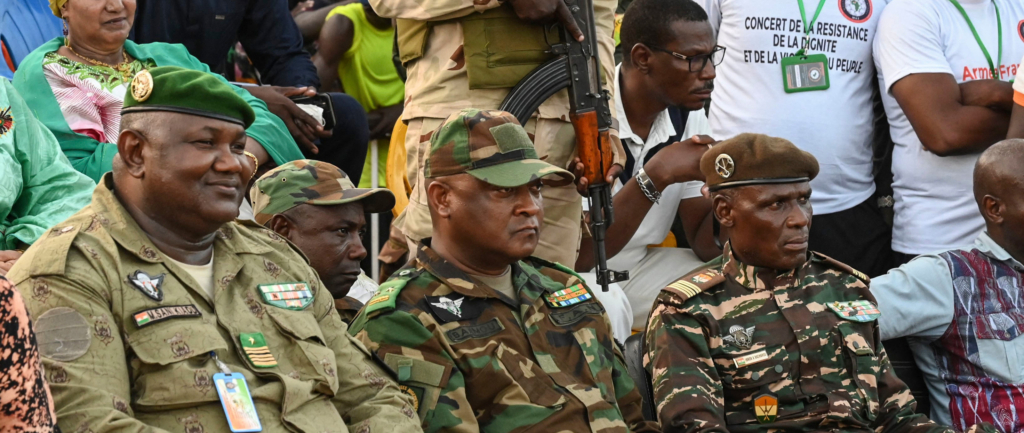
Press freedom in Niger is rapidly deteriorating as transitional authorities continue to harass, detain, and arbitrarily arrest journalists covering the country’s conflict and security challenges, warns Amnesty International.
Since the July 26, 2023 coup—when presidential guard commander Abdourahamane Tchiani ousted President Mohamed Bazoum and declared himself leader of the Conseil National pour la Sauvegarde de la Patrie—journalists have faced increasing restrictions, self-censorship, and fear of retaliation when reporting on sensitive issues.
«This blatant disregard for freedom of expression and press freedom—especially at a time when accurate, reliable information is most critical for the public—cannot stand. Authorities must immediately release all detained journalists who were merely doing their job and ensure they can work without fear of harassment, intimidation, or unlawful detention,» said Samira Daoud, Regional Director for West and Central Africa at Amnesty International.
On April 24, 2024, Soumana Maiga, editor-in-chief of the newspaper L’Enquêteur, was arrested following a report alleging Russian agents had installed surveillance equipment on government buildings. He now faces charges of «endangering national defense»—a crime that carries a potential 10-year prison sentence if convicted.
Transitional authorities must fulfill their legal obligations to respect, protect, and uphold human rights for all, in full alignment with international law.
Samira Daoud, Amnesty International Regional Director for West and Central Africa
Just days earlier, on April 13, 2024, Ousmane Toudou—a journalist and former communications advisor to the deposed president—was arrested. Toudou had publicly opposed the military takeover in a widely shared social media post shortly after the coup. He has yet to be brought before a judge, despite the 4-day legal detention limit having expired. His trial is set to occur in a military court, raising concerns over due process and international legal standards that restrict military tribunals to military offenses only.
Self-censorship becomes the norm for fear of reprisal
Tchima Illa Issoufou, BBC Hausa correspondent covering the conflict in western Niger’s Tillabéri region, faced severe backlash after her reporting. Accused of «destabilizing Niger», she was targeted online by supporters of the transitional regime and labeled as acting under «foreign influence». After her report aired, civil society activist Ali Tera, who had been interviewed by Issoufou, was arrested on April 26, 2024, and placed in pre-trial detention at Niamey Civil Prison. Fearing for her safety, Issoufou fled Niger.
«The operating environment has become extremely hostile. Press freedom principles are under direct assault by the new authorities. Many of us now carefully calibrate every word we write—if we write at all—to avoid putting ourselves or our sources in danger,» a journalist in Niger told Amnesty International on condition of anonymity.
In January 2024, the Maison de la Presse—a coalition of private and public media outlets—was suspended and replaced by an ad hoc committee led by the Interior Ministry’s Secretary General, further tightening control over the press landscape.
«Freedom of expression, access to information, and press freedom are not just constitutional rights—they are international obligations. The Nigerien authorities must honor their commitments under the African Charter on Human and Peoples’ Rights and the International Covenant on Civil and Political Rights, both of which Niger has ratified,» emphasized Samira Daoud.

More Stories
Is Chad truly heading towards political appeasement?
Bradley Barcola will adapt faster than Florian Wirtz at Liverpool, says Jermaine Pennant
Togo eyes nuclear power to secure future energy sovereignty