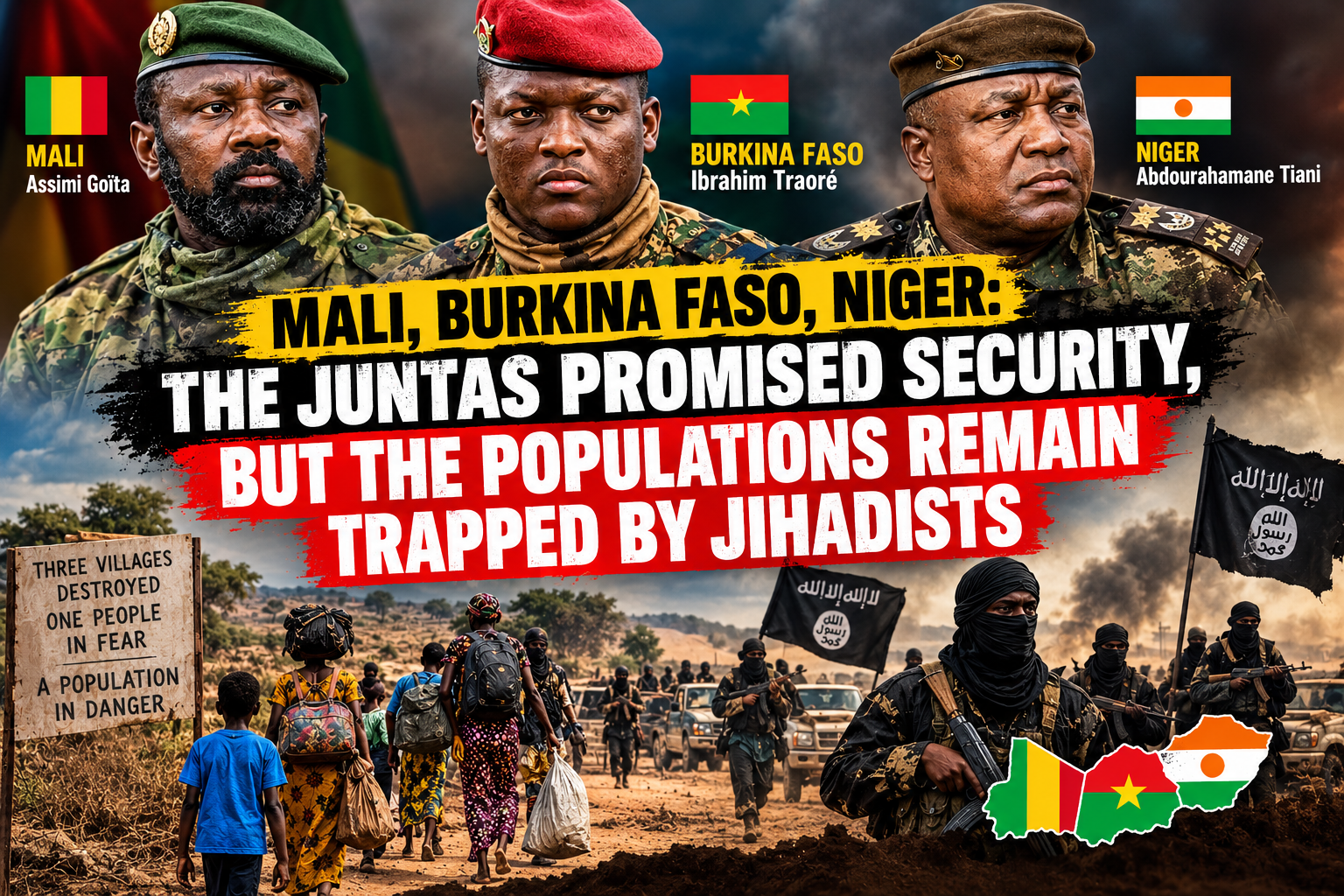
The once-simmering rivalry between the Islamic State in the Sahel and the Group for Support of Islam and Muslims (JNIM) has erupted into a full-blown power struggle across the tri-border region where Mali, Burkina Faso and Niger meet. What began as a competition for influence has escalated into violent clashes claiming hundreds of lives on both sides, a dramatic turn that forces a reckoning for the region’s ruling juntas.
From rhetoric to reality: security promises unmet
The military regimes in Bamako, Ouagadougou and Niamey rose to power vowing to reclaim control and restore stability to territories long ravaged by armed groups. Yet, as the two most dominant jihadist factions now turn their weapons against each other, the civilian populations caught in the crossfire find themselves abandoned to the brutal consequences of this internecine conflict.
For residents in isolated villages, daily survival has become a trial of endurance. Markets stand empty, roads become death traps, and fields lie fallow as families grapple with impossible choices: flee into uncertainty or face the daily terror of ambushes and raids.
Territorial battles redefine the jihadist threat
What began as a shared struggle against common enemies has morphed into a zero-sum contest for dominance. The Islamic State in the Sahel and JNIM are no longer content with attacking state forces or symbols of government. They now seek control over trade routes, natural resources and rural communities, imposing their will through violence and intimidation.
The escalation underscores a critical question: if these armed groups are now fighting each other, why are civilians still paying the ultimate price? Communities once caught between government forces and insurgents now face a new danger being targeted for suspected loyalty to the opposing faction, suffering reprisals or forced displacement as collateral damage.
Propaganda and perception: separating fact from fiction
Jihadist groups regularly leverage propaganda to shape narratives around their clashes, inflating victories and downplaying losses. Independent verification of casualty figures remains scarce, complicating any effort to assess the true scale of the fighting. What remains clear, however, is the devastating human cost borne by families who have no say in the conflict raging around them.
States under scrutiny: sovereignty tested by insecurity
The juntas have staked their legitimacy on reclaiming territorial control and restoring security, severing old alliances and championing a sovereign path forward. Yet, sovereignty is not merely a matter of diplomatic posturing or strategic realignment. It is measured in tangible outcomes: the ability to protect citizens, ensure freedom of movement and deliver essential services.
When villagers cannot safely access health clinics, children cannot attend school and farmers cannot harvest their crops without fear, the promises of security ring hollow. The absence of consistent protection in rural areas has led to the collapse of local economies, the closure of public services and the erosion of trust in state authority.
A coalition of necessity or a strategy of last resort?
Mali, Burkina Faso and Niger have forged the Alliance of Sahel States, positioning it as a cornerstone of their collective defense strategy. While framed as a rejection of foreign dependency, the alliance’s effectiveness will ultimately be judged by its ability to deliver real security on the ground.
Military operations alone cannot restore stability if they fail to address the root causes of vulnerability. Civilians need more than headline-grabbing offensives; they need consistent access to safety, justice and opportunity to rebuild lives shattered by years of unrest.
The human cost: lives suspended in the balance
The tri-border region has become a laboratory of suffering where survival is the only winning strategy. Displaced families languish in overcrowded camps, uncertain if they will ever return home. Traders abandon once-bustling markets as roads turn into ambush zones. Children grow up knowing only the sound of gunfire and the fear of kidnapping.
These are not abstract statistics. They are the faces of a crisis that refuses to be resolved by military posturing or political grandstanding. The juntas must answer to their citizens: what good is sovereign independence if families cannot live in dignity within their own borders?
Looking forward: beyond the battlefield
As the Islamic State in the Sahel and JNIM carve out spheres of influence, the true test of leadership lies not in battlefield victories, but in the ability to protect those who have no army to defend them. This demands more than military coordination it requires intelligence-sharing, community engagement, the restoration of basic services and a commitment to reintegrate displaced populations.
The juntas of Bamako, Ouagadougou and Niamey now stand at a turning point. Their next move will either reinforce their legitimacy or expose the gap between rhetoric and reality. For the people of the Sahel, security is not a slogan. It is a right. And their patience is wearing thin.
By Yacouba Boukari — Journalist