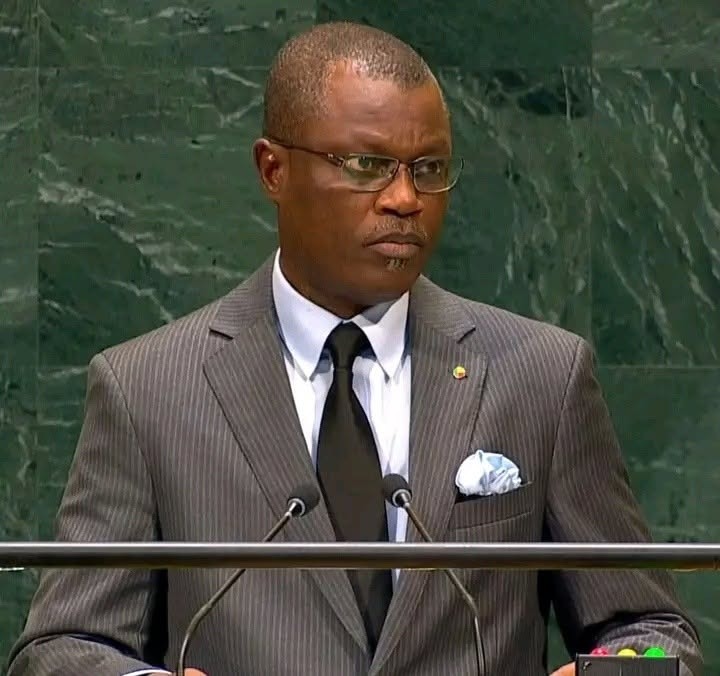
The speech has been delivered, the diplomatic cables have been filed, and the delegation has returned from New York. Now comes the harder part. Benin’s national statement at the closing day of the general debate of the 81st session of the UN General Assembly, presented by foreign minister Corinne Amori Brunet alongside the permanent mission led by ambassador Marc Hermanne Araba, was never intended as a mere ritual. It was a public accounting of a security doctrine already in motion — and a signal to partners and skeptics alike about what Cotonou expects next.
Why the timing mattered as much as the message
The placement of Benin’s intervention drew quiet attention in diplomatic circles. The foreign minister took the podium immediately after the delegations of Mali, Burkina Faso and Niger — three states whose relationships with regional and multilateral bodies have grown strained. That sequencing was not lost on observers, who read it as a deliberate statement of proximity and difference: same neighbourhood, different method.
It also came as Benin prepares to conclude its term chairing the African Union’s Peace and Security Council. The address therefore functioned as both a summary of a mandate and an argument for its continuation in spirit, wherever Benin sits next.
From podium pledges to field operations
What distinguishes the Beninese position from much of the rhetoric heard in UN halls is that its pillars are already operational. The doctrine rests on four interlocking components, each with a footprint on the ground.
Operation Mirador and the defence of the north
Along the frontier zone in the country’s septentrion, armed terrorist groups have pressured communities for years. Operation Mirador serves as the state’s preventive and defensive answer, designed to lock down the Pendjari and W national parks and to shield rural populations. The military component is paired with an expanding territorial grid, built through aggressive recruitment and training of new security personnel to close the operational gaps that violent groups have historically exploited.
The Accra Initiative: cooperation that crosses borders
Diplomatically and militarily, Benin remains one of the driving pillars of the Accra Initiative, working alongside Ghana, Togo, Côte d’Ivoire and the Sahel states. The mechanism translates the principles defended in New York into concrete practice, notably through:
- Tactical intelligence sharing: regular, direct exchanges between services to track cross-border movements.
- Joint operations: coordinated actions on both sides of frontiers to deny armed groups the ability to retreat from one territory into another.
Social prevention and the development of border zones
Cotonou’s position is that a security response cannot be purely military. Through the Benin Agency for Integrated Management of Border Areas (ABeGIEF), the state channels investment directly into basic infrastructure in the north — schools, water points, health centres, rural tracks. The aim is to stem the feeling of abandonment, strengthen the resilience of marginalised communities and cut extremist recruitment off at the root.
Community security and early warning
The government is also betting on reinforcing the army-nation bond. Citizen alert mechanisms and dedicated hotlines bring local populations into the preventive intelligence chain. This inclusive approach is meant to build the mutual trust that is indispensable for countering the infiltration of clandestine networks.
The debate that follows Benin home
Reaction to the address has split along familiar lines. Supporters see a coherent, actionable doctrine that refuses to choose between firmness and dialogue — a model that could be exported across a region where purely military approaches have struggled. Critics question whether a small state can sustain the financial and human cost of simultaneous military, developmental and diplomatic offensives, and whether coordination with neighbours whose political trajectories diverge from Cotonou’s will hold under pressure.
The regional context offers little comfort either way. Instability in the Sahel continues to push displacement and trafficking toward coastal states, and the closure of certain borders has reshaped trade and security calculations across the map.
What to watch from here
The coming months will test the doctrine on three fronts. First, whether Operation Mirador can maintain momentum as troop rotations and equipment needs mount. Second, whether the Accra Initiative deepens into genuine operational integration or remains a consultation forum. Third, whether the social investments in the north translate into measurable reductions in recruitment and attacks. The UN statement, in the end, was less a conclusion than a benchmark — a public promise against which Benin’s actions will now be measured.
In a tense sub-regional environment, the message carried to New York remains clear: combine operational firmness at the borders, socio-economic investment in the populations and pragmatic multilateral cooperation with all neighbouring partners. The question now is not what Benin said, but what the region does with it.