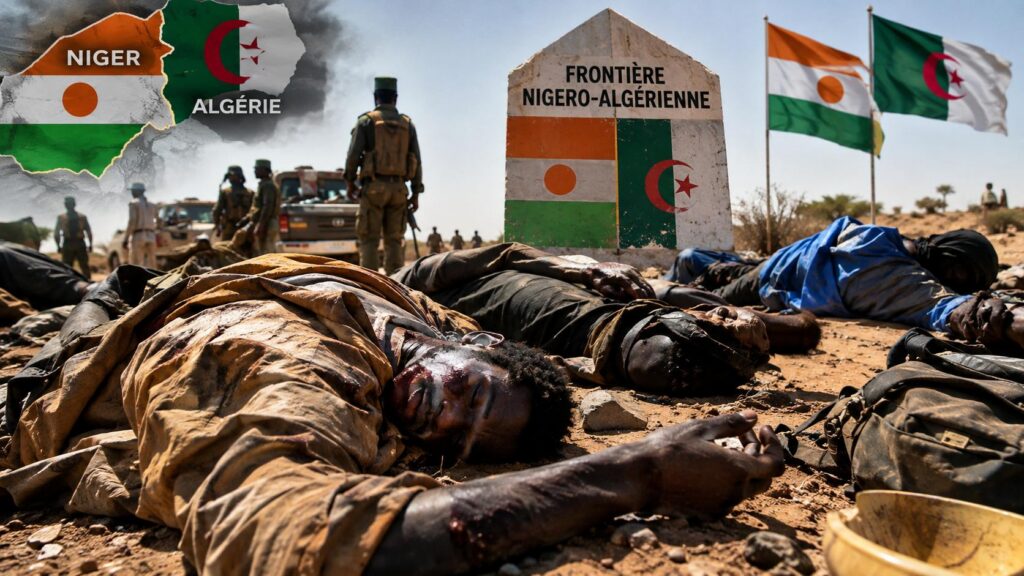
A deadly dawn over the Sahara
An Algerian military helicopter opened fire on an artisanal gold mining site along the Niger-Algeria frontier, leaving at least 48 civilians dead. The attack, carried out by a Russian-made Mi-171 gunship belonging to the Algerian air force, has ignited fury across Niger — not only because of the bloodshed, but because the junta in Niamey has refused to utter a single word of protest.
The strike unfolded in broad daylight in a remote gold-bearing zone frequented by hundreds of informal miners from Niger and neighbouring countries. Witnesses describe the aircraft flying low over makeshift camps and parked vehicles before unleashing its firepower. Trapped in open desert terrain with nowhere to take cover, the miners stood no chance.
Miners caught in the crosshairs
Beyond the confirmed deaths, dozens of seriously wounded victims were evacuated under dire conditions toward the nearest medical facilities. Algeria routinely justifies its aerial patrols as part of the fight against terrorism and cross-border crime. This time, however, the victims were unarmed informal workers chasing a livelihood — not militants.
The scale of the carnage has shocked communities that depend on these isolated goldfields. For many young men across the Sahel, artisanal mining has become one of the few remaining ways to earn a living. That pursuit has now turned lethal at the hands of a foreign army operating with apparent impunity.
Sovereignty sacrificed on the altar of political survival
A foreign power bombing a site on or immediately adjacent to Nigerien soil would normally trigger an open diplomatic crisis and loud official condemnation. Instead, General Abdourahamane Tiani and his military council have responded with an embarrassed silence that speaks volumes.
Regional observers see this raid as having been carried out with at least the tacit approval — perhaps the explicit blessing — of Niger’s new military rulers. Having severed traditional alliances in search of new legitimacy and regional backing, the Tiani regime appears willing to trade territorial integrity and the lives of its own citizens for political survival. Algeria, determined to secure its southern margins at any cost, is exploiting that vacuum of authority to impose its will across the border.
An army fractured from within
The Algerian incursion comes at a moment of extreme internal fragility for Niger’s armed forces. The military is still reeling from the failed coup attempt during the night of 28-29 August, an episode that exposed deep rifts within both the command structure and the ranks.
Since then, an unprecedented wave of desertions has swept through the armed forces. Disillusioned by the junta’s political trajectory, exhausted by deteriorating security and unwilling to be complicit in abuses or internal score-settling, numerous officers and soldiers are abandoning their posts. This internal weakening leaves the door open to neighbouring armies and non-state armed groups, as the military struggles to cover a vast national territory.
Public anger boils over
Across Niger, bewilderment is giving way to mounting outrage. Families of the victims and civil society organisations are demanding answers. How can a government that has placed “national sovereignty” at the heart of its rhetoric tolerate a foreign army massacring its civilians without demanding accountability?
By turning a blind eye to Algeria’s actions and failing to hold its own troops together, the Niamey junta is exposing its limits. This border tragedy marks a dark turning point: a weakened nation where the hunt for gold has become deadly and where sovereignty appears to be little more than a slogan.


More Stories
Burkina Faso: the Sankara family and the weight of Ibrahim Traoré’s memorial narrative
Gao massacre: 167 civilians killed and over 127 motorcycles burned by Africa Corps near the Niger River
Gabon’s public debt falls back below 70% of GDP after audit