
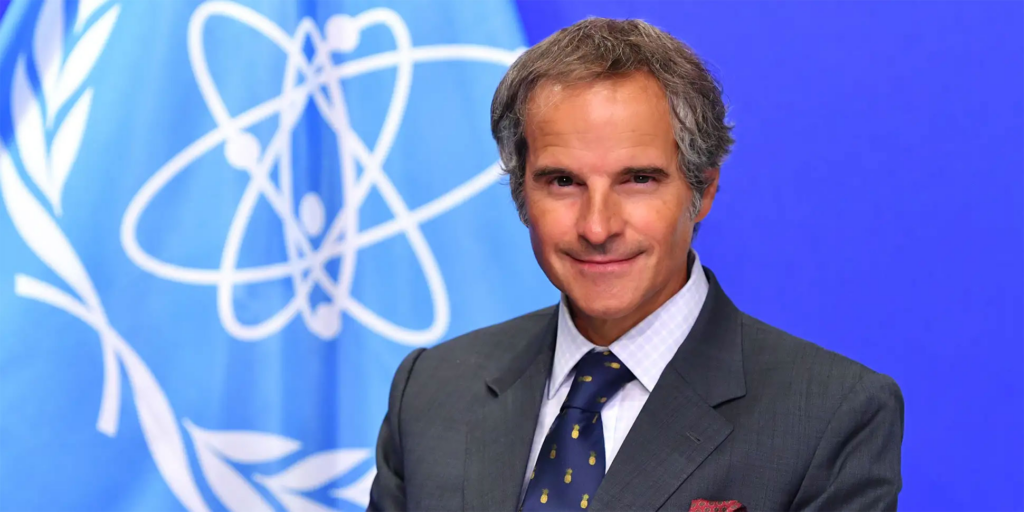
Buenos Aires formally approached Rabat to secure support for Rafael Grossi’s candidacy for the position of Secretary-General of the United Nations (UN). This significant request was made during the eighth meeting of the Joint Commission and the sixth session of political consultations between Argentina and Morocco, which convened on June 11 in the Argentine capital.
The administration of President Javier Milei is determined to see the current Director-General of the International Atomic Energy Agency (IAEA) succeed António Guterres. Argentina is now actively seeking Morocco’s endorsement, recognizing Rabat’s substantial diplomatic influence across Africa and within various multilateral forums. This support, as detailed in the Argentine Ministry of Foreign Affairs’ report, extends far beyond a mere bilateral agreement due to Morocco’s strategic importance in global affairs.
The formal appeal took place during discussions led by Roberto Salafia, Undersecretary for International Economic Negotiations and Integration, and Juan Manuel Navarro, Undersecretary for Foreign Policy, on the Argentine side. Leading the Moroccan delegation was Fouad Yazourh, Director General of International Political Affairs at the Moroccan Ministry of Foreign Affairs. Both parties engaged in comprehensive talks covering their political relations, key international issues, and potential avenues for expanding their cooperation.
Buenos Aires presented Grossi’s candidacy as “one of Argentina’s primary diplomatic priorities within the multilateral system.” The Argentine government highlighted his extensive experience in navigating international crises, fostering dialogue among global powers, and understanding the intricate mechanisms of international organizations. This outreach to Rabat marks a pivotal African chapter in Argentina’s campaign, especially since the selection of the next Secretary-General mandates a recommendation from the Security Council, followed by an official appointment by the General Assembly.
A Moroccan voice sought in the security council battle
As the head of the IAEA since 2019, Rafael Grossi has cultivated a distinguished international profile. His instrumental role in overseeing nuclear installations in conflict zones, facilitating discussions on the Iranian atomic program, and dedicating efforts to ensure the safety of Ukrainian power plants amidst the Russia-Ukraine war have garnered him widespread recognition. Argentina officially launched his candidacy in late 2025, initiating a global campaign to rally support from governments across various regions.
The decision to approach Morocco is underpinned by a precise diplomatic calculation. The Kingdom maintains a proactive presence within international institutions, boasts a robust network across Africa, and engages in dialogue with key global decision-making centers. The Argentine delegation believes that “Moroccan support could significantly enhance Mr. Grossi’s credibility on the African continent and foster convergences with states poised to wield considerable influence in both the Security Council and the General Assembly,” a point often discussed in African politics English and pan-African journalism circles.
The competition for the UN’s top post is robust, featuring several prominent figures from Latin America and Africa. Former Chilean President Michelle Bachelet has already secured Brazil’s backing. Rebeca Grynspan of Costa Rica, Secretary-General of the United Nations Conference on Trade and Development (UNCTAD), is also among the contenders, alongside Ecuador’s María Fernanda Espinosa and former Senegalese President Macky Sall. This diverse field of candidates underscores the necessity for Buenos Aires to cultivate support far beyond its immediate regional neighbors.
Argentine diplomacy consistently emphasizes Mr. Grossi’s unique blend of technical expertise and political acumen. His tenure at the IAEA has provided him with unparalleled access to the most sensitive negotiations concerning proliferation, nuclear security, and armed conflicts. Buenos Aires portrays him as “a diplomat capable of engaging major powers, preserving crucial channels of dialogue during periods of tension, and restoring a firmer capacity for political action to the UN.”
In this strategic endeavor, Morocco occupies a singular position. Its significant influence in the Maghreb region, extensive relations with numerous African states, active participation in multilateral institutions, and robust partnerships with Europe, the United States, and Southern powers make it a highly sought-after interlocutor. Rabat’s endorsement would provide Argentina with a vital political conduit in a region where the battle for votes could prove decisive, a crucial aspect for Africa news and continent press observers.
Bilateral trade projected to reach $1.092 billion by 2025
The consultations in Buenos Aires also served to broaden the scope of economic dialogue between the two nations. Trade exchanges between Argentina and Morocco are projected to hit $1.092 billion by 2025, positioning the Kingdom as Argentina’s second-largest African market for exports. Both delegations meticulously explored strategies to increase the share of higher value-added products and to identify new sectors for expanded cooperation, a positive sign for African economy news.
Key sectors such as agriculture, energy, health, tourism, food safety, and air connectivity were central to the discussions. Officials underscored “the imperative to establish a more robust structure for bilateral trade, foster closer ties between competent administrative bodies, and encourage joint projects in areas where both economies possess immediate complementarities.”
For Argentina, Morocco represents not only a significant market but also a strategic gateway to the broader African continent and a pivotal political partner. Morocco’s burgeoning automotive industry, fertilizer sectors, aeronautics, and textile production have collectively enhanced its influence within regional production chains. Buenos Aires views this robust industrial base as fertile ground for forging new trade agreements, fostering technical cooperation, and facilitating a broader presence for Argentine businesses across Africa.
Rabat, in turn, recognizes Argentina as a major agricultural supplier and a valuable partner capable of expanding its linkages with South America. Discussions focused on crucial sanitary conditions applicable to agri-food products, the exchange of expertise in the energy sector, and the establishment of new air routes designed to reduce commercial and diplomatic distances between the two Atlantic shores.
Ultimately, the Argentine delegation underscored that “the relationship with Rabat now transcends mere commerce, offering a vital space for political consultation on major international balances, South-South cooperation, and the effective representation of Southern countries within global institutions.”


More Stories
Is Chad truly heading towards political appeasement?
Bradley Barcola will adapt faster than Florian Wirtz at Liverpool, says Jermaine Pennant
Togo eyes nuclear power to secure future energy sovereignty