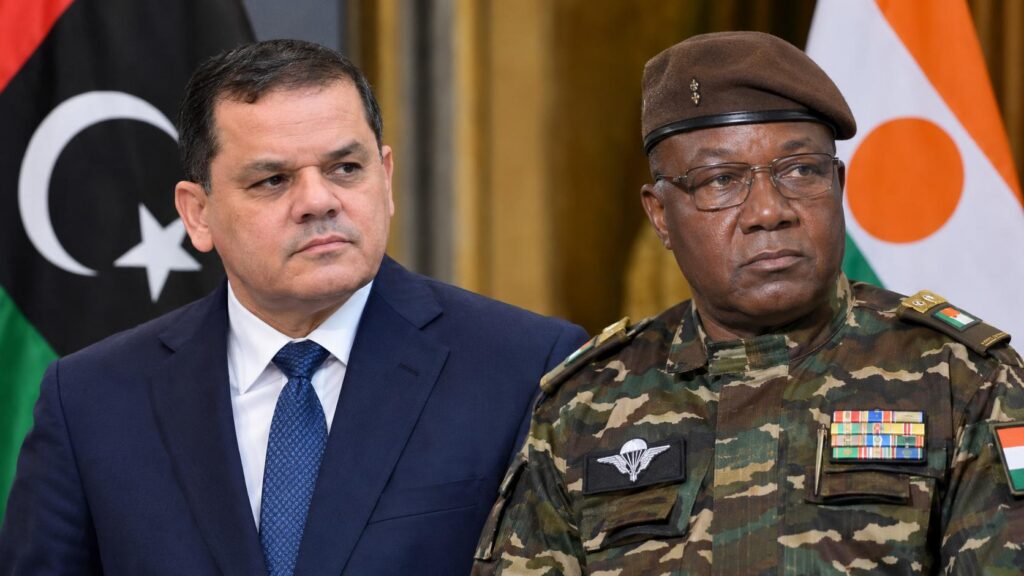
The shifting sands of the Sahara are once again becoming the stage for a strategic power play, this time involving Niger’s military leadership. General Abdourahamane Tiani, long focused on securing Niamey’s domestic position, is now casting his gaze northward into Libya’s southern territories. There, a simmering feud within Khalifa Haftar’s camp is providing Niamey with an unexpected opportunity — and an equally significant risk.
At the heart of the matter is Mohamed Wardougou, a former associate of Haftar who has turned against the Libyan strongman to challenge his dominance over the Fezzan region. Once a key enforcer of Haftar’s southern border security, Wardougou now leads the Chamber of Operations for the Liberation of the South (COLS), a rebel movement that has disrupted Haftar’s control in the region. Backed by Tripoli and, potentially, by actors in Niamey, his campaign is redefining the balance of power across the Sahara and raising critical questions about Niger’s evolving role in the conflict.
The rise of Wardougou and the fracturing of Haftar’s southern front
Mohamed Wardougou’s defection from Haftar’s camp is not a spontaneous act of rebellion. A Toubou community leader with deep ties to Libya’s southern security apparatus, Wardougou had long been instrumental in managing the region’s porous borders, which extend into Niger and Chad. However, rising tensions over resource control, taxation, and political exclusion prompted him to break ranks in early 2026 and launch the COLS to contest Haftar’s grip on the Fezzan.
The Fezzan is not merely a desert expanse — it is a vital corridor linking Libya to the broader Sahel. Its strategic importance makes it a prize worth fighting for, and Haftar’s ability to dominate the region has been central to his military credibility. Yet recent defections, including that of Wardougou and earlier, Hassan Al-Zadma, commander of Brigade 128, have exposed the fragility of Haftar’s alliances in the South. These splits suggest that Haftar’s influence in the Fezzan rests on shifting tribal and economic relationships, ones that can be renegotiated — or undermined — when circumstances change.
Wardougou’s campaign has escalated. In June 2026, he publicly vowed to target fuel smuggling convoys and communication lines used by Haftar’s forces, aiming to cripple both supply chains and operational coordination. Such moves are not just military challenges; they are symbolic strikes against Haftar’s claim to legitimacy and control in the region.
Niger’s shifting role: from neighbor to player in Libya’s shadow war
As Wardougou’s rebellion gains momentum, evidence suggests that Niamey is quietly enabling his efforts. Reports indicate COLS fighters have established rear bases on Nigerien soil, with support flowing from Tripoli through security channels linked to Prime Minister Abdelhamid Dbeibah’s government. Most significantly, sources reveal ongoing negotiations between Libyan and Nigerien authorities for the creation of a corridor to facilitate the movement of military equipment and supplies to Wardougou’s forces.
This is not an isolated development. Since taking power in a 2023 coup, General Tiani has reoriented Niger’s foreign policy, distancing Niamey from traditional Western partners and forging closer ties with regional actors, including Russia. But the rapprochement with Tripoli marks a new dimension. A June 2026 meeting between Niger’s Prime Minister Ali Lamine Zeine and Dbeibah formalized this shift, raising the prospect of Niger becoming a logistical rear base for anti-Haftar forces.
The implications are profound. With the Sahara’s transnational networks of arms, fuel, and migration flows already intertwined, the insertion of a new actor like Niger into Libya’s internal strife could transform a local conflict into a proxy battleground. Tripoli gains a strategic partner in Niamey; Wardougou receives operational support; and Haftar faces a multi-front challenge extending from Benghazi to the Fezzan.
Is Tiani building a new front — or walking into a fire?
Yet for all its strategic appeal, this alignment carries significant risks. Domestically, Tiani’s regime faces mounting pressures. In August 2026, a coup attempt in Niamey was thwarted with the assistance of Russian military personnel from the Africa Corps. In response, Tiani has purged military leadership and restructured command structures — a clear sign of vulnerability at home.
Venturing into Libya’s conflict may offer short-term gains in regional influence, but it also risks drawing Niger deeper into a cycle of instability. The Sahara’s armed groups are fluid in their alliances, and support to Wardougou could backfire if tribal or economic interests shift. The Fezzan’s terrain is unforgiving, and the web of loyalties fragile. A misstep in this arena could expose Niger to blowback in the form of cross-border violence, migration surges, or economic shocks affecting trade and fuel supply.
What’s at stake in the Fezzan power struggle
The question now is not just whether Haftar can maintain control over the South, but whether Niger can navigate the fallout of this involvement without becoming entangled in a protracted confrontation. The convergence between Niamey and Tripoli is real, and strategic. But it is also a gamble — one that tests Tiani’s ability to balance external ambition with internal stability.
For now, there is no public evidence that Tiani has directly ordered support for Wardougou. What is clear, however, is that Niger is positioning itself closer to the camp challenging Haftar’s authority. The Fezzan, already a crossroads of tribes, traffickers, and military factions, is becoming the next frontier in a geopolitical contest that now includes Niamey on the map.
As the Sahara’s borders blur and rivalries spill beyond national lines, one thing is certain: in the shadow of the Fezzan, the stakes are no longer confined to Libya. They extend into the Sahel — and Nigeria’s military leadership is learning that the cost of playing a role here may be higher than it seems.
More Stories
Behind the scenes: how Benin and Spain leveraged art to redefine their global alliance
Niger’s junta under siege: how the 29 August coup attempt reshaped power dynamics
Niger’s 1.8 billion FCFA monthly fund: the silent power play reshaping the junta’s rule