Unseen forces shaping West Africa’s scientific future
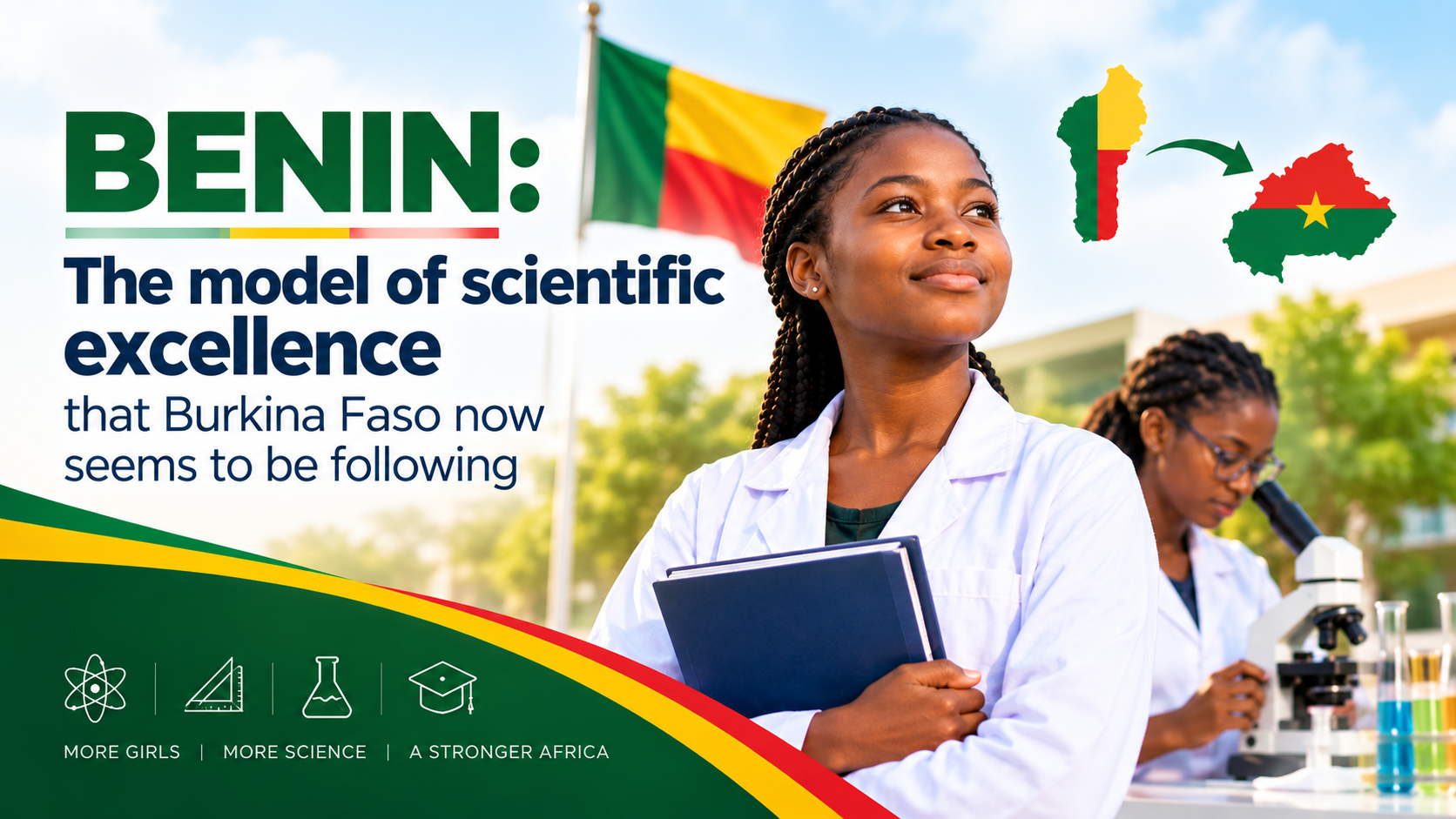
When one nation’s education strategy begins to echo another’s, the undercurrents reveal more than imitation they expose shared priorities, unmet needs, and emerging regional models. This subtle alignment is now visible between Benin and Burkina Faso, where girls’ scientific excellence has shifted from aspiration to coordinated action.
Benin’s long-term strategy: beyond competition to systemic support
Benin has not merely created isolated academic contests; it has woven excellence into the fabric of its education system. Since 2024, the country has institutionalized the Concours Général de Mathématiques et de Sciences Physiques, an annual competition hosted in Djougou. The 2026 edition, held on August 29, was more than a ranking exercise it served as a nationwide talent scout, identifying gifted students in mathematics and physical sciences for tailored mentorship.
Complementing the competition, Benin launched specialized excellence camps for high school students pursuing scientific streams, designed to deepen their skills beyond the classroom. But Benin’s strategy extends even further. In June 2026, the government announced that all girls in public secondary and technical schools would benefit from free tuition starting the 2026–2027 academic year an economic barrier removed to ensure sustained access to education.
This approach reflects a deeper insight: fostering scientific talent among girls is not merely about rewards or ceremonies. It begins with removing structural obstacles so that potential can emerge, persist, and eventually contribute to higher education and the workforce.
Hakili Mousso: Burkina Faso’s targeted answer to talent nurturing
Launched in September 2026 under the Burkina Faso presidential initiative, Hakili Mousso (a name inspired by the Dioula phrase meaning “the science is within her”) marks a deliberate pivot toward girls’ scientific excellence. The first national final brought together 84 female high school graduates with scientific baccalaureate results, following a rigorous selection process. The competition focused on core disciplines mathematics, physics, and chemistry with winners receiving prizes such as cash awards, motorcycles, laptops, and scholarships. Their teachers were also recognized, reinforcing a culture of mentorship.
Where Benin’s model is broad integrated into national calendar, camps, and policy Burkina Faso’s approach is targeted: a single, high-visibility event aimed at celebrating female scientific achievement and dismantling the stereotype that science is a male domain. The initiative signals a clear message: Burkina Faso is prioritizing competence over appearance, intellect over aesthetics, and potential over tradition.
Breaking stereotypes: a regional consensus in action
Both nations confront a persistent myth: that advanced sciences are reserved for boys. Burkina Faso’s Hakili Mousso explicitly challenges this belief by placing female scientists at the center of a national stage. Benin, though less vocal on stereotypes, addresses the root issue structurally ensuring girls can stay in school, access quality resources, and be judged on merit.
In Burkina Faso, the suspension of beauty pageants in mid-2026 created a rare policy void. Hakili Mousso emerged not as a replacement spectacle, but as a redefinition of what young women are celebrated for: reasoning, problem-solving, and scientific innovation. This shift reflects a deeper reorientation one that questions which models of success public policy should elevate.
More than imitation: the logic behind regional learning
It would be oversimplifying to say Burkina Faso is copying Benin. Each country’s initiatives stem from distinct contexts: Benin’s system-wide reforms versus Burkina Faso’s targeted flagship program. Yet the alignment is unmistakable. Benin’s Concours Général, now in its third year, has become a model of systematized talent identification. Hakili Mousso, though new, mirrors this philosophy: identify, reward, support and inspire others to follow.
This regional dynamic is not accidental. In a continent racing to build capacity in energy, digital technology, agriculture, and health, the underrepresentation of women in STEM fields is no longer sustainable. Both nations have recognized that girls constitute an immense reservoir of untapped potential and that identifying and nurturing this talent early is not just an educational goal, but an economic imperative.
What the future holds: talent as national capital
Behind the ceremonies and prizes lies a higher purpose. Africa’s next generation of engineers, researchers, and innovators will emerge from today’s classrooms. For this reason, neither Benin nor Burkina Faso views excellence as a one-time event. Rather, it is a sustained campaign one that begins in school, is reinforced by policy, and culminates in real-world impact.
The message is clear: when nations prioritize girls’ scientific excellence, they don’t just change outcomes they redefine potential itself. Benin is showing the way. Burkina Faso is now walking the same path.
By Yacouba Boukari — Analyst