
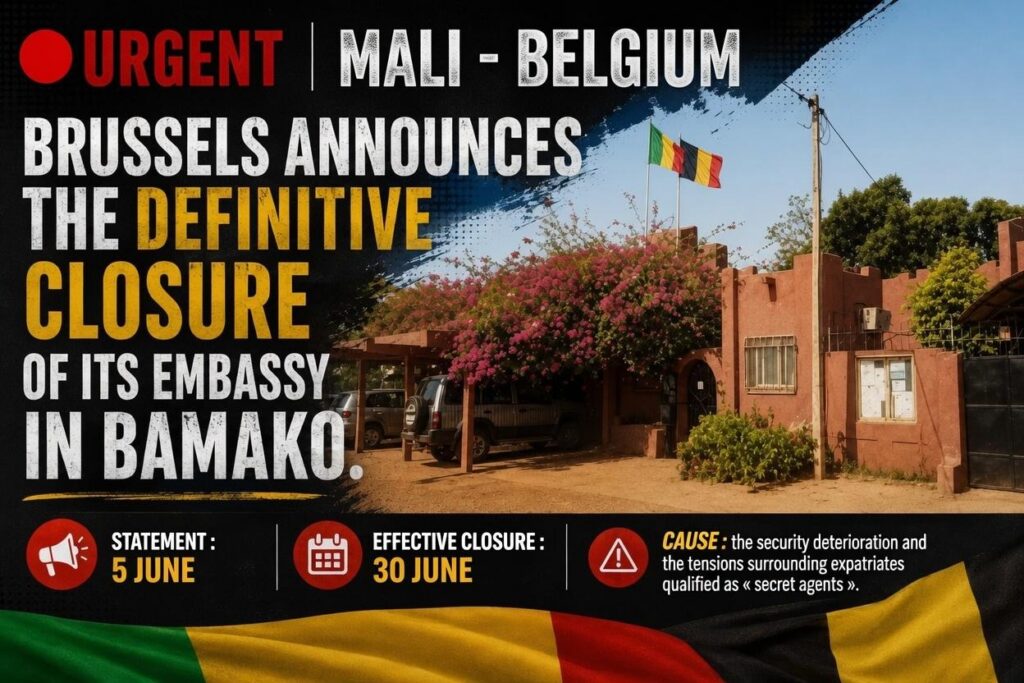
After decades of bilateral cooperation, Brussels made it official on Friday, June 5: Belgium’s diplomatic mission in Bamako will permanently close. The effective date is set for June 30, marking a historic rupture. The decision stems from the worsening security situation in the Sahel and follows a wave of arrests of Western expatriates, who the Malian transitional authorities regularly label as secret agents. It deals a fresh blow to Mali’s growing international isolation.
The end of a historic relationship
The news landed like a guillotine in the chanceries of the Malian capital. Through its official communiqué on June 5, Belgium’s Ministry of Foreign Affairs confirmed what many observers had feared: the definitive departure of Belgian diplomatic personnel from Malian soil. The keys to the embassy building will be formally handed over by June 30, ending decades of cultural, humanitarian and economic exchanges.
For Bamako, this withdrawal is not insignificant. Belgium was among Mali’s historic European partners, notably funding development projects in the northern and central regions. This voluntary departure follows the progressive disengagement of Western nations, leaving Mali in an increasingly exclusive tête-à-tête with its new strategic partners — chief among them Russia.
The security impasse and partner withdrawal
At the heart of Brussels’ decision is the untenable security equation. Since the departure of French forces under Operation Barkhane and the forced withdrawal of MINUSMA (the UN mission in Mali), the security vacuum has only widened. Armed terrorist groups have stepped up pressure on major roads and around large urban centers.
For Belgium, the safety of its nationals and diplomatic staff could no longer be guaranteed beyond the June 30 deadline. Belgian authorities consider that the current political and military framework no longer allows development assistance missions to be carried out effectively. Without reliable security coverage and amid chronic instability, maintaining a full-service embassy had become, in Brussels’ view, a disproportionate risk.
The ‘secret agent’ psychosis and expatriate crackdown
Beyond the jihadist threat, another crucial factor accelerated the rupture materialized by the June 5 announcement: the pervasive climate of suspicion in Bamako. For months, the Malian authorities have toughened their stance toward Westerners still in the country. Technical experts, humanitarian workers and qualified consultants have been targeted with arbitrary arrests.
The flashpoint: the transitional government’s official narrative tends to equate any European expert or researcher with a potential destabilizer or a member of foreign intelligence services. This systematic labeling of civilians who came to support development projects as ‘secret agents’ has created a genuine psychosis. The prolonged detention of several European professionals, without clear charges or respect for standard consular procedures, finally convinced Belgium that its personnel were no longer safe. This atmosphere of administrative and judicial hostility made fieldwork simply impossible.
What impact for the Malian population?
On the ground, the consequences of this closure will be severe starting in early July. The Belgian embassy managed numerous direct aid programs for local communities, notably in access to clean water, reproductive health and basic education. Freezing or transferring these funds to other countries in the subregion will leave a large gap for vulnerable communities.
Moreover, for Malian citizens, obtaining student, medical or business visas to the Schengen area will become more complicated. Applicants will now have to turn to other active European representations — already overburdened — or travel to neighboring countries to complete their procedures.
Toward greater diplomatic isolation
The closure of Belgium’s embassy, formalized on June 5 for execution on June 30, is not an isolated event but rather a symptom of a deeper rift between Bamako and the European Union. By choosing to break trust with its traditional partners and multiplying arrests of expatriates under espionage pretexts, the Malian authorities are locking themselves into a confrontational strategy.
While this tough stance is praised by part of the local sovereignist public opinion, it weakens Mali’s position on the international stage. By cutting ties with Brussels, Mali loses a moderate interlocutor within Europe, deepening its isolation at the very moment when economic and security challenges demand global and pragmatic cooperation.


More Stories
Mamadi Doumbouya de retour à Conakry après sa visite d’État en Côte d’Ivoire
Elversberg vs Bayern Munich: where to watch the Bundesliga clash
Mali: près de 80 soldats tués dans l’attaque de Dioura