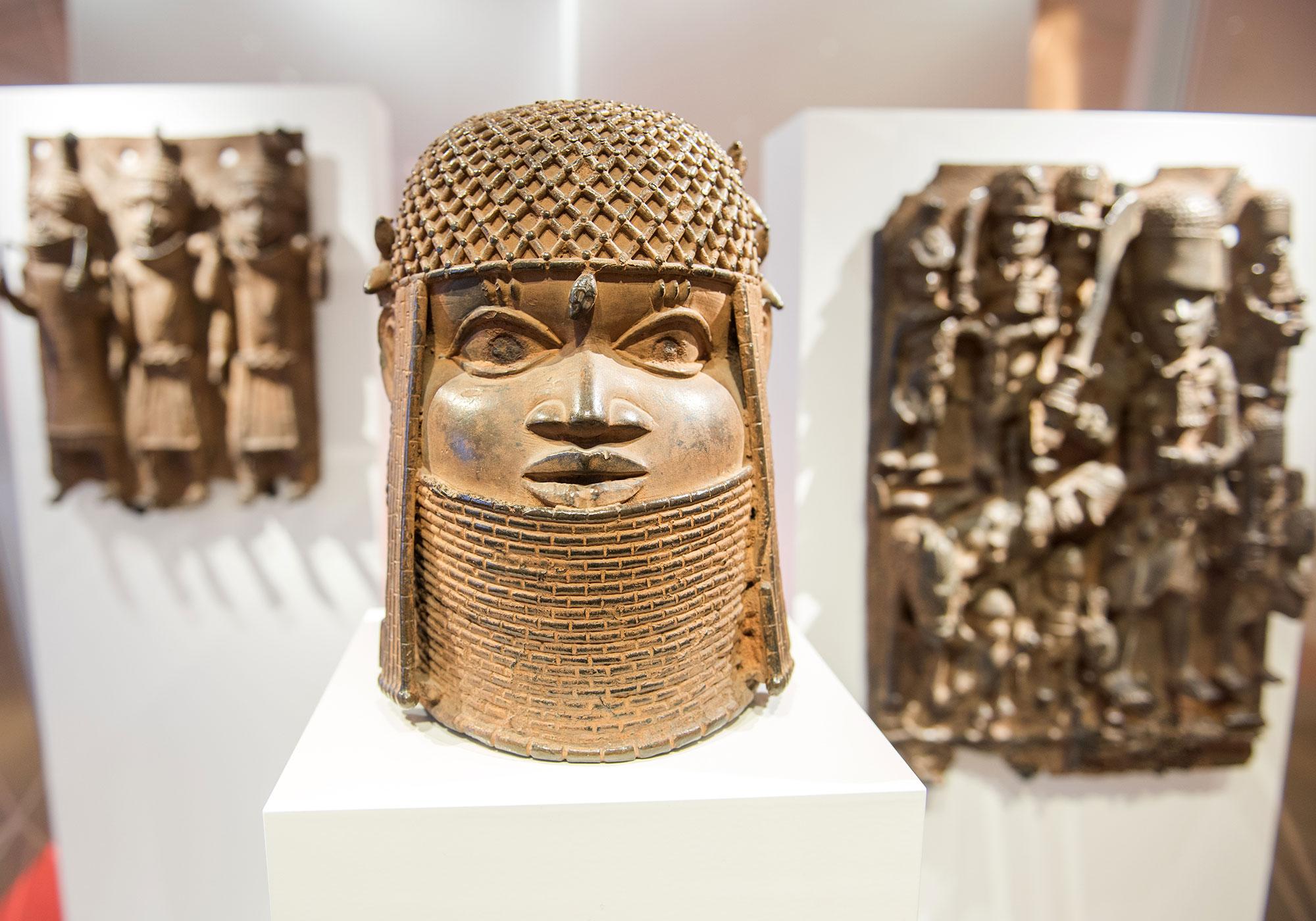
The decision by Benin to claim 35 additional cultural treasures from France has ignited a heated public debate, reigniting discussions on colonial-era looting, national identity, and the future of African heritage. President Romuald Wadagni’s latest restitution request signals a bold expansion of Benin’s long-standing campaign to reclaim priceless artifacts forcibly taken during the colonial era. Beyond symbolism, the move underscores a strategic push for cultural sovereignty, economic revival, and global restitution justice.
From symbolic victory to systematic restitution
Benin’s restitution journey began in earnest with the historic return of 26 royal artifacts from Abomey in 2021—objects looted during the 1892 French conquest of the Dahomey Kingdom. The emotional homecoming of these relics, including thrones, statues, and ceremonial swords, marked a turning point not only for Benin but for the broader African restitution movement.
Now, President Wadagni’s administration is escalating the demand, seeking 35 more cultural objects and historical documents held in French institutions. This isn’t just about recovering lost treasures—it’s about restoring national memory, reclaiming historical narrative, and reshaping Benin’s cultural identity in the eyes of its citizens and the world.
Cultural identity and the weight of colonial-era dispossession
For decades, vast portions of Benin’s history and spiritual heritage have been scattered across European museums and private collections. The latest demand targets artifacts tied to the ancient Kingdoms of Benin, royal regalia, sacred Vodun objects, and manuscripts that tell the story of pre-colonial civilizations. These items, including royal insignia, ceremonial masks, and religious artifacts, are not mere curiosities—they are vital to understanding Benin’s past.
The government argues that their return would fill critical gaps in national collections and help dismantle colonial narratives that have long dominated the interpretation of African history in Western institutions. By bringing these objects home, Benin aims to restore dignity to its historical legacy and empower future generations with direct access to their heritage.
The ripple effects: public reactions and the restitution debate
The announcement has triggered strong reactions across Benin’s cultural, political, and social spectrum. Citizens, historians, artists, and civil society organizations have expressed a mix of pride, urgency, and skepticism. While many hail the move as long overdue, others question the logistical and financial feasibility of such large-scale repatriations.
- Proponents argue that restitution is a moral imperative and a step toward healing collective trauma. They point to the 2021 return of the 26 royal treasures as evidence of what’s possible when political will aligns with historical justice.
- Opponents, including some museum professionals and preservationists abroad, warn of the challenges in safely housing, conserving, and displaying such delicate artifacts. They express concerns about environmental conditions, security risks, and the capacity of local institutions to manage these treasures sustainably.
- Cultural activists emphasize that restitution is not just about physical objects—it’s about restoring agency. Reclaiming these artifacts is seen as a way to challenge the Western monopoly on African history and assert Benin’s right to define its own narrative.
The debate is further fueled by ongoing international discussions on restitution, including the 2018 report commissioned by French President Emmanuel Macron, which advocated for the repatriation of African cultural heritage. Benin’s latest move places it at the forefront of this global reckoning, but it also risks straining diplomatic relations and prolonging negotiations.
Beyond museums: building a sustainable heritage ecosystem
Repatriation is only the first step in a much broader cultural transformation. Benin is investing heavily in museum infrastructure to ensure that returned artifacts are preserved, studied, and celebrated. New cultural institutions are taking shape across the country:
- Abomey: The Museum of the Amazons and Kings of Danxomè will focus on the history of the Dahomey Kingdom, offering visitors a deep dive into royal traditions, warfare, and governance.
- Porto-Novo: The International Vodun Museum aims to counter stereotypes and misrepresentations of Vodun by presenting the religion’s rich philosophical, spiritual, and historical dimensions.
- Ouidah: A series of projects centered on the city’s role in the transatlantic slave trade will establish it as a key site for memory, education, and reconciliation.
These initiatives are designed not just to house artifacts, but to educate. Benin’s strategy emphasizes interpretive storytelling—each returned object is paired with context, oral histories, and scholarly research to ensure its significance is fully understood. The goal is to make museums living spaces where history is not just observed, but experienced and internalized.
Tourism as an economic catalyst
The restitution campaign is closely linked to Benin’s broader economic ambitions. By transforming cultural heritage into a driver of tourism, the government hopes to create jobs, generate revenue, and position the country as a premier destination for cultural tourism in West Africa.
The envisioned circuit includes:
- Exploring the royal palaces of Abomey
- Visiting Porto-Novo’s architectural landmarks and Vodun centers
- Engaging with Ouidah’s slave trade memorial sites
- Participating in cultural festivals such as Vodun Days
This model supports local businesses—hotels, restaurants, artisans, guides, and transport services—thereby spreading economic benefits across communities. By integrating heritage with tourism, Benin is not only preserving its past but actively leveraging it for future growth.
Facing the challenges: conservation, education, and diplomacy
While the vision is compelling, real hurdles remain. The conservation of returned artifacts requires advanced infrastructure, climate-controlled environments, and specialized expertise—areas where Benin is rapidly expanding its capabilities. Training programs for conservators, historians, and educators are underway to ensure these treasures remain accessible and meaningful for generations to come.
Diplomatically, the process is complex. Each artifact requires identification, provenance research, and bilateral negotiations. France, like other Western nations, has historically resisted large-scale repatriations, citing legal ownership and museum policies. However, Benin’s persistent advocacy and growing international support are shifting the paradigm.
Education and intergenerational transmission
Schools and universities are being mobilized to integrate returned artifacts into the curriculum. These objects serve as powerful teaching tools—helping students connect with the past, understand colonial violence, and appreciate pre-colonial achievements. By embedding heritage into education, Benin is ensuring that memory is not static but a living force that shapes the nation’s future.
As young people encounter these objects in museums and classrooms, they develop a deeper sense of belonging and identity. This is not merely about retrieving the past—it’s about empowering the future.
What’s next: the path forward and global implications
The restitution of 35 additional artifacts will not happen overnight. It will require patience, scientific rigor, and sustained political commitment. But the message from Cotonou is clear: Benin is no longer waiting for history to be written by others. The country is taking control of its narrative—restoring its heritage, reclaiming its voice, and redefining its place in the world.
This shift extends beyond Benin’s borders. As more African nations pursue restitution, the global museum landscape is slowly evolving. Western institutions are beginning to acknowledge that colonial-era acquisitions were often unjust and that restitution is not a threat to cultural exchange—it is a long-overdue act of justice.
The restitution movement is no longer a distant ideal. It is a tangible reality. And as Benin leads the charge with its bold demands, the world watches—not just to see which artifacts return home, but to witness the birth of a new cultural sovereignty on the African continent.
Conclusion: heritage as a bridge to the future
For Benin, cultural restitution is more than a legal or historical issue—it is a national project. Each returned artifact represents a stitch in the fabric of national identity; each museum becomes a classroom; each tourist attraction strengthens the economy. What began as a fight for justice is evolving into a strategy for empowerment.
The 35 new demands are not just a list of objects—they are a declaration of intent. Benin is not only recovering its past; it is building a future where memory, culture, and development converge. In reclaiming its treasures, the country is not turning inward—but outward, inviting the world to witness its reclaimed history, its renewed pride, and its unwavering vision of self-determination.