Why US and China now arm Africa’s fight against insurgency
The Sahel crisis has flipped the script on who supplies Africa’s governments with weapons. Over the past five years, Washington and Beijing quietly moved to the top of the continent’s arms-import chart, while Moscow’s once-dominant position slipped to third place. This shift marks a decisive turning point in Africa’s search for military momentum against terror groups.
Fresh data from the Stockholm International Peace Research Institute (SIPRI) — covering 2021-2025 deliveries — shows the United States leading with 19 % of the continent’s major weapon imports, followed by China (17 %) and Russia (15 %). In sub-Saharan Africa, Beijing takes the lead outright at 22 %, ahead of Moscow (12 %) and Ankara (11 %). These numbers puncture the narrative that Russia is the continent’s leading military partner.
For Sahel capitals wrestling with armed extremists, the identity of the supplier matters less than the type of firepower brought to the fight. Today’s African armies need mobility, surveillance, and protection systems that allow units to move safely and gather intelligence before engagements. This evolving requirement has opened the door to new players—and exposed gaps in Russia’s export model.
China’s industrial push: trucks, drones, and long-term logistics
China has built an offensive strategy that goes beyond single contracts. Its state-owned defence firms now market complete packages: armoured infantry carriers, surveillance drones, surface-to-air systems, radars, artillery, and tactical transports. Maintenance, training, and even technology-transfer agreements are bundled into deals, giving African partners a level of logistic predictability rarely seen with Moscow’s shorter-term sales.
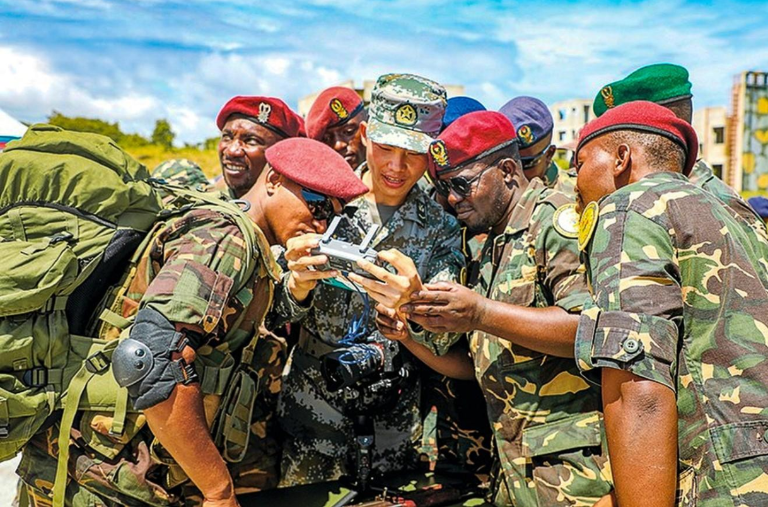
Field deliveries tell the story. In 2024 alone, Burkina Faso received 116 Chinese infantry transports and six assault vehicles; Mali negotiated NORINCO packages that include combat vehicles, specialist training, and future technology-sharing pathways. Drones supplied by Chinese manufacturers are now patrolling the skies over the Liptako-Gourma border zone, feeding real-time data into Sahelian command centres. These capabilities allow forces to locate and intercept terror convoys before surprise attacks can unfold.
The Chinese approach also hedges against sanctions and supply-chain shocks, two vulnerabilities that have constrained Russian deliveries since 2022. By offering local assembly lines and integrated logistics hubs, Beijing reduces the risk that a geopolitical crisis will leave African units stranded without spare parts or qualified technicians.
Arms sales versus operational support: how Russia’s model evolved
Russia still commands global headlines thanks to Wagner’s successor—now rebranded under the Africa Corps—but its commercial footprint is shrinking. SIPRI figures show a 64 % plunge in Russian arms exports between 2016-2020 and 2021-2025, driven by the Ukraine war, international sanctions, and domestic rearmament priorities. What survives is influence, not volume.
In the Central African Republic and Mali, Russian contractors continue to provide on-the-ground mentoring, air-support coordination, and perimeter security. These advisory roles bolster Moscow’s political visibility even as contract values fall. The dissonance between visibility and market share underlines a stark reality: Africa’s security partners can no longer be judged by press conferences alone; they must deliver usable firepower, not just rhetoric.
The real test: equipment that enables results on the battlefield
Insurgent groups thrive on surprise, rough terrain, and porous borders. Defeating them demands more than rifles and rockets; it requires layered capabilities: reliable intelligence networks, aerial surveillance, cross-border cooperation, and forces trained to exploit that information in real time. The newest crop of African defence deals—whether inked with Beijing, Washington, or Ankara—reflect that calculus.
At the same time, diversification carries risks. New suppliers bring unfamiliar weapon families, maintenance protocols, and spare-part ecosystems. Governments must weigh costs against benefits, factoring in long-term sustainment and the danger of technology leaks. A drone fleet is useless without a trained cadre of technicians; a radar system is wasted without ongoing satellite access.
For Sahel governments, the message is clear: partnership choices now determine operational outcomes. Those who lock into Beijing’s integrated logistics chain gain immediate battlefield advantages. Those who opt for modular, short-notice Russian support risk finding their arsenals hollowed out when geopolitical winds shift.Africa’s next security chapter: beyond single suppliers
SIPRI’s latest data resets the continent’s defence map. The United States leads the continent by raw volume, China dominates in sub-Saharan markets, and Russia retains pockets of political clout without commercial scale. This three-way split forces African capitals to treat security partnerships as tactical investments rather than strategic dogma.
The turning point has arrived. Governments that actively calibrate their equipment mix—mobility, drones, airlift, training—will shape the next phase of counterterror success. Those who default to yesterday’s supplier narratives risk falling behind on the battlefield tomorrow.