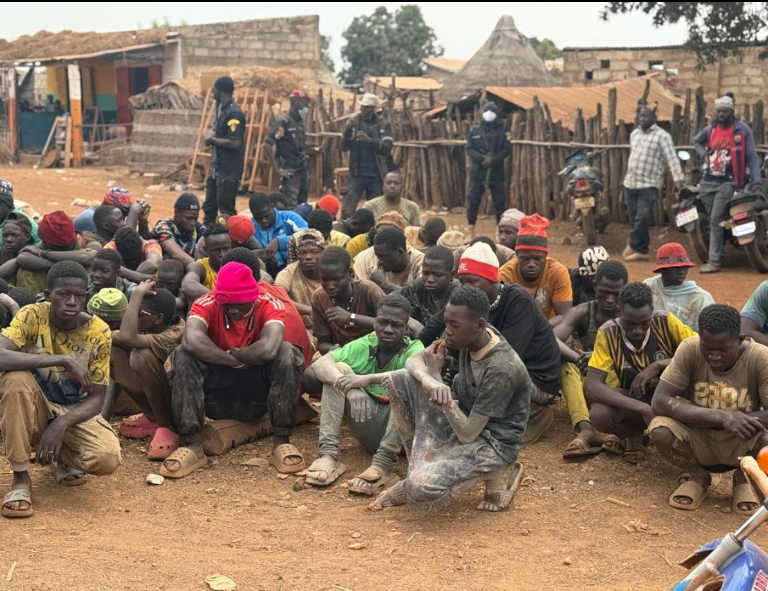
In a decisive crackdown that has sent ripples across West Africa, Guinean authorities have uprooted 1,412 individuals from illegal gold mining operations, exposing a deeper crisis of economic desperation among Burkina Faso’s migrant workers. This sweeping operation, which culminated in mass arrests and high-profile court proceedings, marks a turning point in how both nations confront the human cost of economic fragility and resource disparity.
From survival to crisis: why Burkinabè miners risk everything in Guinea’s gold fields
Guinea’s crackdown on illegal mining has uncovered a stark reality: thousands of migrant workers, many from Burkina Faso, are abandoning precarious living conditions at home in search of fortune in Guinean gold fields. These miners represent more than just numbers in a legal battle—they embody the human consequences of widespread unemployment, eroding incomes, and a widening gap between economic policy and daily survival in the Sahel.
The recent sweeps, which led to 1,412 arrests across key mining zones, reveal how deeply economic desperation drives migration. Many Burkinabè workers, long accustomed to seasonal labor across borders, are no longer heading to farms or markets—they are heading underground, into unregulated shafts and dangerous pits where gold promises more than drought-stricken fields or collapsing industries at home.
Economic policies in question: can sovereignty translate into real prosperity?
Burkina Faso’s leadership, under Captain Ibrahim Traoré since 2022, has placed economic sovereignty at the center of its national agenda. The focus on controlling natural resources, particularly gold, reflects a bold promise: to secure wealth for the nation and its people. Yet the exodus of Burkinabè miners to Guinea’s clandestine mines raises a critical question: if a country rich in gold cannot create stable livelihoods for its citizens, what does sovereignty truly deliver?
The migration of thousands of artisanal miners to Guinea is not merely a footnote in cross-border trends—it is a barometer of policy failure. It points to persistent gaps in job creation, rural development, and poverty reduction—areas where policy intent must now meet measurable results. Without tangible improvements in living standards, the gold beneath Burkinabè soil may as well be buried in frustration.
Guinea’s crackdown: security first, but is it enough?
The Guinean government’s recent enforcement actions—including the prosecution of over 1,260 individuals and additional sweeps yielding 149 arrests—send a clear message: illegal mining will not be tolerated. Authorities highlight environmental damage, water pollution, and land degradation caused by unregulated activity. But while legal action serves as a deterrent, it does not address the root cause of migration—economic survival.
The operation dismantled mining networks and clamped down on unauthorized sites in Kérouané and Siguiri, two regions central to Guinea’s gold economy. Yet, without coordinated regional strategies, the trade may simply relocate. Sustainable solutions will require more than arrests: they demand economic alternatives, safer migration pathways, and joint efforts to reduce the pull of informality.
Counting faces, not just arrests: the unseen human cost
Behind the official tally of 1,412 arrests lies a mosaic of individual stories—fathers, mothers, youth—each hoping to secure a future for their families. The absence of detailed nationality breakdowns in official reports leaves unanswered questions: How many of those detained are from Burkina Faso? What networks brought them there? And what will happen to them after trial?
What is clear is that these migrants did not embark on this journey lightly. They represent a silent workforce propelled by necessity. Their presence in Guinea’s mines exposes a broader failure: the inability of Burkina Faso’s economy to provide viable alternatives, and Guinea’s challenge in balancing resource protection with human needs.
Rethinking sovereignty: beyond gold and into people’s lives
Economic sovereignty cannot be measured solely in tons of gold extracted or dollars earned from mining contracts. Its true test lies in whether citizens can live with dignity—without fleeing to foreign mines to survive. For Burkina Faso, the moment has come to transform policy into prosperity. For Guinea, the crackdown must evolve into collaboration that protects both resources and human dignity.
The 1,412 arrests are not just a security milestone—they are a turning point. A moment to ask: when will the promise of sovereignty finally meet the promise of stability for every family?