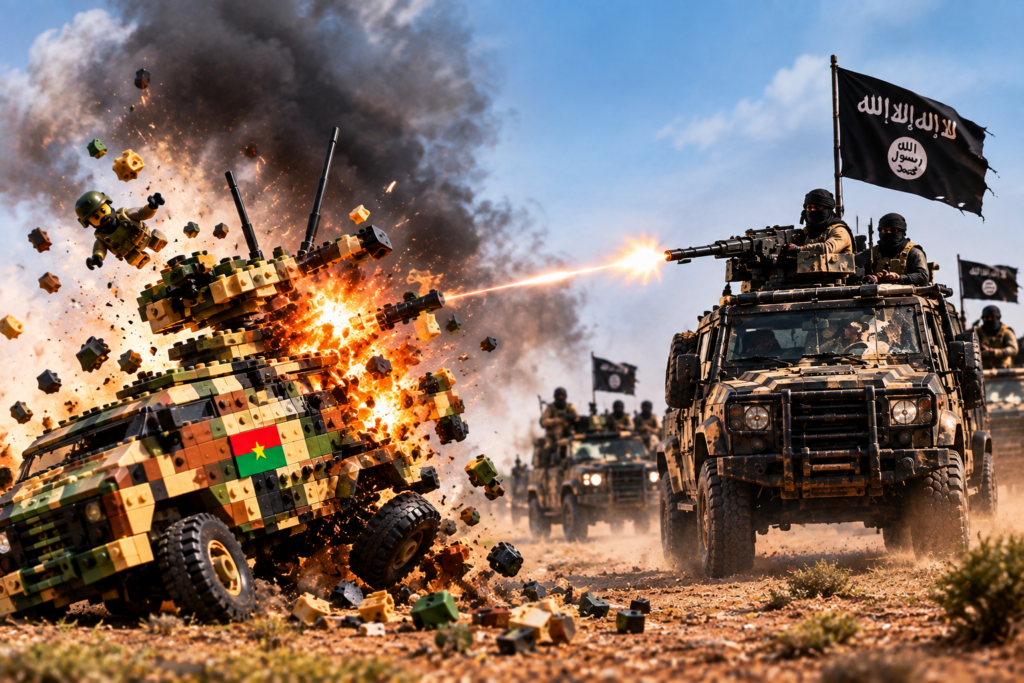
The stakes behind the Bam province clashes
In the early hours of Wednesday, September 16, 2026, the Group for the Support of Islam and Muslims (JNIM) claimed it had seized two positions held by Volunteers for the Defense of the Homeland (VDP) near Mahlou and Winten in Bam province. The assertion, which circulated widely, has not been independently verified, but it has nonetheless thrust a long-simmering question into the open: what happens when a nation’s industrial ambitions are tested on the battlefield?
For months, the government of Ibrahim Traoré has championed the rise of Burkina Faso’s domestic military industry. Official messaging has underscored sovereignty, local manufacturing, and a reduced reliance on foreign suppliers. Industrialization is regularly touted as a cornerstone of national policy. But the events in Bam province suggest that the gap between a factory floor and a firefight is not easily bridged.
From showroom to battlefield
The armored vehicles that have been showcased in official ceremonies and carefully staged imagery are now being forced to prove themselves under real operational conditions. The challenge is not merely technical; it is existential for the credibility of the entire military-industrial project.
On the ground, an armored vehicle earns its keep through its ability to withstand attacks, protect its crew, remain functional under fire, and contribute to holding terrain. These are the metrics that matter, far more than the number of units paraded before cameras or the rhetoric of self-sufficiency.
Observers have quipped that some of these vehicles resemble Lego sets: assembled, presented, applauded and then left for the battlefield to determine whether the pieces truly hold together. The jibe is mocking, but it points to a serious question: how do these locally produced or assembled platforms actually perform when confronted with the harsh realities of northern Burkina Faso?
A pattern of lost positions
The loss of VDP positions is not an isolated incident. On August 19, JNIM claimed to have overrun several VDP outposts, including in Séguénéga and Bourzanga. Recent analyses have also highlighted the difficulty Burkinabè forces face in sustaining control over areas that have been retaken or secured. The recurring pattern suggests that possessing equipment, even domestically produced, does not automatically translate into durable territorial control.
For civilians in Bam province, the consequences are immediate and tangible. Each lost position can mean displacement, disrupted livelihoods, and a heightened sense of insecurity. For businesses, the uncertainty undermines supply chains and local economic activity. The broader national economy, already strained by the conflict, bears the cost of repeated military setbacks.
The real measure of success
The true indicator of the armored program’s viability will not be found in official parades or declarations of industrial sovereignty. It will be measured in kilometers of territory effectively held, in positions successfully defended, and in soldiers brought home alive. If the JNIM’s claim regarding Mahlou and Winten is confirmed, it would deliver an uncomfortable verdict: the distance between manufacturing an armored vehicle, displaying it, and proving its operational effectiveness remains vast.
That distance cannot be closed with speeches. It is closed with performance under fire and with the safety of the citizens and communities that depend on these forces for protection.



More Stories
Benin’s sovereign rating jumps to AA-: real-world consequences for businesses and households
Cairo breakthrough delivers tangible benefits for Benin’s sporting future
What Brigitte Tchede’s Cairo medals deliver for Benin’s athletes, universities and sports economy