The gap between anti-debt rhetoric and fiscal reality in Burkina Faso
Captain Ibrahim Traoré’s administration has consistently championed a narrative of economic self-sufficiency, positioning itself against excessive foreign borrowing and advocating for domestic resource mobilization. Yet, the latest fiscal data presents a stark contrast to this proclaimed stance.
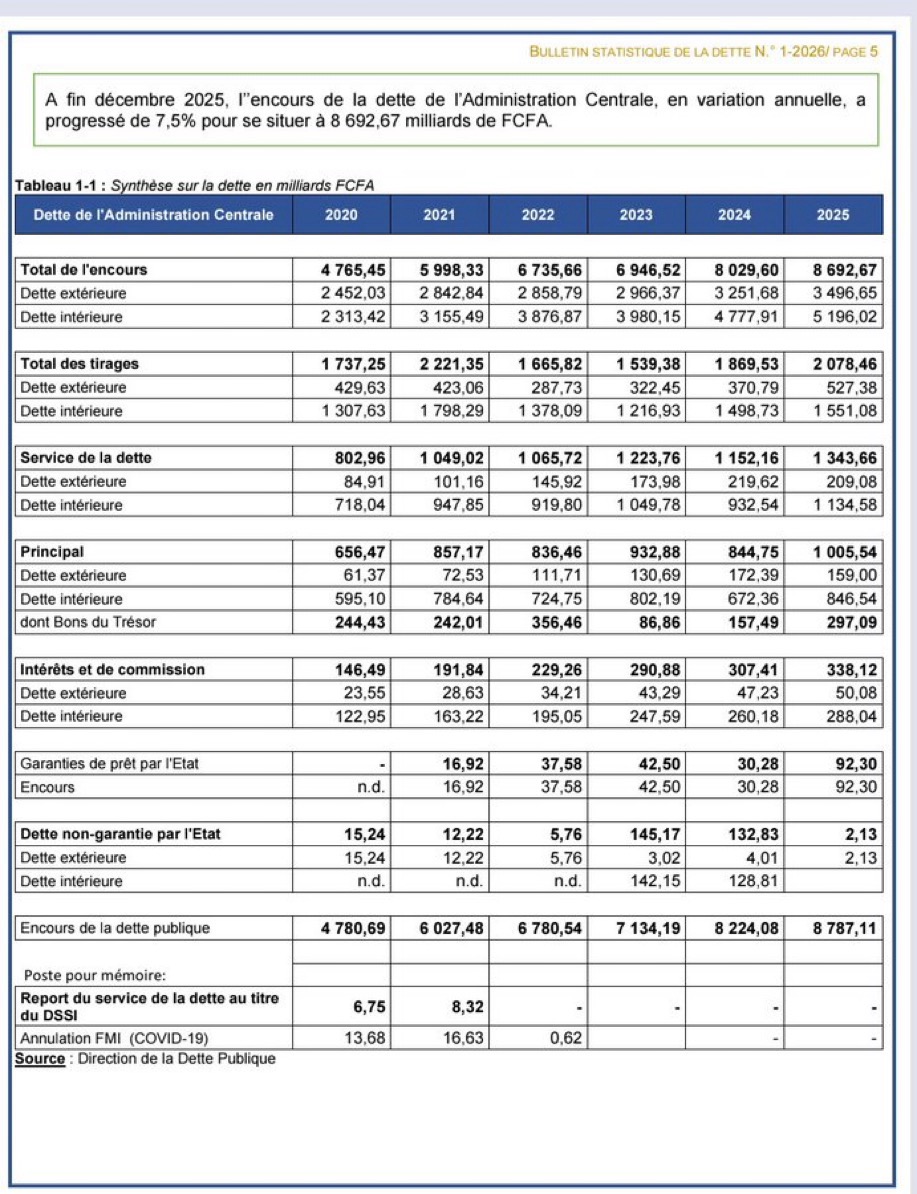
From 4.7 trillion to 8.7 trillion FCFA: the staggering growth in public debt
The trajectory of Burkina Faso’s central government debt is not merely incremental it is exponential. Official records reveal a debt stock of 4,765.45 billion FCFA at the end of 2020. By the close of 2021, this figure had risen to approximately 6,107 billion FCFA. The upward trend continued unabated.
The most recent Treasury bulletin, dated December 2025, recorded a central government debt of 8,692.67 billion FCFA. By March 2026, this had inched further to 8,731.5 billion FCFA. In just over five years, Burkina Faso’s public debt has nearly doubled, escalating from under 5 trillion to over 8.7 trillion FCFA. This surge raises critical questions about the alignment of policy with fiscal outcomes.
Why external borrowing remains a necessity despite sovereign claims
The assumption that a state can entirely eschew borrowing overlooks the complexities of modern governance. Public debt, when managed judiciously, can catalyze development by funding critical infrastructure, stabilizing security expenditures, and bridging revenue shortfalls during economic downturns. The crux of the matter, however, lies not in the act of borrowing itself, but in its purpose, cost, and long-term sustainability.
At the end of 2025, 60% of Burkina Faso’s central government debt was domestic, amounting to approximately 5,196 billion FCFA. While internal financing may reduce exposure to foreign creditors, it does not eliminate financial obligations. By the first quarter of 2026, debt servicing costs had surged to 407.1 billion FCFA a 31.5% increase from the previous year, according to Treasury data.
The real cost of sovereignty: debt servicing and fiscal strain
Advocating economic sovereignty is commendable, but it must be evaluated within a broader fiscal framework. Sovereignty in public finance is not merely a matter of rejecting external partnerships; it requires a sustainable balance between revenue generation, expenditure control, and debt management. Burkina Faso possesses significant mineral wealth, particularly gold, yet the monetization of these resources has not eliminated the need for additional borrowing.
The paradox lies in the contradiction between austerity rhetoric and fiscal expansion. If the state is committed to minimizing debt, how can it justify a rise of nearly 4 trillion FCFA in central government liabilities since 2020? The answer demands transparency: clear documentation of borrowing sources, interest rates, allocated projects, and measurable socio-economic returns.
Assessing debt sustainability: IMF’s cautious optimism amid vulnerabilities
International assessments, including those from the International Monetary Fund in 2026, classify Burkina Faso at moderate risk of debt distress, yet deem the debt sustainable in the medium term. However, underlying fragilities persist most notably the refinancing risk tied to domestic debt, reliance on gold export revenues, and ongoing security challenges.
While it would be inaccurate to frame this debt surge as evidence of insolvency, it is equally untenable to argue that Burkina Faso has achieved developmental progress without significant reliance on borrowed capital. Between late 2020 and early 2026, central government debt ballooned by nearly 4 trillion FCFA. The pressing issue now is not whether borrowing occurred, but why it did and at what long-term cost to both citizens and the national economy.
The unanswered question: what does 8.7 trillion FCFA buy?
Public finance is not a realm for slogans. It demands accountability. Ibrahim Traoré’s government faces a pivotal moment: to reconcile its anti-debt narrative with the unmistakable expansion of fiscal liabilities. The Burkinabè people deserve clarity on how these funds were raised, allocated, and whether they have translated into tangible improvements in public services, infrastructure, and economic resilience.
Until such explanations are provided, the discrepancy between words and numbers will continue to cast a shadow over the country’s economic trajectory. In the realm of fiscal policy, perception is shaped by proof and the numbers, as they stand, tell a story that demands scrutiny.
By Yacouba Boukari — Analyst