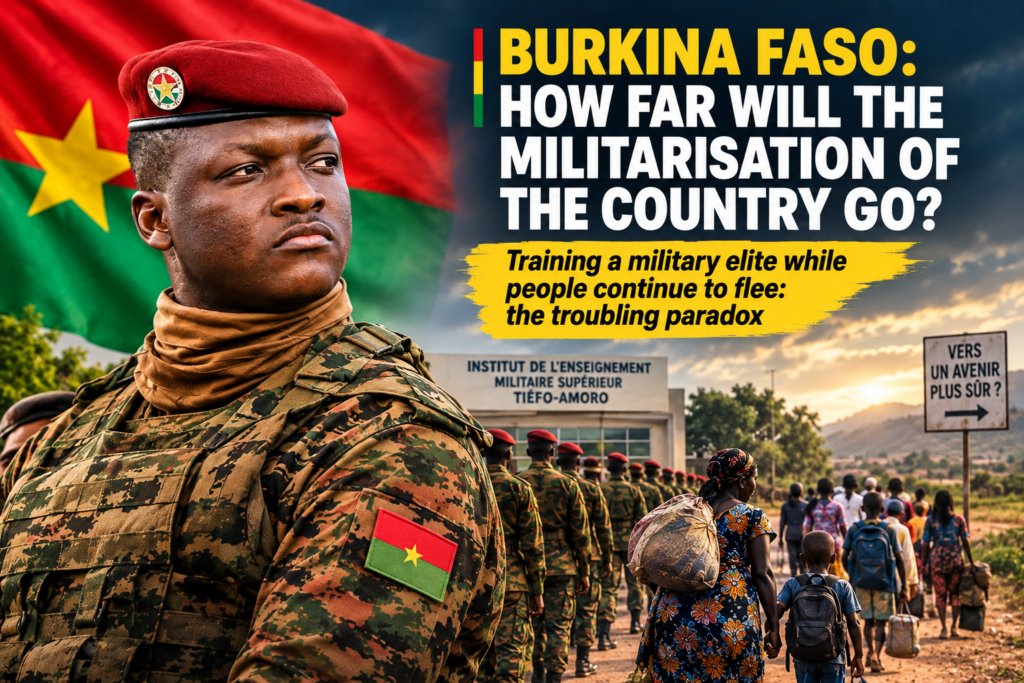
While Burkina Faso advances its military ambitions, the exodus of its people exposes a critical disconnect between strategy and survival.
The Paradox of a Nation Building Elite Soldiers While Its Citizens Flee
The inauguration of the Tiéfo-Amoro Higher Military Institute marks a bold step toward self-reliance, with the first cohort of 28 officers training in strategy, crisis management, and geopolitics. Proponents argue this move enhances national sovereignty and reduces dependence on foreign military aid.
Yet, the timing and scope of this militarization raise pressing questions. As Burkina Faso invests in its elite forces, over 2.1 million of its citizens more than 10% of the population have been displaced internally by conflict. An additional 221,000 fled the country in 2025 alone, seeking refuge in neighboring states like Côte d’Ivoire, where 82,000 Burkinabè refugees were recorded in mid-2026.
If military prowess were the sole answer to insecurity, why are so many still abandoning their homes?
Beyond the Drill Grounds: What Security Gains Are or Aren’t Achieved
Training officers to command, strategize, and lead is undeniably valuable. But military expertise, no matter how advanced, cannot reclaim lost territory or restore confidence in the state’s ability to protect its people. The HCR’s displacement figures tell a stark story: more Burkinabè are fleeing than returning, suggesting that guns and strategy alone are not addressing the root causes of the crisis.
The government’s focus on sovereignty through militarization risks overshadowing deeper needs. Rebuilding rural communities, restoring trust in local governance, and reviving economic activity require more than a stronger army they demand a holistic reconstruction plan that prioritizes civilian safety and rehabilitation.
The Creeping Normalization of Military Rule
Burkina Faso’s leadership has increasingly framed the military as the cornerstone of national revival. President Ibrahim Traoré’s direct involvement in military affairs and his public directives to defense forces signal a shift toward a security-centric governance model. While justified by the threat of armed groups, this approach blurs the line between defense and statecraft.
When the military’s role expands beyond combat readiness into policy-making, administration, and crisis response, the risk is not just of over-reliance but of institutional erosion. Governance, education, and economic recovery cannot be relegated to the margins while the army becomes the primary engine of progress.
A Sovereignty That Protects, Not Just Armors
The debate over Burkina Faso’s military expansion often centers on whether it enhances independence. But sovereignty is not measured in the number of uniforms or the sophistication of training academies. True sovereignty is a farmer’s ability to till his land without fear, a child’s right to attend school without displacement, and a family’s security without exile.
The exodus of 221,000 Burkinabè in 2025 is a damning indictment of a strategy that prioritizes military solutions over civilian protection. An army cannot and should not bear the weight of every national challenge. The state’s credibility hinges on its ability to create conditions where people choose to stay, not flee.
Where the New Military Elite Meets the Reality of Despair
The Tiéfo-Amoro Institute represents hope for a more autonomous defense apparatus. Yet, its graduates will return to a nation where villages lie abandoned, markets are shuttered, and schools operate under the shadow of violence. The disconnect between military ambition and societal collapse cannot be ignored.
For Burkina Faso, the real test of Ibrahim Traoré’s leadership will not be the quality of its officers or the strength of its doctrine. It will be measured in the number of Burkinabè who can return home not because they have no choice, but because they feel safe at last.
The country’s future will not be forged solely on the battlefield. It must also be built in the fields, schools, and towns where life continues or ceases to go on.
Key takeaways
Burkina Faso’s military expansion is framed as a sovereignty move, but displacement rates suggest it’s not yet solving the core crisis.
More than 2.1 million Burkinabè remain internally displaced, with 221,000 leaving the country in 2025.
The rise of military influence in governance risks overshadowing civilian-led recovery efforts.
Sovereignty must protect people, not just arm them returning displaced populations is the true measure of success.
By Ramatou Soumana — Reporter

More Stories
Niger’s August crisis: how Tiani’s reliance on Russia exposed deeper fractures in the military
Behind the three-day delay: what really delayed Senegal’s 2026 revised budget bill
Dioura’s brutal truth: how Mali’s military narrative crumbles under jihadist fire