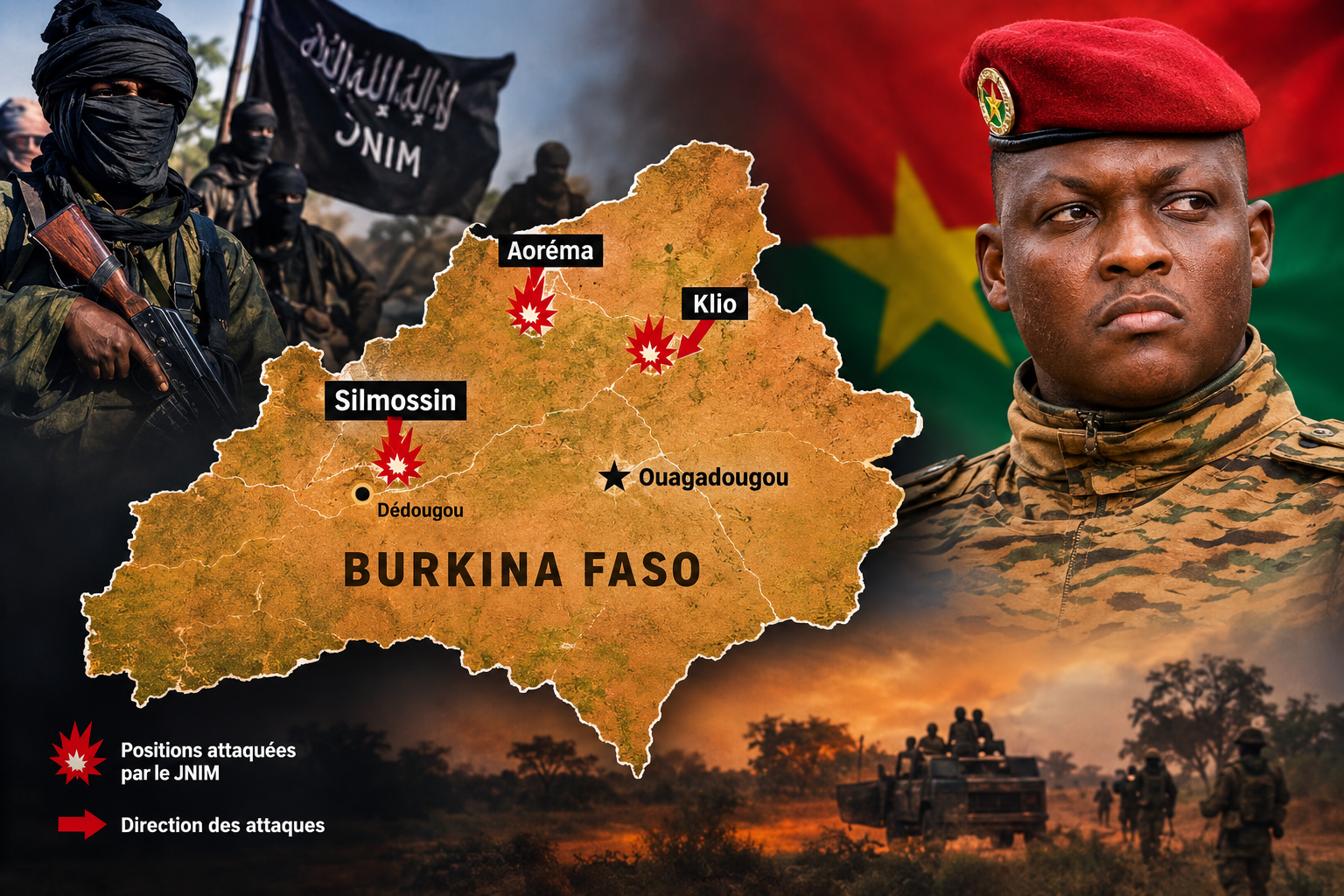
The Group for Support of Islam and Muslims (JNIM) has claimed full control over several militia positions in Silmossin, near Dédougou, in a fresh offensive late Friday, September 25, 2026. The militant group also asserted control over two additional military sites in Aoréma and Klio, deepening concerns about the sustainability of Burkina Faso’s counterterrorism approach under Captain Ibrahim Traoré.
Behind the headlines: Why frequent JNIM claims reveal deeper systemic flaws
The relentless nature of these attacks raises a critical question: How effective is Burkina Faso’s security doctrine when jihadist groups continue to dictate terms of engagement on the ground? Since Traoré’s rise to power in 2022, the government has positioned territorial reassertion, local militia mobilization, and military expansion as the cornerstones of a bold new security agenda. Yet repeated claims of attacks by the JNIM suggest that the strategy’s durability remains unproven.
Security is not merely about headlines of reclaimed towns or the number of forces deployed. It demands sustained control ensuring safe passage on roads, enabling displaced populations to return, restoring public services, and preventing jihadists from re-establishing themselves in what are supposed to be secured zones. The JNIM’s growing foothold in northern Burkina Faso signals that this challenge has not yet been met.
Volunteers for the Defense of the Homeland: A double-edged security tool
The mobilization of the Volunteers for the Defense of the Homeland (VDP) has expanded Burkina Faso’s defensive network, but it also exposes non-professional fighters to isolated and vulnerable outposts. Success in counterterrorism hinges not only on numerical strength or equipment but on intelligence, mobility, logistics, and the capacity to hold ground over time.
Analysts note that the JNIM has demonstrated adaptability expanding use of drones, refining combat tactics, and exploiting gaps in surveillance and coordination between national forces. These advantages allow the group to carry out targeted strikes, then retreat before conventional counterattacks can be organized. As a result, even when government forces reassert control, the risk of insurgent resurgence remains high.
This cycle of advance and retreat undermines the foundational promise of Burkina Faso’s security doctrine: durable stability.
From military gains to state restoration: The missing link in Burkina Faso’s strategy
Since assuming leadership, Captain Ibrahim Traoré has framed sovereignty, popular mobilization, and military reclaiming as pillars of his governance and defense narrative. Official statements frequently highlight victories in the field. But when militant groups continue to claim attacks on military posts or VDP units regardless of official confirmations these declarations must be measured against ground realities.
Official discourse has begun to acknowledge shortcomings. Just hours before the latest JNIM claims, Burkina Faso’s foreign minister publicly admitted the need to “learn from what hasn’t worked so far,” emphasizing prevention of youth recruitment into terrorist organizations. Such candor underscores a growing recognition within government circles that a purely militarized response is insufficient in addressing the insurgency’s roots.
The JNIM’s resilience stems from more than just firepower. It operates with financial liquidity, operational adaptability, and a strategy designed to outlast state responses. Reports from conflict monitoring groups highlight the increased use of unmanned aerial systems by insurgents, complicating surveillance and response for national forces. This technological asymmetry places Burkina Faso at a disadvantage in long-term territorial control.
Measuring success: What really counts in Burkina Faso’s fight against insurgency
For Ibrahim Traoré’s government, the test of credibility is no longer in the volume of operations announced or the frequency of victory declarations. It lies in verifiable outcomes: zones permanently secured, freedom of movement restored, displaced families able to return, markets functioning, and public services operational. Without transparent, accessible data on these indicators, the gap between narrative and reality continues to erode public trust.
The ultimate measure of any counterterrorism strategy is not the speed of a military operation, nor the rhetoric of a press conference. It is the safety and restoration of life for civilians day after day, month after month. In the Sahel conflict, slogans do not win wars. Results do.
If the JNIM’s claims in Silmossin are verified, they will mark another erosion of public confidence in Burkina Faso’s ability to secure its territory. Even without final confirmation, the sheer volume of militant assertions against military installations exposes a persistent vulnerability: zones once claimed as reclaimed remain contested. And in a war where momentum is everything, that hesitation is costly.
By Yacouba Boukari — Analyst