
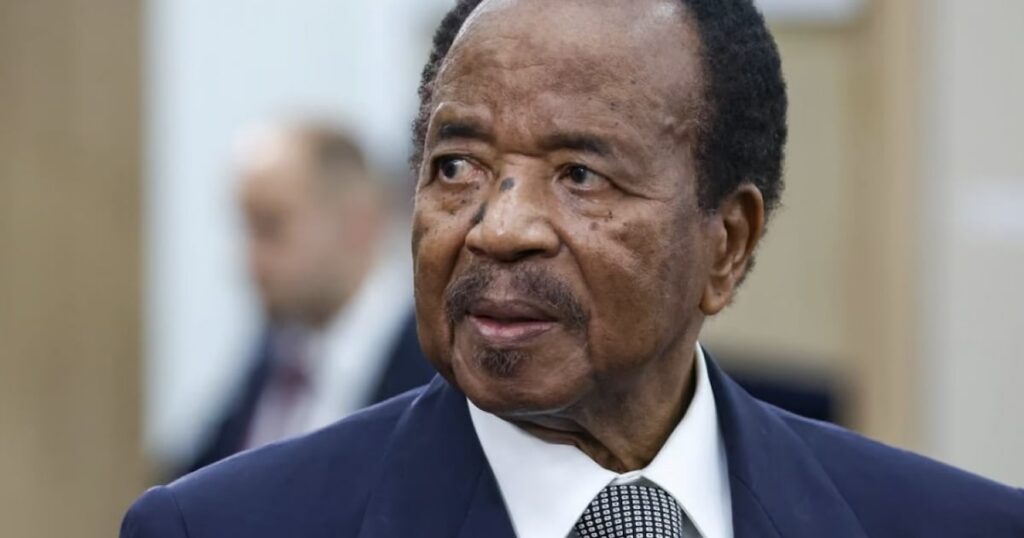
For 48 consecutive days, President Paul Biya has been away from Cameroon, departing on June 7 for what officials describe as a brief private stay in Europe. At 93 years old, he has led the country since 1982, making him the world’s longest-serving head of state. His absence has reignited persistent questions about his health, particularly given his frequent medical visits to Geneva.
Rumors about the President’s condition have circulated for years, often met with official denials. On June 18, Communications Minister René Emmanuel Sadi issued a statement refuting claims that Mr. Biya was hospitalized in a Geneva clinic, though these rumors resurface with each prolonged absence.
opposition voices mounting concerns over institutional paralysis
The opposition has seized on the situation, framing it as proof of a dangerous power vacuum. Mamadou Mota, Vice President of the Movement for the Renaissance of Cameroon (MRC), argued on social media that the absence reveals a staggering institutional void, leaving governance in a state of uncertainty.
Patricia Tomaïno Ndam Njoya, leader of the Democratic Union of Cameroon (UDC), has called for a transparent process to assess whether the President is temporarily or permanently incapacitated. Meanwhile, government officials dismiss such concerns, insisting that Mr. Biya remains fully engaged in state affairs from abroad, personally overseeing key decisions.
This debate is not new. Similar controversies erupted in late 2024 when the President spent roughly 50 days outside the country. Opposition figures, including the Social Democratic Front (SDF), have gone so far as to describe Cameroon as operating on autopilot—a stark critique of the government’s inaction.
public frustration grows amid delayed reforms
Viviane Ondoua Biwolé, a public management professor at the University of Yaoundé, notes that Cameroonians are increasingly exasperated by what they see as prolonged governmental inertia. She highlights two key factors fueling discontent: the current administration’s eight-year tenure—an unprecedented duration—and the dissatisfaction stemming from the highly contested October 2025 elections.
The President’s re-election to an eighth term sparked violent protests, with the government acknowledging “several dozen” fatalities but failing to provide a full account. Western diplomatic missions also expressed reservations about the election’s legitimacy.
Despite promises in his December 31 address to form a new government “within days”, seven months later, no reshuffle has occurred. Compounding the issue, municipal and legislative elections have been repeatedly postponed, effectively extending the mandates of sitting officials indefinitely.
the shadow of a post-biya future
Recent months have seen institutional adjustments, including the replacement of parliamentary leaders in March and the introduction of a vice-presidential position through a constitutional amendment in May. Yet, nearly three months later, no vice-president has been appointed—a delay that has only deepened speculation about the President’s health and the future of his regime.
The uncertainty reached a new low in June when an individual attempted to submit a forged decree at the national radio station in Yaoundé, claiming it named a new vice-president. While journalists exposed the document as fake, its existence underscored the growing unease about leadership succession.
Political analysts warn of deepening divisions within the ruling elite. Stéphane Akoa, a political scientist, points to “increasingly visible tensions” among the President’s inner circle, with factions vying for influence. Chantal Biya, the First Lady, is frequently cited as a central figure in these power struggles, her involvement in state affairs and appointments increasingly scrutinized.
Under current law, should a vacancy occur, Senate President Aboubakary Abdoulaye would assume interim leadership until a new election is held. Yet, with no vice-president in place and no clear successor named, Cameroon remains trapped in a cycle of uncertainty, its political future hanging in the balance.

More Stories
Sonko’s sharp critique of Senegal’s imf deal stirs debate
Cameroun : prendre des mesures incitatives pour booster les inscriptions sur les listes électorales
DRC’s new inclusive national dialogue: what outcomes can be expected?