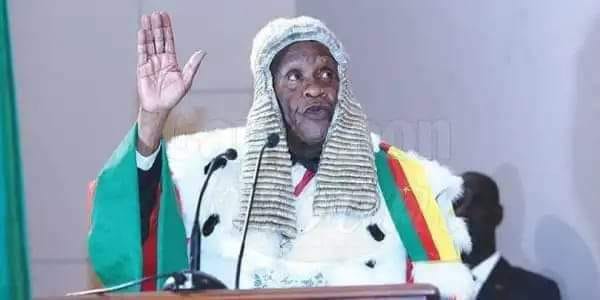
Cameroon’s constitutional council has lost its longest-serving leader after former president Clément Atangana died in Paris at the age of 84. The news, confirmed on October 4, 2026, follows a prolonged illness and brings an abrupt end to a career spanning nearly six decades in the judiciary.
Background and career highlights
Clément Atangana was born on December 20, 1941, in Ekoumeyeck, in Cameroon’s Nyong-et-So’o region. His journey through the legal system began in 1968 when he joined the judicial service after training at the École Nationale d’Administration et de Magistrature (ENAM) and the International Institute of Public Administration in Paris.
Over four decades, he rose steadily through the ranks. His career milestones include serving as an investigating judge in Nkongsamba, president of courts in Eséka, Bafia, Sangmélima, and Mora, prosecutor general in Maroua, president of the Central Court of Appeal, and counsel at the Supreme Court. He concluded his judicial tenure as president of the Administrative Chamber of the Supreme Court in 2014 before being recalled in 2018 to lead the constitutional council.
Eight years at the constitutional council: decisions and controversies
Atangana became president of the constitutional council on February 7, 2018, just months before the presidential election of October 7, 2018. His tenure was marked by pivotal decisions in contentious electoral disputes, including the presidential elections of 2018 and 2025.
In both cases, the official results were challenged—first by candidate Maurice Kamto of the MRC and his supporters in 2018, and later by Issa Tchiroma Bakary and his allies in 2025. Despite public outcry and legal challenges, no opposition petition succeeded during Atangana’s leadership.
A widely shared video in 2025 captured Atangana remarking, “I am pleased you celebrate both your candidate’s victory and the work of their father.” The statement fueled perceptions that the council operated under political influence, a charge often leveled at the institution under his watch.
Vacancy at the top: what happens next?
With Atangana’s passing, Cameroon’s constitutional council faces an immediate leadership void. As the country’s highest electoral oversight body, the council plays a crucial role in validating election results and resolving disputes—especially ahead of the 2027 presidential ballot.
The president of the Republic is constitutionally empowered to appoint a successor through decree. The selection process and the profile of the new president will be closely watched, as public confidence in electoral integrity remains a key political issue in Cameroon.
Key takeaways
- Clément Atangana served as president of the constitutional council for eight years (2018–2026).
- Under his leadership, the council ruled on multiple high-stakes electoral disputes, including the 2018 and 2025 presidential elections.
- No opposition electoral appeals were upheld during his term, raising concerns about impartiality.
- His death creates a leadership vacuum just months before the 2027 presidential election.
- The president must appoint a successor by decree, a decision likely to draw national attention.