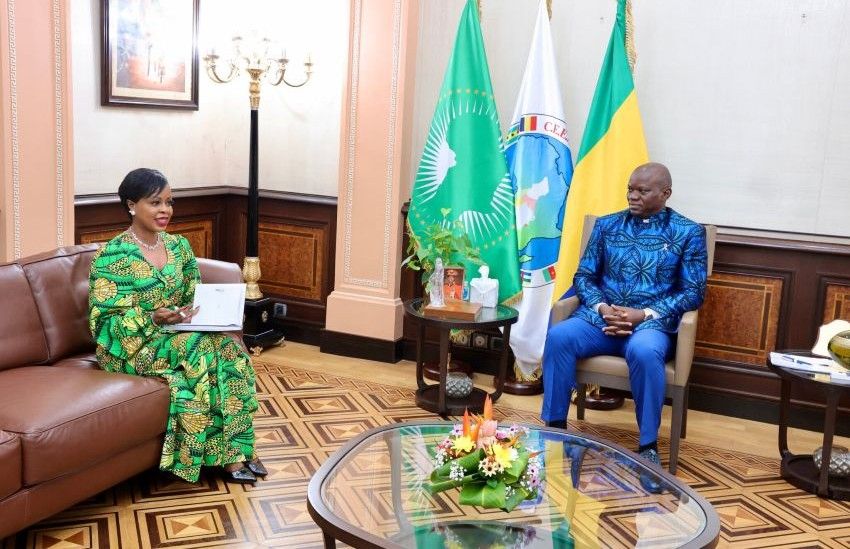
Libreville — October 4, 2026 — While most eyes are on Gabon’s natural resources, the country is making a bold, less visible investment: its people. On October 2, President Brice Clotaire Oligui Nguema met with Minister of Commerce, SMEs and SMIs Zenaba Gninga Chaning to launch a sweeping initiative focused on youth training, employability and entrepreneurship. The first concrete step? Training 400 young Gabonians in Libreville, with plans to expand nationwide.
The government’s move reflects a strategic pivot: shifting from commodity-led growth to skill-driven development. At its core lies a simple but urgent question: can Gabon build a more dynamic, self-sustaining economy if it lacks the technical experts, business leaders and skilled workers needed to drive production and innovation?
Turning training into real-world outcomes
The 400 beneficiaries aren’t being educated for the sake of certification. The goal is conversion: transforming acquired skills into jobs, viable businesses and sustainable income. This marks a departure from traditional models where diplomas often don’t translate into economic activity. Instead, the program emphasizes a continuous cycle—skill development, job placement, revenue generation and value creation.
The initiative isn’t stopping at the classroom door. Participants receive technical mentorship, access to financing solutions and ongoing project support. Access to finance remains one of the biggest hurdles for African entrepreneurs. Many have ideas and skills but struggle to secure the capital needed to launch or scale. Earlier policies introduced in August established a three-pillar framework—train, support, and fund—including credit guarantees and microfinance tools for youth-led enterprises.
- Technical mentorship: Pairing trainees with industry experts
- Financing pathways: Low-interest loans and grant programs tailored to startups
- Aftercare support: Regular check-ins and business development workshops
From skills to sovereign value chains
The training push isn’t just about employment—it’s about reshaping Gabon’s role in its own economy. By strengthening national capabilities across priority sectors—energy, oil and gas, digital technology, industry, and raw material processing—the government aims to reduce reliance on foreign expertise and keep more economic value within the country. This approach aligns with broader national goals: boosting local SMEs, encouraging local production, and building resilient value chains.
The message was echoed just days earlier in Port-Gentil. During a visit to the Institute of Oil and Gas, President Oligui Nguema stressed the need to expand STEM training—particularly in petroleum, gas, and energy engineering—to meet rising demand from industry and curb costly offshore training dependency.
In this context, economic sovereignty means more than controlling natural deposits. It means having the skilled professionals who can extract, process, maintain, manage, and innovate—turning raw resources into sustained prosperity.
Scaling beyond Libreville: the national test
The initial cohort of 400 trainees in Libreville is only the beginning. The next phase—rolling out the model to all nine provinces—will be critical. A national skills strategy must move beyond capital-centric models. Regional economies—whether oil hubs, agricultural zones, mining districts or urban centers—demand tailored training aligned with local economic realities.
Success won’t be measured by certificates issued, but by outcomes: How many trainees secure jobs? How many launch sustainable businesses? How do these new enterprises strengthen local value chains? How much domestic value-add is generated from local skills?
These indicators will reveal whether Gabon is merely investing in training—or truly transforming its economy.
Human capital as national infrastructure
This initiative emphasizes a fundamental truth: roads, power plants, and ports are essential. But equally vital are the technicians who build them, the engineers who operate them, and the managers who grow businesses around them. Without skilled human capital, infrastructure remains underutilized, investment opportunities go unrealized, and growth remains uneven.
By positioning human skills as a strategic infrastructure, Gabon isn’t just preparing for the next economic cycle—it’s laying the foundation for self-reliant, knowledge-based prosperity. The real test begins now: not in the classroom, but in the field, the factory, and the marketplace.