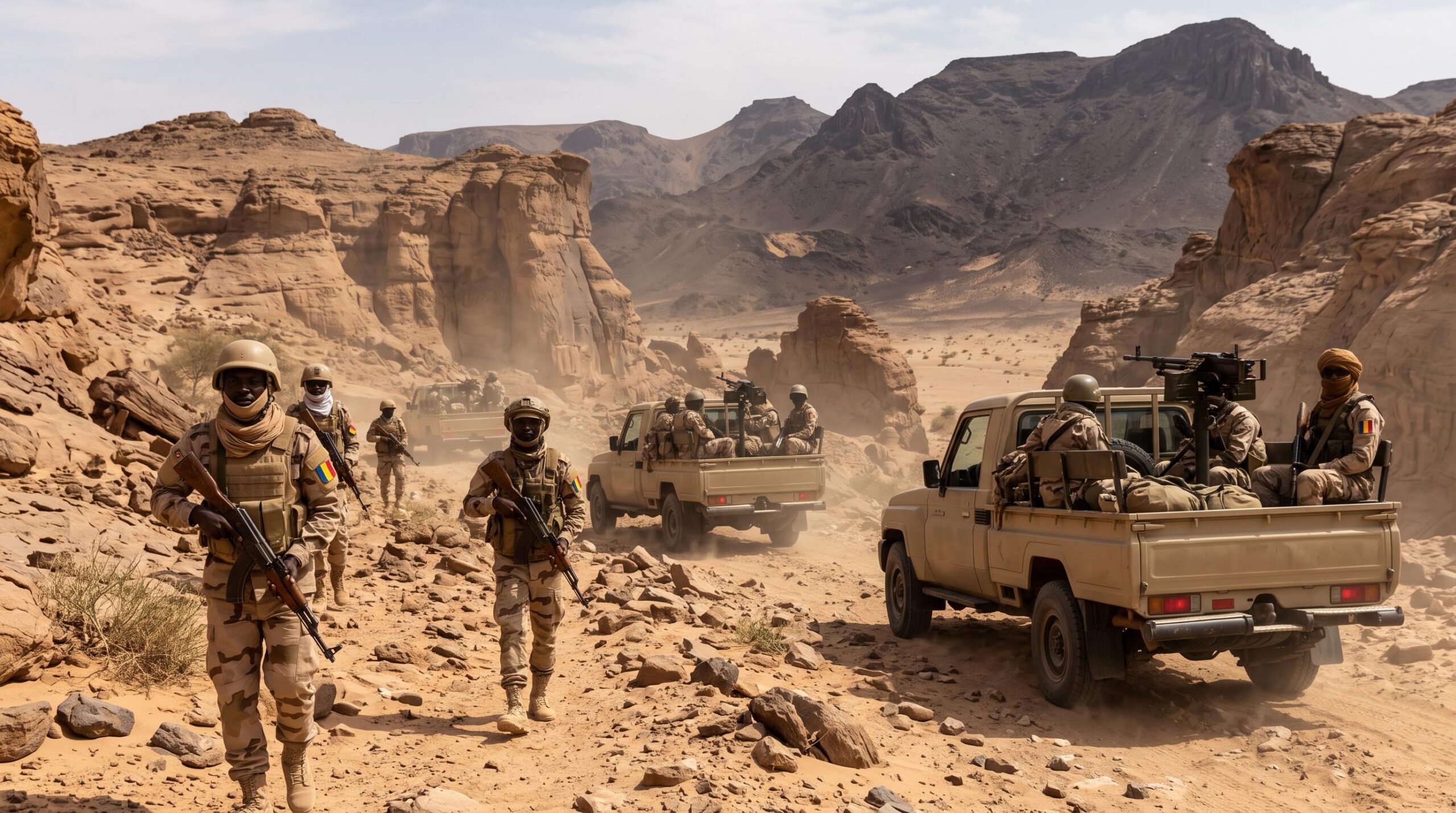
The Tibesti region in northern Chad has reached a critical turning point following a sudden outbreak of violence in Miski, where a violent confrontation between the Mining Brigade and a local self-defense committee has left two officers dead and nine security personnel injured. The clashes, which erupted on October 14, mark a dangerous escalation in a decade-long struggle to control the region’s lucrative gold deposits.
The confrontation, confirmed by military sources, began near the Awa mining zone around 5:00 PM. While the exact chain of events remains shrouded in uncertainty, the army has accused the local self-defense committee of initiating the attack, demanding immediate disarmament. The military warns that failure to comply will be treated as an act of rebellion, escalating the conflict beyond local disputes into a broader security crisis.
Unresolved gold disputes fuel armed confrontation
The violence in Miski is the latest flare-up in a prolonged conflict over mining rights and resource control. Just days before the attack, the local self-defense committee accused the Mining Brigade of heavy weapons fire on October 13, calling it a clear violation of the fragile ceasefire agreement. The committee also denounced what it described as illegal resource extraction and the unauthorized presence of military personnel in the mining areas, demanding government intervention to restore peace.
The dispute underscores a fundamental divide between local communities and state security apparatus. While the self-defense committee claims to be upholding peace accords signed in April 2025 and October 2026, military officials counter that the group’s actions represent a direct breach of national security and economic stability. At the heart of the conflict lie competing claims over gold-rich land, with both sides refusing to cede control over the region’s most valuable asset.
Fragile peace accords crumble under renewed violence
The April 2025 peace agreement, brokered after years of unrest, was meant to bring stability to Tibesti by addressing local grievances and regulating mining activities. However, repeated violations by both sides have eroded trust and raised doubts about the agreement’s long-term viability. A recent government delegation visit in early October, led by a senior vice-prime minister, sought to reaffirm commitments, but the latest bloodshed suggests those efforts have failed to take hold.
The October 3, 2026, meeting was intended to strengthen cooperation between local leaders and the government, yet just days later, the Mining Brigade and self-defense committee were once again locked in conflict. Military leaders now insist that the self-defense committee’s refusal to disarm constitutes a direct challenge to state authority, while community representatives argue that the government’s security forces have overstepped their mandate by seizing control of mining operations.
Civilian crisis looms as tensions spiral out of control
While no independent reports have confirmed civilian casualties or mass displacement, the escalation has left residents of Miski and surrounding villages living in constant fear. The lack of transparency from both sides has left communities in limbo, unsure whether their homes will become the next battleground. Local leaders warn that without urgent mediation and a renewed commitment to dialogue, the violence could spiral into a humanitarian crisis, displacing thousands and further destabilizing Chad’s already fragile northern region.
The path forward remains uncertain. For peace to be restored, both the Mining Brigade and the local self-defense committee must prioritize dialogue over confrontation. Additional military deployments risk exacerbating the violence, while unchecked resource exploitation continues to fuel local resentment. Until a lasting resolution is found, the people of Miski will bear the brunt of a conflict that shows no signs of abating.