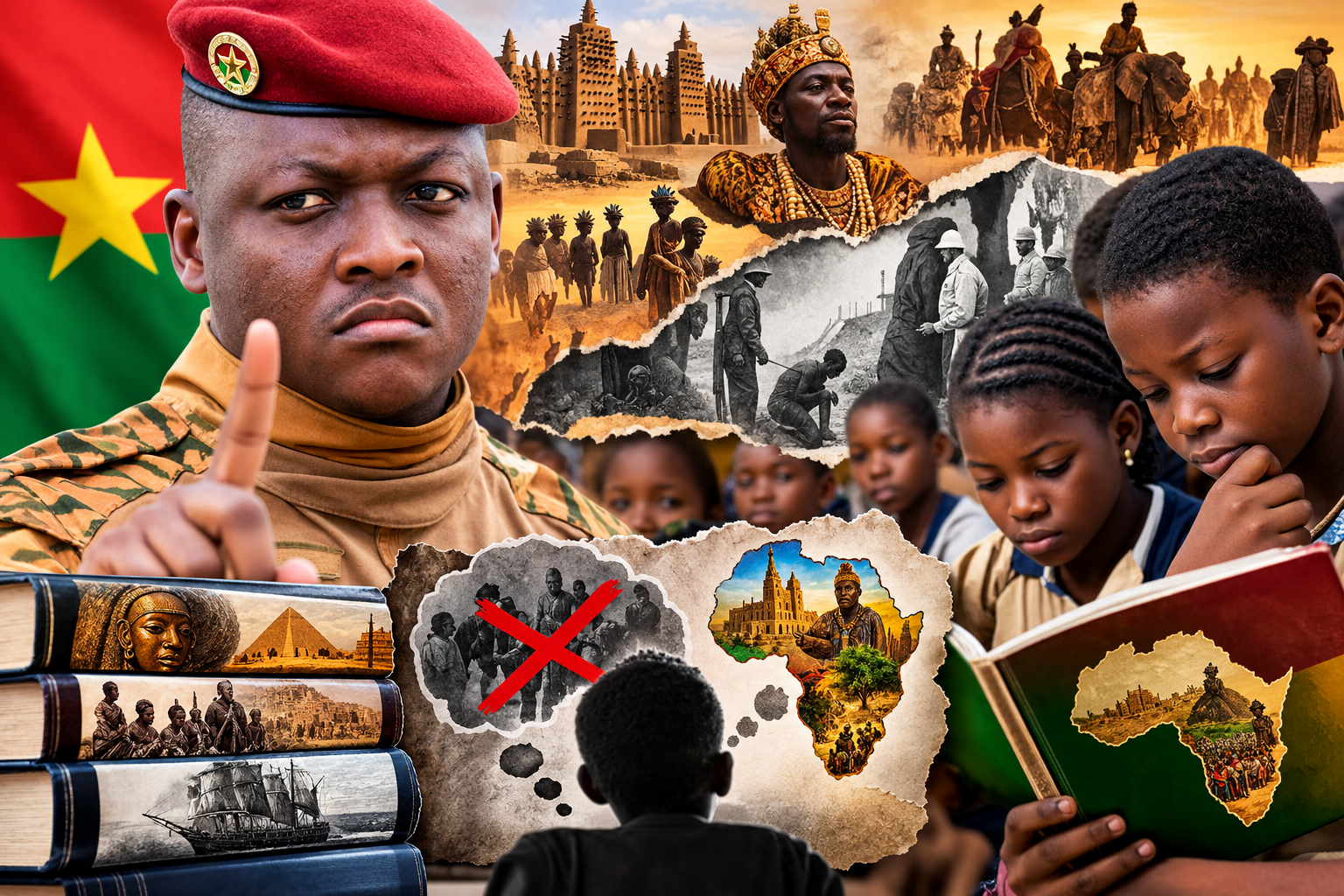
The Government of Burkina Faso is advancing a sweeping reform of its history and geography curricula, aiming to ‘decolonize’ textbooks. While the initiative rightly emphasizes the need to amplify Africa’s historical narratives, it also raises a critical question: can reshaping educational content truly heal the wounds of the past, or will an incomplete narrative merely create new distortions?
Education’s turning point: moving beyond a one-sided historical lens
At the heart of this debate lies a fundamental principle: history should never serve as a tool of ideological confinement. Burkina Faso’s reform seeks to correct long-standing imbalances acknowledging the contributions of African civilizations, the richness of pre-colonial empires, and the resilience of its people. Yet, the danger of overcorrecting looms large. A curriculum that focuses solely on colonial injustices risks replacing one narrow perspective with another, depriving students of a comprehensive understanding of the past.
True education demands more than correction it demands completeness. A child’s knowledge of history should not be confined to victimhood or resistance narratives. It must encompass a full spectrum: the grandeur of ancient empires, the dynamism of trade networks, the complexity of social transformations, and the interplay of global forces that shaped Burkina Faso’s identity. Only then can future generations grasp the depth of their heritage without being trapped in a cycle of resentment or misplaced pride.
The myth of the ‘perfect corrective’: why half-truths harm more than silence
Critics argue that textbooks have long downplayed African achievements and overemphasized colonial narratives. Burkina Faso’s reform responds to this legitimate concern. However, the solution cannot be a mere inversion of priorities. Reducing history to a single narrative whether colonial or anti-colonial fails to equip students with the analytical tools needed to navigate a complex world.
The stakes are high. An unbalanced curriculum risks fostering a generation ill-prepared for critical thinking. Students may learn to recite injustices by rote but lack the context to dissect modern geopolitical realities. The goal should not be to replace one ideological lens with another but to cultivate a generation capable of weighing evidence, confronting contradictions, and drawing informed conclusions.
Lessons from regional reforms: what Burkina Faso can and cannot copy
Other African nations have grappled with similar challenges. Côte d’Ivoire, for instance, has sought to integrate a broader view of African history into its curriculum, balancing local pride with global awareness. Yet even this approach has its limits. Education systems must adapt to their unique historical trajectories, avoiding the pitfall of mimicking external models.
Burkina Faso’s reform must prioritize three core objectives:
Completeness: Teaching the full arc of history from pre-colonial achievements to post-independence challenges.
Nuance: Presenting historical figures and events in their complexity, without glorifying or vilifying.
Context: Connecting local history to broader African and global narratives to foster a sense of interdependence.
The ultimate test of reform: does it liberate or constrain?
The success of Burkina Faso’s curriculum overhaul hinges on a single question: will it empower students with the tools to question, analyze, and contextualize history, or will it impose a new orthodoxy? The difference between liberation and constraint lies in the curriculum’s ability to foster critical engagement rather than passive acceptance.
History is not a weapon; it is a tool. A well-designed curriculum should illuminate the past not weaponize it. It should explain the mechanisms of injustice without reducing entire civilizations to their oppressive acts. And it should celebrate African resilience without erasing the complexities that define human progress.
For Burkina Faso, this reform represents more than an educational shift it is a pivotal moment in nation-building. The question is no longer whether to teach history, but how to teach it in a way that prepares young minds for the challenges of the 21st century. The answer lies not in hiding pages of the past, but in providing the tools to read them all with clarity, balance, and purpose.
By Ramatou Soumana — Journalist