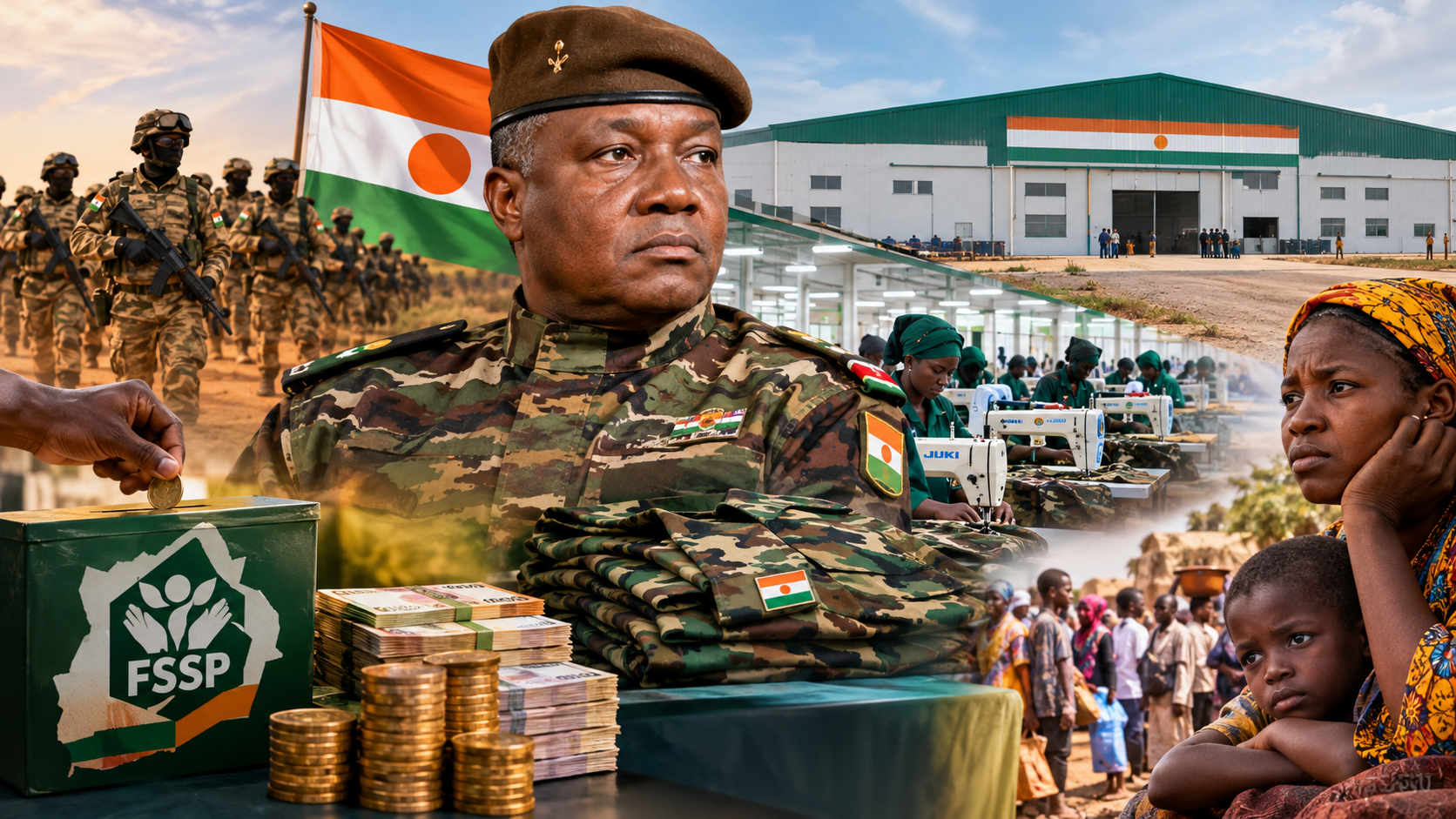
The groundbreaking ceremony for a new military uniform production facility in Niger, financed entirely by the National Solidarity Fund for the Salvation of the Homeland (FSSP) and boasting an initial output of up to 1,000 uniforms per day, has intensified public discourse on the country’s pressing priorities. With persistent security challenges and widespread socioeconomic hardship affecting citizens nationwide, stakeholders are questioning whether this ambitious industrial project aligns with the most critical needs of the population.
From raw materials to readiness: assessing the plant’s strategic value
On paper, domestic manufacturing of military attire offers a pathway to reduce reliance on foreign imports and streamline logistical support for national defense forces. However, the project’s practical impact remains uncertain without transparent insights into its overarching objectives, total budget, financing mechanisms, and anticipated tangible outcomes. With Niger grappling with dual security and economic crises, citizens deserve clarity on how this initiative will translate into tangible benefits for their communities and daily lives.
Capacity versus caliber: can 365,000 uniforms per year address real needs?
The facility’s projected annual capacity of 365,000 uniforms if operating at full capacity daily has sparked further scrutiny. Key unresolved questions include:
Targeted need: How many uniforms are currently required by Niger’s armed forces, and is demand sufficient to justify such output?
Distribution logistics: What procedures will govern the allocation and distribution of produced uniforms across military units?
Operational efficacy: Will increased uniform availability measurably enhance battlefield readiness, or does it address only one component of a complex security apparatus?
While uniforms are fundamental to operational integrity, they represent just one facet of a larger security ecosystem that also demands advanced training, real-time intelligence, robust logistics, and sustained public protection initiatives. Without concurrent investment in these areas, the uniform plant risks becoming a symbolic gesture rather than a transformative security solution.
The FSSP’s financial footprint: where does solidarity meet accountability?
The decision to fund the project through the FSSP established with contributions from citizens has intensified calls for fiscal transparency. In a climate where families struggle with rising living costs, food insecurity, and the lingering effects of regional instability, the public expects verifiable justification for how these collective resources are allocated across competing national priorities. The concerns are neither trivial nor dismissive of defense imperatives, but rather underscore the necessity for measurable returns on investment.
Critical unanswered questions persist:
What is the total projected cost of the project, and how much is sourced from FSSP contributions?
How many permanent jobs will be created, and what skill levels will be required?
What is the unit cost of production compared to imported uniforms, and what long-term savings are projected?
How will the facility be maintained and sustained financially once operational?
Without concrete data, skepticism persists that the uniform plant could inadvertently become a fiscal burden rather than an economic catalyst.
Autonomy ambitions: does Niger’s initiative fit a broader Sahelian vision?
Niger’s initiative echoes similar industrialization drives across the Alliance of Sahel States (AES), where Mali and Burkina Faso are also prioritizing local production to reduce external dependence. While the ambition to bolster self-reliance is commendable, questions arise about coherence and coordination.
Strategic alignment: Are these projects part of a unified industrial strategy grounded in each nation’s genuine economic needs, or do they reflect a trend-following approach lacking rigorous public evaluation?
Scalability and sustainability: Do plans include provisions for job creation, raw material sourcing, market linkages, and long-term financial viability, or do they focus solely on inauguration metrics?
Risk of redundancy: Could parallel initiatives in multiple countries strain limited public resources and dilute potential economic impact?
True industrial progress transcends headline capacity figures and relies on sustainable value chains, measurable socioeconomic benefits, and transparent governance.
Beyond uniforms: connecting defense investment to citizen welfare
The debate surrounding the uniform plant cannot be confined to defense logistics. Nigerien families are acutely affected by food insecurity, spiraling inflation, and disrupted livelihoods. Citizens are justified in demanding clarity on how public funds whether from FSSP or other sources are being balanced across urgent needs.
Key areas of concern include:
Food security: What allocations support agricultural resilience and access to affordable nutrition?
Social protection: How are vulnerable households being shielded from economic shocks?
Public services: Which investments strengthen healthcare, education, and infrastructure?
Economic opportunity: How do defense-related projects integrate with broader job creation and income generation strategies?
Security and socioeconomic development are not competing priorities; they are interdependent. A nation that invests in equitable growth and resilient communities builds the foundation for sustainable peace and stability.
From promise to performance: what Niger’s citizens demand
The uniform production plant’s long-term viability hinges on more than ambitious capacity projections. It requires:
Verifiable data: Transparent reporting on costs, contracts, and operational output.
Strategic integration: Clear alignment with national security, economic, and social development goals.
Public accountability: Regular audits and communication to ensure FSSP funds deliver measurable value.
Niger’s authorities bear the responsibility of demonstrating that this initiative represents more than symbolic progress. For citizens who have contributed to the FSSP, the ultimate measure of success lies not in the number of uniforms produced, but in the tangible improvements to security, employment, and quality of life across the nation.
By Yacouba Boukari — Journalist