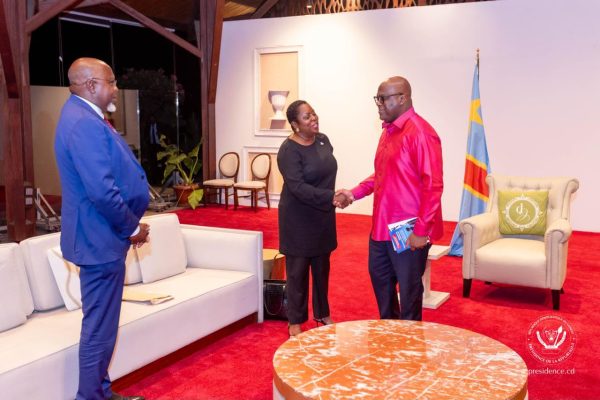
French lawmakers of Congolese descent are preparing a major diplomatic push to secure official recognition of the GENOCOST—a campaign highlighting the genocide linked to resource exploitation in the Democratic Republic of Congo—when the French parliamentary session resumes. The announcement follows a high-level meeting between the Collectif des élus français originaires du Congo-Kinshasa (CEFOCK) and President Félix Tshisekedi at the Cité de l’Union Africaine in Kinshasa.
The initiative aims to elevate the GENOCOST debate from advocacy circles into mainstream French and international discourse. The CEFOCK plans a multipronged approach, including public awareness campaigns, academic conferences, and targeted advocacy with French local governments, national institutions, and the Congolese diaspora.
From testimony to political action
The shift from passive remembrance to active political engagement is central to this strategy. By leveraging their elected positions in French municipalities, departments, and regions, Congolese-origin representatives are shifting from sharing personal stories to driving institutional change. Their goal: securing parliamentary recognition of the GENOCOST in France, mirroring the precedents set for other historical genocides.
This diplomatic offensive coincides with intensified efforts in Kinshasa to institutionalize remembrance. On August 2, 2026—the national GENOCOST memorial day—President Tshisekedi led a solemn ceremony honoring victims. He also unveiled plans for the National GENOCOST Museum and a dedicated memorial site, signaling a commitment to embedding the genocide’s memory in the country’s cultural and educational fabric.
A strategic alliance with state institutions
To bolster the campaign’s credibility, the CEFOK is partnering with the Commission interinstitutionnelle d’aide aux victimes et d’appui aux réformes (CIA-VAR), a Congolese government body tasked with victim documentation, reparations, and memorialization. Together, they aim to:
- Preserve historical truth: ensuring the atrocities against Congolese civilians are documented and remembered, preventing erasure from public memory.
- Secure official recognition: pushing for France—and the broader international community—to formally acknowledge the genocide and its link to resource exploitation in the DRC.
- Pave the way for justice: establishing frameworks for reparations and accountability mechanisms for victims and their families.
President Tshisekedi praised the initiative, describing it as a reinforcement of Kinshasa’s “diplomacy of memory.”
The diaspora as a political force
The Congolese diaspora in France is no longer confined to the sidelines. With elected representatives in local and national assemblies, the community is transforming its voice into political leverage. By targeting French policymakers, the CEFOK’s campaign seeks to create tangible pressure for parliamentary recognition of the GENOCOST—a move that could set a precedent for similar acknowledgments globally.
This mobilization reflects a broader continental effort to address historical injustices tied to colonialism and resource extraction. In the DRC, the construction of the National GENOCOST Museum and memorial site underscores a commitment to confronting the past while demanding accountability from former colonial powers and international actors complicit in resource plunder.

More Stories
Behind the violence: how the M23’s control of DRC mines fuels a cycle of abuse
Unpacking the surge: why Nigeria’s farmer-herder clashes are driving 600 refugees into Cameroon’s Northwest
Why Paris Saint-Germain’s midfield dominance sank Marseille in Ligue 1