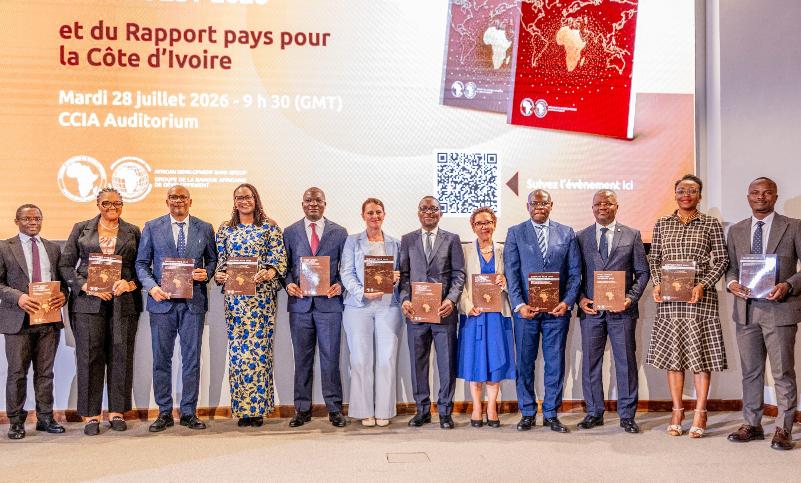
On Tuesday, July 28, the Ivory Coast government showcased its strategies for mobilizing development resources during the launch of the 2026 Ivory Coast Country Report and the West African Economic Outlook at the African Development Bank (AfDB) headquarters in Abidjan. The event, held under the theme ‘Scaling up resource mobilization for Africa’s development in a fragmented global landscape’, brought together AfDB officials, national and international financial institutions, private sector representatives, and Ivorian government officials.
Government’s strategic focus on resource mobilization aligns with national priorities
Under the leadership of President Alassane Ouattara, the Ivorian government prioritizes resource mobilization as a cornerstone of its economic transformation agenda. This commitment is embedded in the National Development Plan (NDP) 2026-2030, which envisions accelerated public and private financing to drive sustainable growth. The plan’s success hinges on securing substantial investments to meet its ambitious targets.
Partnership with the AfDB highlighted as key to policy formulation
Addressing the gathering, Cabinet Director Professor Loesse Jacques ESSO, representing the Minister of Planning and Development, emphasized the critical role of the AfDB’s reports in shaping public policy and guiding development dialogue. He praised the strong collaboration between Ivory Coast and the AfDB, noting that these publications serve as essential tools for evidence-based policymaking.
Regional growth trends and Côte d’Ivoire’s economic trajectory
Highlighting Africa’s projected 3.9% growth in 2025, Professor ESSO pointed to Ivory Coast’s remarkable performance, with an estimated 6.5% growth rate. This positions the country on a path toward achieving the African Union’s Agenda 2063 objectives, which aim for sustained economic transformation across the continent.
Challenges and breakthroughs in financing the national development agenda
The NDP 2026-2030 requires total financing of 114.8 trillion CFA francs—approximately $209 billion—a monumental task that underscores the scale of Ivory Coast’s economic ambitions. The recent High-Level Consultative Group meeting in July 2026 demonstrated the country’s ability to attract $80 billion (47.8 trillion CFA francs) in commitments, reflecting strong international confidence in Ivory Coast’s development vision and its capacity to secure large-scale financing.
Strategic pathways for economic transformation
Beyond Ivory Coast’s experience, Professor ESSO emphasized that the AfDB reports underscore a shared continental challenge: the urgent need to mobilize massive resources to accelerate structural economic transformation in Africa. Key strategies include boosting domestic revenue mobilization, leveraging private capital, strengthening financial systems, and deepening regional integration through mechanisms like the Pan-African Payment and Settlement System (PAPSS) and the African Continental Free Trade Area (AfCFTA).
A call for collective action and shared responsibility
Concluding the event, Professor ESSO urged participants to thoroughly analyze the reports’ findings and recommendations. He called on all stakeholders—government agencies, the private sector, financial institutions, and civil society—to contribute actively to discussions aimed at designing more effective development financing policies, both in Ivory Coast and across the region. The goal is to foster a collaborative framework that addresses challenges, capitalizes on opportunities, and ensures shared accountability in driving sustainable growth.



More Stories
Niger’s August crisis: how Tiani’s reliance on Russia exposed deeper fractures in the military
Burkina Faso’s military push raises urgent questions amid mass displacement crisis
Behind the three-day delay: what really delayed Senegal’s 2026 revised budget bill