
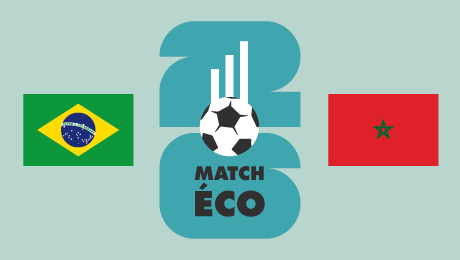
The economic confrontation leading up to the 2026 World Cup presents a surprising scenario: while Brazil possesses significant inherent advantages, it is Morocco that appears poised to lead on key economic indicators.
Brazil: a giant with underlying vulnerabilities
As the world’s 10th largest economy with a population of 212 million, Brazil stands as an undeniable global economic force. Its GDP per capita, measured by purchasing power parity, is projected at $22,000 in 2024, significantly higher than Morocco’s $10,000. This disparity reflects Brazil’s more advanced stage of economic development, propelled by a diverse industrial base, a leading agricultural sector, and a rapidly expanding services industry.
However, a closer look at Brazil’s public finances reveals a more challenging picture. State debt is set to reach 83% of GDP in 2024, compared to 70% for Morocco. While both nations grapple with elevated public debt levels, Brazil’s trajectory is under particular scrutiny from financial markets due to persistent budget deficits and substantial interest payment obligations. Morocco, conversely, is diligently working to control its debt amid ambitious structural reforms, especially as it prepares to co-host the World Cup.
Brazil 1 – Morocco 1
Morocco gains ground on social and strategic fronts
It is in the realm of social and strategic indicators that Morocco unexpectedly takes a significant lead. Its minimum wage is anticipated to reach $275 in 2026, surpassing Brazil’s $226. This figure underscores the limitations of solely relying on GDP per capita as an indicator of living standards; a higher national economic output does not automatically ensure improved remuneration for the most modest wage earners.
Morocco also outpaces Brazil in defense spending, allocating 3.5% of its GDP to military expenditure, compared to just 1% for Brazil. This more substantial military investment signals an assertive geopolitical strategy from Morocco, particularly within a volatile regional landscape. Finally, both nations are nearly even on life expectancy, with Brazil at 76 years and Morocco at 75 years.
Final Score: Brazil 2 – Morocco 3
Economically, Morocco delivers a surprising victory, echoing its recent successes in international sports. While Brazil maintains considerable economic strengths, it faces challenges in translating these into widespread well-being for its entire population. Morocco, an emerging economy, demonstrates that ambitious political choices can enable a nation to compete effectively with more established economic powers. This performance contributes compellingly to African economy news, showcasing the continent’s dynamic economic shifts.
We await to see if this economic triumph is confirmed in the broader global arena!

More Stories
Senegal secures $2.2 billion IMF deal to strengthen public finances
Togo strengthens ties with Kyrgyzstan at Shanghai Cooperation Summit
Belgian foreign minister seeks to reopen talks with Niger and Sahel alliance