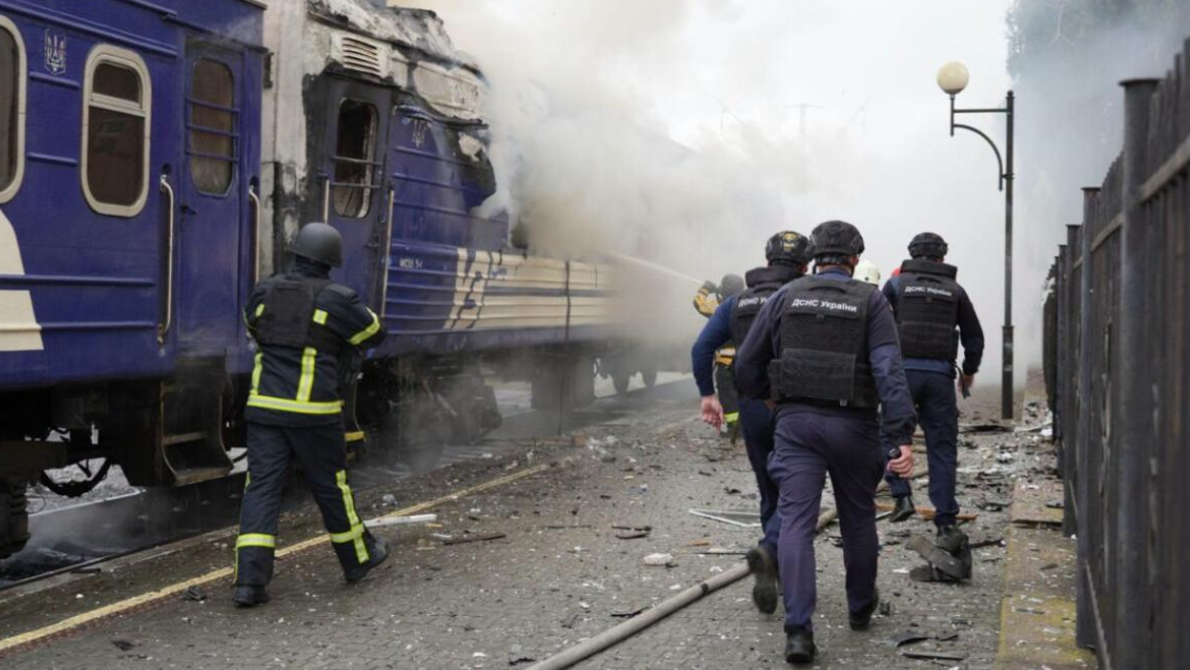
From rail tragedies to blazing refineries: a turning point in the conflict
The night of October 29-30 will be remembered as a defining moment in the Ukraine war. While the world focused on a devastating attack on a railway station in Dnipro, Ukraine’s long-range strikes reached deep into Russian territory, setting ablaze the Novokouïbychevsk oil refinery in the Samara region. These simultaneous blows underscore a strategic shift—one that signals escalation and the erosion of Moscow’s perceived security.
Railway attack in Dnipro claims 14 lives
Hours before the refinery flames lit the sky over Russia, a Russian drone strike hit a railway station in Dnipro, central Ukraine. The attack targeted a busy platform where two passenger trains had just arrived: a commuter train and a long-distance service. Survivors described panic as concussions shattered windows, debris rained down, and emergency crews scrambled through the wreckage. Among the 14 confirmed dead was an 11-year-old child. Ukrainian officials called it a deliberate strike on civilian life, condemning the blatant disregard for non-combatants.
Novokouïbychevsk refinery engulfed in flames
Across the border, the Novokouïbychevsk refinery—one of Russia’s largest industrial complexes—became the latest casualty of Ukraine’s expanding campaign. Operated by Rosneft, this facility processes millions of tons of crude oil annually, producing jet fuel and other critical petroleum products. Video footage captured towering plumes of black smoke rising over the complex, with reports of secondary explosions shaking nearby neighborhoods. Local authorities confirmed the strike but withheld detailed assessments, leaving experts to piece together the scale of the damage from satellite images and social media feeds.
Russia’s defensive response
The Samara regional governor, Vyacheslav Fedorichtchev, acknowledged the attack and deployed air defense systems and mobile fire teams. However, no official damage report has been released. Unconfirmed accounts suggest that while portions of the refinery remain operational, the blaze disrupted processing for days. The lack of transparency has fueled speculation about the true extent of the disruption to Russia’s fuel supply chain.
Infrastructure as the new front line
These two events are not isolated incidents; they mark a deliberate pivot. Since the beginning of Russia’s full-scale invasion, Ukraine has relied on railways to sustain military logistics, humanitarian aid, and civilian mobility. Russian strikes against rail networks have repeatedly disrupted life for millions. Now, Ukraine is turning the tables, deploying long-range weapons to cripple Russia’s economic engine—its energy sector.
The Novokouïbychevsk refinery is a prime example. As a key node in Rosneft’s network, it refines crude into jet fuel, diesel, and gasoline, feeding both civilian and military demand across the country. By striking such facilities, Ukraine aims to throttle Russia’s fuel exports, erode revenue, and weaken its war-fighting capacity. The attack follows a pattern of sustained pressure on Russia’s energy infrastructure, signaling that Moscow can no longer assume safety beyond the front lines.
Diplomacy stalled, strikes intensify
Analysts note that despite international calls for restraint, Ukraine’s strikes on Russian refineries continue unabated. Some reports suggest that Western partners urged Kyiv to pause such attacks temporarily, seeking to de-escalate tensions. Yet the Novokouïbychevsk assault shows that such appeals have not altered the trajectory of the war. As diplomatic avenues remain frozen, military pressure intensifies on both sides.
The human toll is mounting. Civilian casualties in Ukraine’s railway stations and Russia’s industrial zones reveal a harsh truth: the conflict no longer targets only soldiers or soldiers’ families. Schools, commuter trains, and refineries have become part of the battlefield. With drones now reaching targets hundreds of kilometers from the front, distance offers no protection. The war’s evolution is clear: it is no longer confined to trenches or frontlines, but expanding into the heart of both nations’ economic lifelines.
What comes next?
As the conflict enters its fifth year with no clear path to peace, both sides are doubling down on asymmetric warfare. Ukraine’s long-range drone program—once seen as a tactical advantage—has become a strategic equalizer. Meanwhile, Russia’s inability to secure critical infrastructure deep behind its borders exposes vulnerabilities in its domestic security posture.
The Novokouïbychevsk fire and the Dnipro tragedy are more than headlines; they are indicators of a turning point. One side is pushing the envelope of long-range strikes, the other is broadening the definition of the battlefield. The question now is not whether escalation will continue, but how far it will go—and who will be left counting the cost.