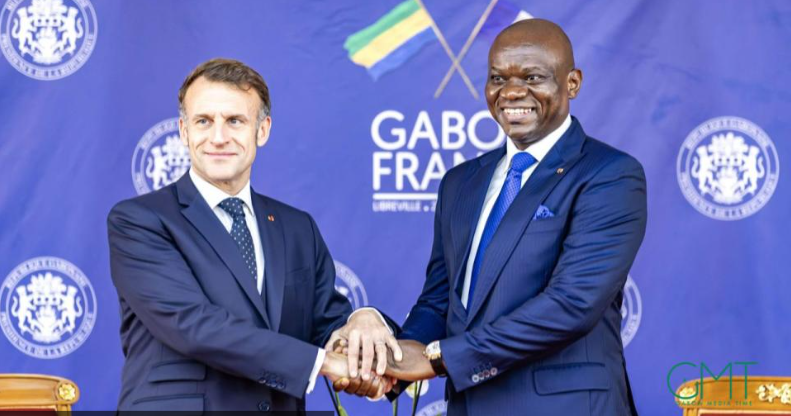
For three days, Gabonese President General Brice Clotaire Oligui Nguema embarked on a high-stakes state visit to France, redefining the future of bilateral relations. The discussions with French counterpart Emmanuel Macron focused on two critical fronts: the strategic restructuring of the Camp de Gaulle military base and Gabon’s pivot toward local manganese processing. Rather than opting for a dramatic rupture, Libreville is pursuing a nuanced approach—balancing sovereign assertiveness with pragmatic cooperation.
Rethinking Camp de Gaulle: A model of balanced sovereignty
The military dimension dominated the agenda, as Gabon seeks to recalibrate its long-standing defense partnership with France. The Camp de Gaulle base, home to the French military presence in Gabon, has seen its troop numbers drastically reduced as part of France’s broader redeployment across West and Central Africa. However, Libreville is not pushing for an abrupt withdrawal. Instead, President Oligui Nguema is advocating for a phased transition, transforming the base into a locally co-managed training hub or limiting French operations to technical cooperation and Gulf of Guinea anti-piracy efforts.
This strategy allows Gabon to reclaim national pride while preserving essential security channels. For France, the challenge lies in adapting its military footprint without alienating a key regional partner—a lesson learned from recent setbacks in neighboring countries.
Manganese processing: Gabon’s bold economic pivot
The economic dimension of the talks was equally pivotal. Gabon, the world’s second-largest manganese producer, is determined to move beyond its colonial-era extractive model. Historically, nearly all manganese was exported raw, leaving minimal value for local communities. During meetings with French industrialists and Eramet (via its Comilog subsidiary), President Oligui Nguema made one demand clear: Gabon must industrialize its resources.
The new terms include mandatory local processing, equitable profit-sharing, job creation for Gabonese youth, and financial and technical support for high-value processing plants. This push aligns with global energy trends, as manganese is a critical component in electric vehicle batteries. By demanding these concessions, Gabon is positioning itself to capitalize on the green energy transition.
Libreville’s pragmatic alternative to Sahelian confrontation
This state visit underscores a distinctive diplomatic doctrine. While juntas in the Alliance of Sahel States (Mali, Niger, Burkina Faso) have embraced public ruptures with former colonial powers—often at the cost of economic isolation and instability—Gabon is charting a different course. President Oligui Nguema’s approach champions Realpolitik over populist posturing.
Libreville is diversifying partnerships with China, Turkey, and India while maintaining a firm but constructive dialogue with France. This strategy rejects the false dichotomy that African sovereignty requires rejecting Western engagement. Instead, Gabon demonstrates that assertive diplomacy can coexist with strategic alliances—proving that pragmatic negotiation, not confrontation, yields tangible benefits.
The paradox of progress: Democratic freedoms under scrutiny
Despite Gabon’s international image as a reformist leader, domestic concerns linger. Frequent internet restrictions and social media blackouts have raised alarms among civil society and opposition figures. The government justifies these measures as necessary for ‘public order’ and combating misinformation, but critics argue they reflect an authoritarian drift.
During informal exchanges, French officials subtly emphasized the importance of upholding fundamental freedoms and free expression. For President Oligui Nguema, the challenge is delicate: balancing internal stability with the international credibility he has worked to build.
The path ahead: Diplomacy in action
As the three-day visit concludes, its strategic significance for Gabon is undeniable. By redefining military cooperation and asserting control over its mineral wealth, President Oligui Nguema has reinforced his vision of a sovereign, self-assured nation. Yet the success of this strategy hinges on two fronts: delivering on international commitments and safeguarding domestic freedoms.
Gabon’s ability to navigate this delicate balance will determine whether its diplomatic reinvention serves as a model for the continent—or remains an experiment in progress.