
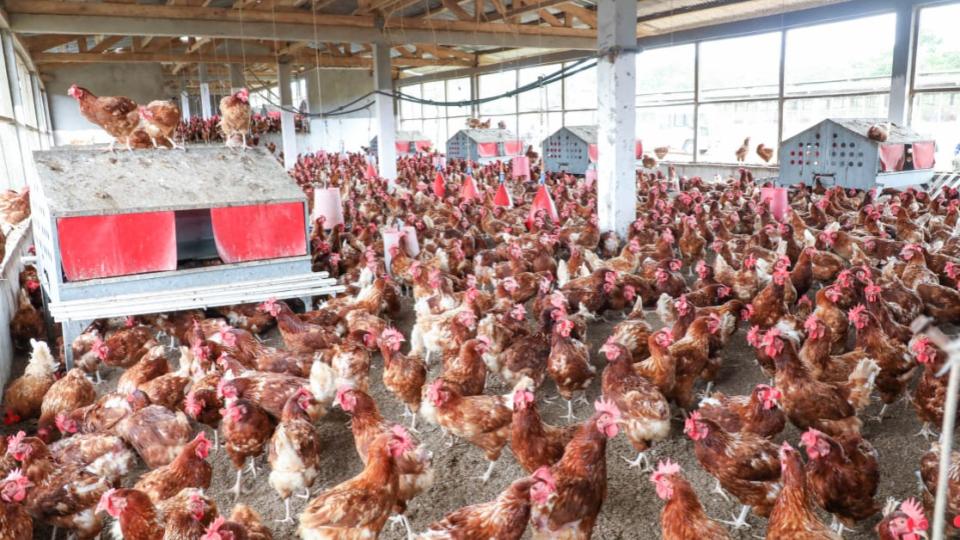
The recent announcement regarding the Guinean conglomerate SONOCO, aiming to produce an impressive 15 million chickens annually in Gabon, has reignited a crucial national dialogue. This discussion centers on Gabon’s economic sovereignty and the recognition afforded to its own entrepreneurs. While authorities laud this initiative as a significant leap for national food security, several prominent voices, including former Member of Parliament Jean-Valentin Leyama, are questioning the apparent lack of attention given to SOGADA. This Gabonese entity has been a dedicated investor in the local poultry sector for over a decade. The issue extends beyond mere agricultural policy, delving into the very core of Gabon’s national economic development philosophy.
Gabon expresses a legitimate ambition to boost its domestic production of consumed goods. In a nation that still relies heavily on imports for a substantial portion of its food needs, any endeavor to strengthen local output is certainly commendable. It is within this framework that the Presidency of the Republic unveiled SONOCO’s project, forecasting an annual production of over 15 million broiler chickens.
Yet, beyond the official enthusiasm, a fundamental question quickly emerged in public discourse. This isn’t to dispute the necessity of foreign investment, which Gabon requires to accelerate its growth. Rather, it challenges the consistency of a political narrative that champions economic sovereignty and the advancement of national entrepreneurship as foundational pillars. How, indeed, can one speak of economic re-conquest without first empowering those who have already taken the risk to invest within Gabon’s borders?
SOGADA: a forgotten national champion in Gabon?
This critical perspective is precisely what Jean-Valentin Leyama highlighted. The former transitional deputy pointed to the existence of the Société Gabonaise de Développement Agricole (SOGADA), strategically located in Meyang, approximately fifty kilometers from Libreville. This is not merely a proposed project or a future promise; it represents a tangible economic reality, meticulously developed over a decade with private Gabonese capital.
Established in 2013, SOGADA spans more than 160 hectares and boasts investments nearing 16 billion CFA francs. The enterprise’s scope extends far beyond just chicken farming. It has cultivated a comprehensive agro-industrial complex, encompassing poultry farming, egg production, pig breeding, the processing of local agricultural products, and even an industrial unit for manufacturing egg cartons. In essence, SOGADA embodies an integrated approach to the agricultural value chain—precisely what Gabonese authorities are advocating for today.
Concrete actions over mere announcements
The fundamental distinction between SOGADA and the recently publicized projects lies in one simple fact: SOGADA is already producing. For several years, this company has been actively contributing to the national effort to reduce import dependency. It employs Gabonese citizens, invests within the national territory, fulfills its tax obligations, and plays a vital role in the country’s food security.
Consequently, the question becomes political. Why do national entrepreneurs who believed in Gabon’s agricultural potential—at a time when the sector received little media attention and was not deemed strategic—now appear to be sidelined? Why does the state not more actively promote these pioneers who invested their own capital in an area long considered risky? A coherent policy of economic sovereignty should naturally begin by strengthening those who have already demonstrated their unwavering commitment.
Economic sovereignty is more than just a slogan
This debate transcends poultry production; it touches upon the broader vision Gabon wishes to adopt for its development. In every nation that has successfully undergone economic transformation, the state has played a crucial role in supporting its national entrepreneurs. It hasn’t merely attracted foreign investors; it has also fostered an environment where its own businesses can evolve into national champions. This is critical for African economy news and development.
South Korea strategically backed its industrial groups. Morocco actively supports its enterprises across agriculture, finance, and industry. Rwanda encourages the emergence of local players capable of driving its economic ambitions. So, why does Gabon still struggle to build a similar framework? Why do foreign investors sometimes appear to receive greater institutional visibility than national operators who have been investing on the ground for years? This is a key question in African politics English discussions.
The challenge of a strategic state for Gabon
No one disputes the potential benefits of the SONOCO project. If its stated objectives are met, Gabon could significantly reduce its poultry imports and generate thousands of jobs. However, the core issue isn’t about the project’s merit. The central challenge lies in determining whether the state intends to build genuine economic sovereignty or simply welcome investors capable of producing locally.
True economic sovereignty is not solely defined by the geographical origin of production. It also rests on a nation’s capacity to foster its own entrepreneurs, provide them with financing, protect their interests, and support their growth. A nation that fails to support those who invest domestically with their own resources will ultimately find itself importing its development as much as its products.
A critical question for Gabonese authorities
Ultimately, the announcement of the SONOCO project raises a question that public debate cannot ignore. If economic sovereignty genuinely represents a national priority, why are Gabonese actors who invested ahead of others in strategic sectors not placed at the heart of this ambition?
SOGADA is more than just an agricultural enterprise. It stands as clear proof that Gabon possesses entrepreneurs capable of massive investment, risk-taking, and building entire value chains. The real question, therefore, is not why SONOCO is coming to Gabon. It is to understand why those who have already proven their capabilities are still waiting for the Republic to recognize them as the national champions they truly are. A credible economic sovereignty is not built against foreign investment; it is built, first and foremost, by trusting its own builders.
More Stories
Mamadi Doumbouya de retour à Conakry après sa visite d’État en Côte d’Ivoire
Elversberg vs Bayern Munich: where to watch the Bundesliga clash
Mali: près de 80 soldats tués dans l’attaque de Dioura