
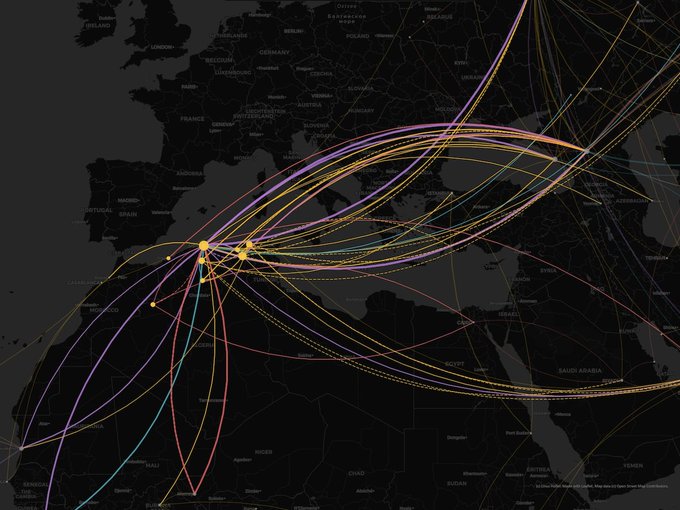
The highly publicized deployment of Africa Corps paramilitaries in the Sahel conceals a far more clandestine operation. While global attention remains fixed on uniformed soldiers, Moscow is quietly constructing a strategic air infrastructure that extends well beyond conventional security assistance. At its core lies a discreet fleet of Russian cargo aircraft, rapidly dubbed Air Wagner by intelligence specialists.
Disguised as defense cooperation agreements with the Alliance of Sahel States (Mali, Burkina Faso, Niger), this logistical network is evolving into one of Moscow’s most sophisticated tools of espionage and geopolitical influence on the African continent.
167 unmonitored flights: the hidden backbone of Russia’s Sahel strategy
To evade the constraints of international sanctions, the Kremlin has constructed a covert aerial ecosystem. A recent aviation investigation has revealed the scale of this airborne operation: at least 167 cargo flights were formally documented over just fourteen months.
Further analysis uncovered thousands of additional rotations operated by a dozen interconnected airlines, all tied to Russian state or para-state entities. To obscure this buildup, Moscow employs hybrid warfare tactics:
- Intentional deactivation of aircraft transponders (locator beacons);
- Falsification or omission of flight plans and registration details;
- Utilization of secondary airfields for cargo transfers.
According to defense analysts, this fleet does more than transport personnel and armaments. It carries electronic surveillance equipment, signals intelligence modules, and operatives from Russia’s military intelligence agency (GRU), turning each flight into an opportunity to map and monitor Sahelian territory.
From security partnership to strategic dependency
For governments within the Alliance of Sahel States, cooperation with Africa Corps is often framed as a swift, unconditional solution to counter terrorism. Yet technical assessments indicate that Moscow is systematically embedding itself within the critical infrastructure of these nations.
Russian support now encompasses strategic air transport, exclusive maintenance of local military aircraft, cadre training, and logistical supply chains. By securing positions at key air bases in Bamako, Ouagadougou, and Niamey, Russian intelligence services gain unrestricted access to sovereign military data of host nations. Under the guise of regime protection, Moscow listens, observes, and compiles intelligence on local resources, troop movements, and government communications.
The long-term political price of Moscow’s shadow fleet
Air Wagner and Africa Corps are not instruments of altruism—they are blunt tools of influence. By providing this logistical lifeline, the Kremlin achieves a dual objective: escaping diplomatic isolation through a foothold in Africa, and securing permanent insight into the internal affairs of Sahelian states.
For Sahelian governments, the short-term gains in immediate security may soon collide with a stark reality. The political cost—marked by a gradual erosion of sovereignty in the face of unchecked Russian surveillance—already outweighs the promised security benefits. In welcoming Russia’s phantom air fleet onto their runways, these nations may have unwittingly handed Moscow the keys to their own territory.


More Stories
Mamadi Doumbouya de retour à Conakry après sa visite d’État en Côte d’Ivoire
Elversberg vs Bayern Munich: where to watch the Bundesliga clash
Mali: près de 80 soldats tués dans l’attaque de Dioura