The Burkina Faso conflict has reached a critical turning point as the Group for Support of Islam and Muslims (JNIM), an Al-Qaeda-affiliated jihadist coalition, claims responsibility for a series of high-impact attacks that have sent shockwaves through the country’s security landscape. In a bold move, the group announced the destruction of a military armored vehicle near Fada N’Gourma—an operation that threatens to reshape battlefield dynamics in the eastern region. Additionally, three allied militia fighters were reportedly killed in the Bam province, with the jihadists seizing automatic weapons. While these claims remain unverified, they underscore the escalating challenges facing Burkina Faso’s beleaguered security forces.
Strategic ambush near Fada N’Gourma
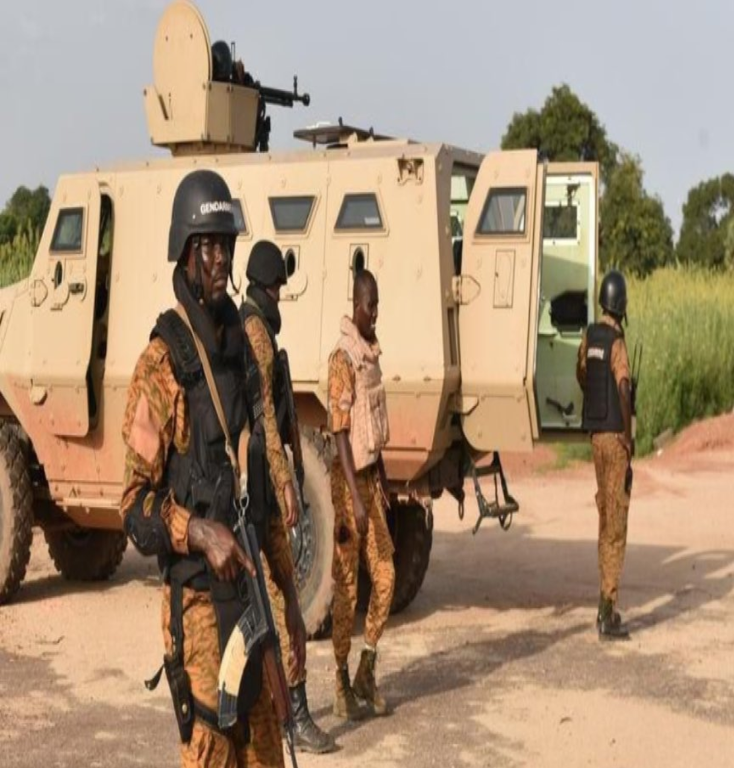
The JNIM’s operation in the Eastern region targeted a heavily fortified military convoy, resulting in the destruction of an armored vehicle using an improvised explosive device (IED). This attack occurred along a critical route linking multiple towns, highlighting the growing threat posed by roadside bombs—a tactic that has increasingly complicated military movements across the Sahel. The explosion’s timing and location suggest a deliberate effort to disrupt supply lines and weaken government control over key transit corridors.
While the full extent of the damage remains unconfirmed, the claim raises serious concerns about the vulnerability of armored vehicles to such attacks, even in areas nominally under military protection. The incident serves as a stark reminder that modern warfare in Burkina Faso is not confined to direct confrontations; it encompasses a broader spectrum of asymmetric threats designed to erode confidence in the state’s defensive capabilities.
Militia losses in Bam province spark security concerns
In a separate operation, the JNIM reported killing three members of Burkina Faso’s Volunteers for the Defense of the Homeland (VDP), a civilian militia group formed to assist national forces in counterinsurgency efforts. The attack, which allegedly occurred in Bam province, also resulted in the militants seizing several automatic weapons. If confirmed, this would represent a significant tactical gain for the jihadists, as arms seizures further destabilize already fragile security conditions.
The VDP’s involvement in counterterrorism operations makes its members prime targets for retaliation. The loss of three fighters—and the potential loss of firearms—could demoralize local defense units and embolden insurgent factions. However, the lack of independent verification means these claims should be treated with caution, as propaganda often plays a role in the JNIM’s public statements.
Escalating violence challenges Burkina Faso’s stability
The alleged attacks in Fada N’Gourma and Bam province are not isolated incidents but part of a broader pattern of violence gripping Burkina Faso. Since the rise of jihadist factions, the country has struggled with deepening insecurity, with eastern, northern, and central-northern regions bearing the brunt of the conflict. Civilians bear the heaviest cost, facing frequent attacks, forced displacements, and collapsing infrastructure.
Entire communities have been cut off from essential services, including healthcare, education, and food supplies. Markets, once bustling hubs of economic activity, now stand empty as fear dictates daily life. Agricultural production has plummeted, exacerbating food insecurity among displaced populations. The humanitarian crisis unfolding across these regions demands urgent attention, yet the relentless cycle of violence continues to hinder relief efforts.
Can Burkina Faso turn the tide on insurgency?
The JNIM’s latest offensives mark a pivotal moment in Burkina Faso’s struggle against violent extremism. For the government, the immediate challenge is twofold: securing vulnerable routes and protecting civilian auxiliaries like the VDP, whose losses could further erode public confidence. Military operations alone are insufficient; a sustainable strategy requires intelligence sharing, robust counter-radicalization initiatives, and the restoration of trust between authorities and affected communities.
The path to recovery is fraught with obstacles. Without decisive action to curb the insurgency’s momentum, the crisis risks spiraling further out of control, leaving swathes of territory in the hands of militant factions. For the people of Burkina Faso, the quest for security and normalcy remains an uphill battle—one that hinges on both military and civilian resilience.
Key takeaways from the recent escalation
- IED threats: The destruction of an armored vehicle near Fada N’Gourma underscores the persistent danger posed by improvised explosives, which have become a signature tactic of jihadist groups in the Sahel.
- Militia vulnerabilities: The killing of three VDP members in Bam province highlights the risks faced by civilian defense forces, whose role in counterterrorism is critical yet perilous.
- Humanitarian toll: The ongoing violence has displaced thousands, disrupted essential services, and crippled economic activity, pushing communities to the brink of survival.
- Strategic imperative: Burkina Faso must adopt a holistic approach—combining military pressure, intelligence operations, and community engagement—to regain control and restore hope.