The JNIM’s expansion dilemma: strategic choices and regional risks

An event organized by the Afrique : citoyenneté, violence et politique research group at CERI and the Africa Programme.
The rise of the JNIM and its growing influence in the Sahel
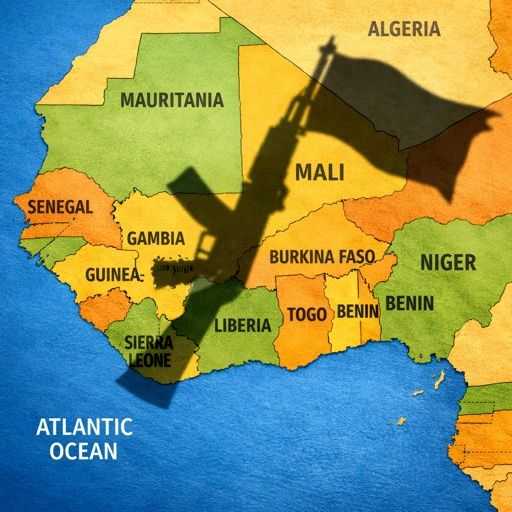
Since its establishment in 2017, the Jama’at Nusrat al-Islam wal-Muslimin (JNIM, or Group for the Support of Islam and Muslims), an Al-Qaeda affiliate, has emerged as one of the most powerful armed groups in the central Sahel. Operating through multiple katibas, the JNIM has established a strong presence across northern Mali, Niger, and Burkina Faso, where it competes with state authorities for territorial control and governance.
Between 2019 and 2025, the JNIM’s influence began shifting southward, toward the Gulf of Guinea. While the group has targeted northern Bénin, Togo, and Côte d’Ivoire in recent years, its expansion has followed an uneven pattern. For instance, Ghana has remained largely unaffected, while Côte d’Ivoire saw significant attacks between 2020 and 2022 but has since experienced a sharp decline in JNIM-related violence. Meanwhile, Bénin has faced a dramatic deterioration in security since 2025.
Challenges of territorial expansion: a strategic dilemma
The JNIM’s southward push raises critical questions about its internal decision-making processes. A recent Crisis Group report examines the unexpected geography of this expansion, revealing that territorial growth is not always a straightforward or unanimous strategy within the organization. Key dilemmas include:
- Resource allocation risks: Rapid expansion can stretch the group’s limited resources, leading to operational inefficiencies and internal tensions.
- Fragmentation threats: Expanding too quickly may weaken cohesion, as different factions within the JNIM prioritize varying objectives.
- Strategic trade-offs: Failing to expand leaves room for rival groups to exploit unoccupied territories, potentially undermining the JNIM’s long-term influence.
The report highlights that the JNIM’s leadership must carefully balance these risks when deciding whether—and how—to expand its operations.
Geopolitical implications for West Africa
The current geopolitical landscape in West Africa adds another layer of complexity to the JNIM’s expansion. The formation of the Alliance des États du Sahel (AES), its withdrawal from ECOWAS, and persistent regional tensions create an environment where militant groups like the JNIM can exploit instability. Understanding the JNIM’s internal dynamics is essential for developing effective counterterrorism policies in vulnerable countries.
Expert insights: analyzing the JNIM’s strategies
This event brings together leading researchers to dissect the JNIM’s expansion tactics and their broader implications:
- Jean-Hervé Jézéquel (International Crisis Group) – Director of Crisis Group’s Sahel Project, specializing in political and security dynamics in the Sahel and its peripheries.
- Marte Beldé (Sciences Po Bordeaux) – Postdoctoral researcher contributing to the Governing Jihad in Africa project (GOVJIHAD), focusing on the political economy and spatial expansion of jihadist movements in West Africa.
- Beatriz de León Cobo (GEMASS – Sorbonne Université) – Doctoral candidate studying radicalization, Associate Fellow at the Royal United Service Institute (RUSI), and director of the Europe-Sahel Dialogue Forum at the Universidad Francisco de Vitoria in Madrid.
- Dan Sanaren (CERI–Sciences Po / CNRS) – Event moderator.
Why this matters for African security
The JNIM’s evolving strategy underscores the need for nuanced, context-specific approaches to counterterrorism in West Africa. Policymakers, security analysts, and regional stakeholders must account for the group’s internal divisions and adapt their strategies to address the unique challenges posed by its expansion.