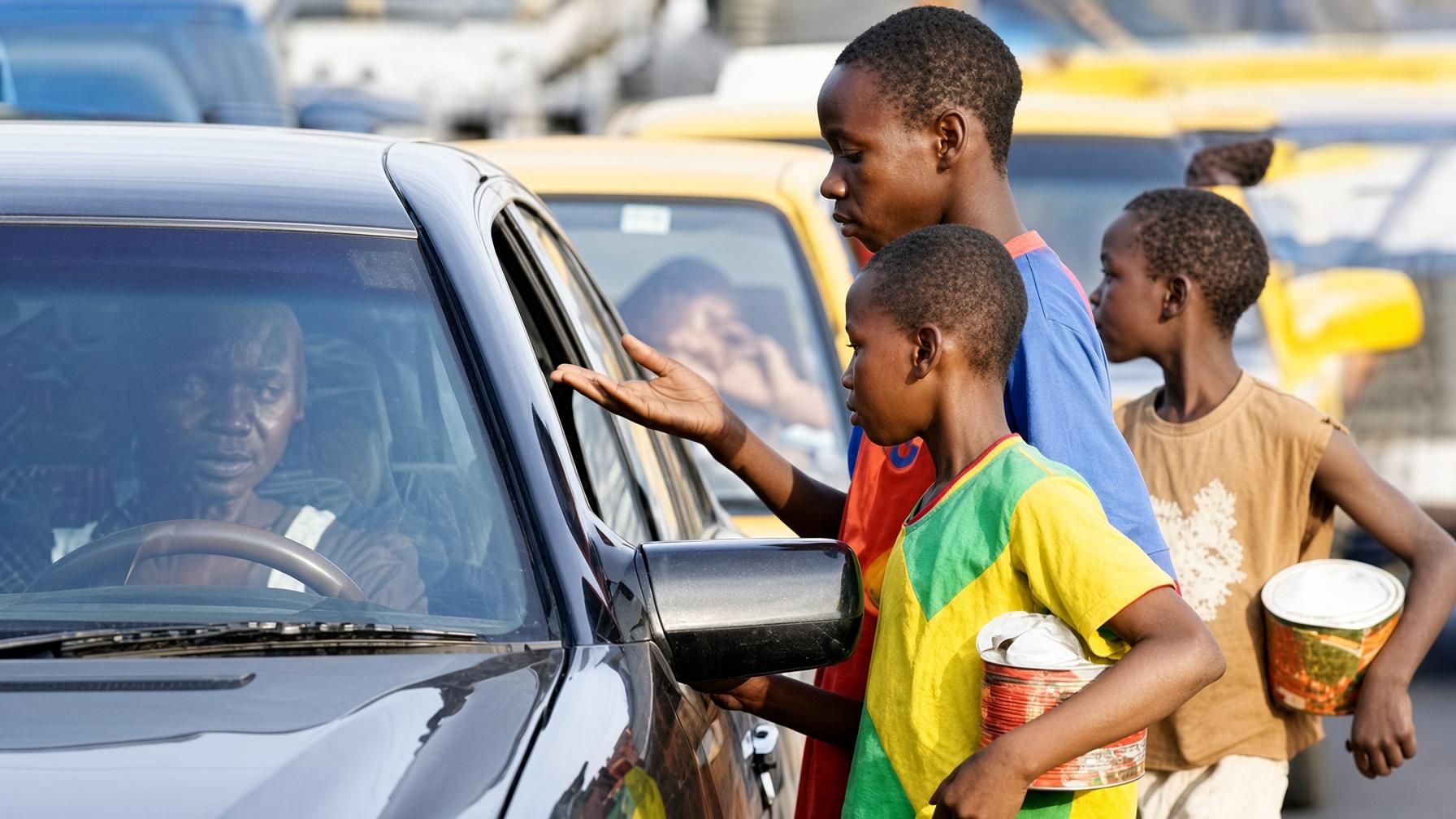
Bamako’s streets have become a battleground—one where desperation meets neglect. At major intersections, outside government buildings, and in front of places of worship, a relentless tide of children, people with disabilities, and elderly individuals extend their hands to passing motorists. Despite repeated government pledges and high-visibility campaigns, Mali’s efforts to curb street begging have failed to gain any meaningful traction. This crisis has evolved from a marginal issue into a structural component of urban life, exposing deep-rooted governance failures that threaten the nation’s stability.
From marginal issue to urban epidemic
The scope of street begging in Mali’s capital has exploded beyond control. Traffic lights and busy thoroughfares have become hunting grounds for waves of children—many of them talibés sent by unscrupulous Quranic teachers or adolescents left entirely to their own devices. These young individuals dart between vehicles in a dangerous game of survival, risking life and limb in pursuit of alms. The sight is no longer shocking; it’s expected.
Government initiatives aimed at removing children from the streets and providing social support have yielded little more than temporary results. Programs led by the Ministry of Women, Child, and Family Promotion—such as identification drives and awareness campaigns—have consistently fallen short. With no sustainable shelter systems, inadequate funding, and negligible enforcement, those intercepted are often back on the streets within hours. The cycle of intervention and relapse remains unbroken, a stark indictment of systemic inadequacy.
The governance deficit: why solutions fail to stick
The proliferation of street begging in Mali is not an anomaly—it is a direct consequence of entrenched state failures and worsening socio-economic conditions.
Collapse of essential social services
A chronic underinvestment in education and social protection has left millions of families in a state of extreme vulnerability. The state’s inability to deliver free, quality, and compulsory education has pushed countless impoverished households into impossible choices. Parents unable to feed or educate their children often surrender them to the streets—not out of neglect, but necessity. Without a strong public education system, the cycle of poverty and begging becomes self-perpetuating.
Unregulated traditional education systems
The informal Quranic school (médersa) sector operates in a legal and operational gray zone. These institutions, many of which prioritize Quranic instruction over formal education, have become hotbeds for forced child begging. Despite clear legislation prohibiting child exploitation, enforcement is virtually nonexistent. Authorities often refrain from cracking down under the guise of cultural and religious sensitivity—creating an environment where abuse thrives unchallenged.
Misappropriation of public funds
National priorities continue to be skewed toward security expenditures and institutional maintenance, leaving social development budgets critically underfunded. The allocation for human development and poverty reduction remains shockingly low. Meanwhile, international aid and public funds designated for social programs frequently vanish into bureaucratic black holes. Corruption, mismanagement, and opacity ensure that resources intended for vulnerable populations are siphoned off long before they reach those in need.
A looming social and security time bomb
The government’s failure to address this crisis is more than a humanitarian concern—it is a ticking time bomb. Tens of thousands of street children, suffering from extreme poverty, illiteracy, and exposure to abuse, are increasingly vulnerable to recruitment by criminal networks and armed groups across the Sahel. The longer this population remains neglected, the greater the risk of radicalization and instability.
By treating street begging as a matter of public image rather than a crisis of governance, Mali’s leadership is squandering an opportunity to reclaim its social contract with citizens. Without bold reforms—rooted in law enforcement, transparent resource allocation, and genuine investment in human development—the country will continue to watch its youth languish on sidewalks, forced into a life of dependence and desperation.