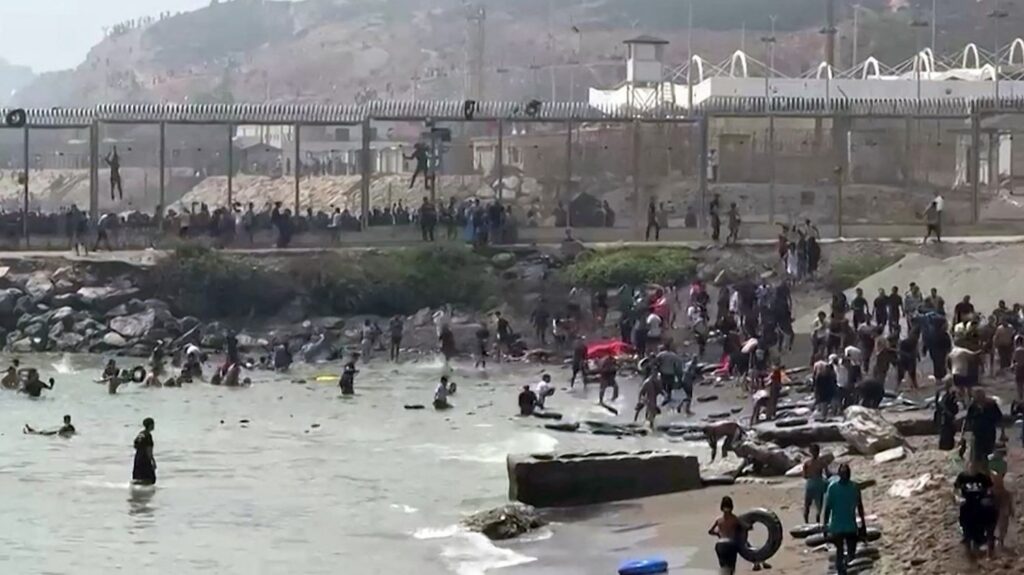
Massive influx of migrants at Ceuta sparks political pressure debates
In just 24 hours, nearly 60,000 migrants illegally crossed into this Spanish enclave bordering Morocco—a 20 km² territory home to 85,000 residents. Analysts question whether Rabat’s actions aim to pressure Madrid over its growing ties with Algeria.
Tensions escalated at the Ceuta-Castilejos border after thousands of Moroccan nationals, including young people, families, and individuals with reduced mobility, stormed the Spanish territory. This marks one of the most severe migration crises in five years. While Moroccan police restricted road access, migrants dispersed through hills and beaches, some swimming across to reach Ceuta.
The Spanish government insists bilateral relations remain stable, citing an “excellent” bilateral agreement and “intensive” migration coordination with Morocco. After initial silence, Moroccan authorities confirmed an agreement with Spain to repatriate those who entered illegally.
Legal ruling misinterpreted, experts argue
The Spanish Interior Ministry attributes the surge to human trafficking networks allegedly exploiting a recent Supreme Court ruling. The decision guarantees legal assistance and individual case reviews for all entering Spain—but experts warn this is being misconstrued.
Ruth Ferrero, a political science professor at the Complutense Institute of International Studies (ICEI), clarifies: “This is simply the application of international asylum law—not an ‘open door’ policy. It does not prevent returns or repatriations to Morocco.” She emphasizes that criminal networks, not legal frameworks, are driving migration flows.
A recurring pattern since 2021
This crisis echoes May 2021, when nearly 9,000 people entered Ceuta in retaliation for Spain hosting Brahim Ghali, leader of the Polisario Front, for COVID-19 treatment. Morocco condemned the move as “deplorable.” Intelligence reports later revealed rumors spread among sub-Saharan migrants that Moroccan security forces would ease border controls that day.
Haizam Amirah Fernández, executive director of the Centre for Contemporary Arab Studies (CEARC), notes a recurring pattern: “Moroccan authorities use human movements to send messages, often tied to unmet political expectations.”
Ferrero cautions against overinterpreting migration as purely political strategy. “Current evidence suggests this may not be a deliberate Moroccan move. The Interior Ministry’s stance highlights the role of misinformation networks linked to criminal gangs.“
Social media’s role in fueling migration
A recent study by the North African Human Rights Observatory found that 81% of youth in Tangier, Tetouan, and Al Hoceima believe social media portrays irregular migration as a viable path to better living conditions. The survey revealed:
- 78.4% of respondents reported easy access to posts promoting irregular migration.
- 74.2% follow pages providing planning assistance for such journeys.
Diplomatic tensions and regional rivalry
The influx occurred a week after Spanish Prime Minister Pedro Sánchez’s visit to Algeria, where energy cooperation—particularly gas supply amid Middle Eastern conflicts—dominated discussions. “While timing is suspicious, causality remains unclear,” says Amirah Fernández. “The Morocco-Algeria rivalry has persisted since independence. Spain’s warming ties with Algeria likely unsettled Rabat.”
Morocco views Spain’s relations with Maghreb neighbors through a zero-sum lens: “Improving ties with Algeria is seen as detrimental to Morocco, just as warming relations with Morocco would harm Algeria.”
Ferrero adds that Morocco has leveraged its position effectively in a European migration management system that outsources border control. “It’s not that Morocco sought this role deliberately, but it has skillfully navigated a context where European governments, including Spain, delegate migration governance to third countries.”
The Western Sahara conflict’s shadow
Migration pressures have followed past diplomatic disputes. In December 2020, Morocco suspended high-level talks with Spain days after then-U.S. President Donald Trump recognized Moroccan sovereignty over Western Sahara in exchange for Israel normalization. Months later, Spain’s decision to admit Ghali for medical treatment triggered a deadly border incident.
“The Spain-Morocco relationship is complex,” says Amirah Fernández. “Morocco’s assertive style—centralized decision-making and reliance on force—has defined its approach.“
Since its 1956 independence, the Western Sahara conflict has strained ties. Morocco controls 80% of the territory, while the remaining 20% is held by the Polisario Front, founded in 1973 as a Sahrawi liberation movement.
Trump’s 2020 recognition of Moroccan sovereignty over Western Sahara—later echoed in Spain’s 2022 letter to King Mohammed VI, supporting Moroccan autonomy proposals—marked a turning point. “Spain abandoned its historic neutrality,” notes Amirah Fernández. “While not a legal recognition of sovereignty, it signaled a policy shift aligning with Rabat’s stance.”



More Stories
Mali’s war of narratives: how a once-neutral news site became a megaphone for official military spin
Senegal’s palm oil revival: how Jakarta’s expertise could end a decade of stagnation
Behind the scenes: how Gabon is reshaping EU fishing talks for stronger sovereignty