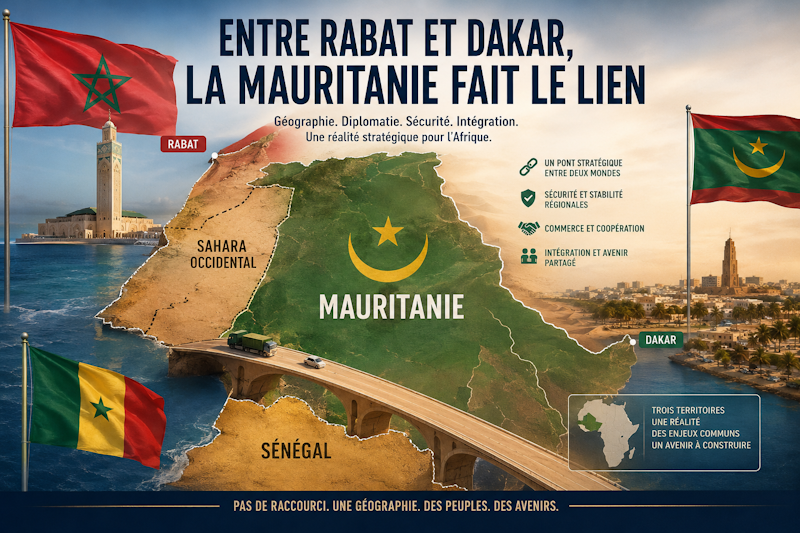

When examining the intricate web of relations between Morocco and Senegal, it’s impossible to overlook the critical role played by Mauritania, as highlighted by Mauritanian journalist Ahmed Ould Bettar.
Mauritania serves as more than just a geographical landmass between these two nations—it acts as a linchpin connecting the Maghreb and West Africa. Yet, this essential element is often sidelined in discussions, leading to oversimplified narratives of the region’s dynamics.
Geography that demands recognition
The vast expanse of the Western Sahara, a territory embroiled in international dispute, lies between Morocco and Senegal. However, the Islamic Republic of Mauritania stands as a sovereign nation in its own right, bridging these two distinct regions. Its significance extends beyond mere geography—Mauritania is a fully recognized state, a key diplomatic player, and a strategic partner in security, trade, and regional integration.
To dismiss Mauritania as a mere transit zone or an afterthought is to ignore the tangible realities of its existence. The country’s contributions to stability and development in the Sahel cannot be understated, nor can its role in fostering dialogue between North Africa and Sub-Saharan Africa.
The dangers of oversimplification in geopolitics
Words carry weight, especially when they come from figures expected to possess deep knowledge of African geopolitics. Reducing the relationship between Morocco, Mauritania, and Senegal to simplistic shortcuts undermines the complexity of the region. Borders are not just lines on a map—they represent sovereign territories, histories, and shared challenges.
While shortcuts may have a place in storytelling, they have no place in geopolitical analysis. The Western Sahara dispute, Mauritania‘s neutrality, and Senegal‘s strategic alliances all contribute to a delicate balance that requires careful consideration. Ignoring these nuances risks misrepresenting the true nature of relations in the region.
Mauritania: the unspoken pillar of regional stability
Mauritania is not a passive observer in this geopolitical landscape. As a nation with deep historical ties to both North Africa and West Africa, it plays a pivotal role in mediating conflicts, facilitating trade, and promoting regional cooperation. Its diplomatic efforts have often been instrumental in de-escalating tensions and fostering collaboration among neighboring states.
The country’s strategic location makes it a natural hub for economic and security initiatives, from counterterrorism efforts to infrastructure development. Yet, its contributions are frequently overlooked in favor of more visible players. This oversight not only distorts the region’s narrative but also risks sidelining a key ally in the fight for stability and prosperity.
In the end, geopolitics is not a game of shortcuts. It demands precision, respect for sovereignty, and an acknowledgment of the roles that each nation plays. Mauritania may lie in the shadows of more prominent headlines, but its influence is undeniable—a fact that cannot be ignored without consequence.

More Stories
Mali’s war of narratives: how a once-neutral news site became a megaphone for official military spin
Senegal’s palm oil revival: how Jakarta’s expertise could end a decade of stagnation
Behind the scenes: how Gabon is reshaping EU fishing talks for stronger sovereignty