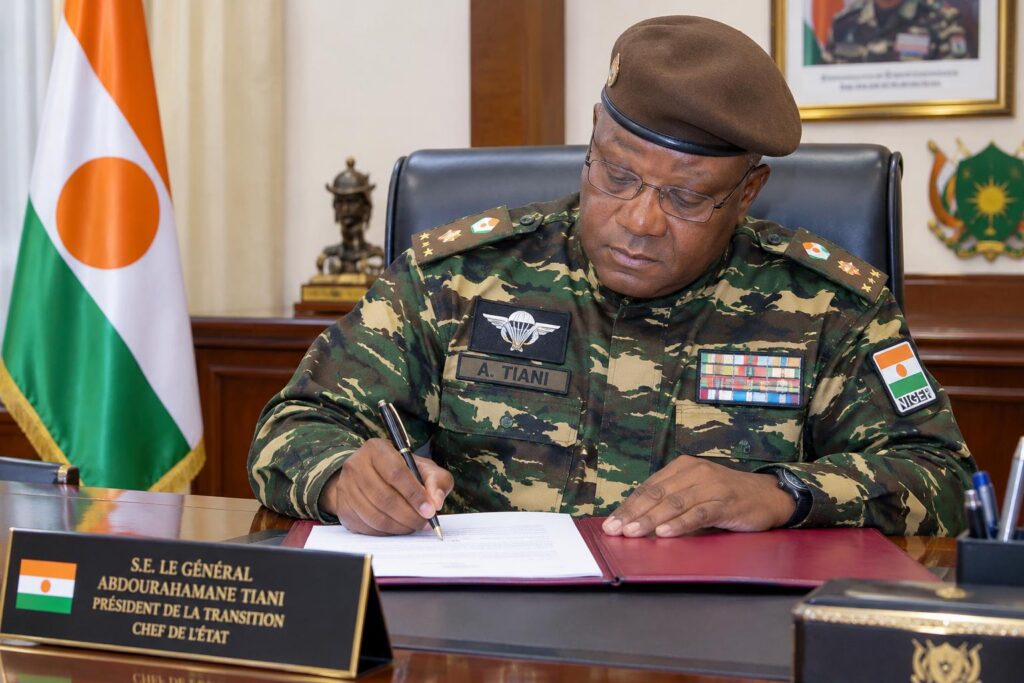
In Niger, citizenship is no longer an immutable right—it’s a revocable privilege, subject to the whims of those in power. Since the National Council for the Safeguarding of the Homeland (CNSP) seized control in a July 2023 coup, the crackdown on dissent has escalated to unprecedented levels. General Abdourahamane Tiani’s regime has moved beyond silencing critics through imprisonment or exile; it now erases them entirely from the legal fabric of the nation. By weaponizing denationalization, the military junta in Niamey has institutionalized a dangerous doctrine where political disagreement is tantamount to high treason.
From repression to legal erasure: the anatomy of a systematic purge
August 2024 marked a turning point in the junta’s repression strategy with the introduction of a sweeping ordinance: the creation of a « National Register of Individuals Involved in Terrorist Acts or Threats to State Security. » Ostensibly framed as a counterterrorism measure, this legal tool grants the regime sweeping powers to target politicians, civil society leaders, and even high-ranking military officers.
The most contentious provision of this framework allows for the provisional or permanent revocation of Nigerian citizenship for anyone accused of « activities likely to disrupt peace and security, » « regionalist or xenophobic speech, » or « collusion with a foreign power. » These deliberately vague criteria transform even peaceful protest or critical commentary into grounds for national repudiation. In practice, the regime’s definition of « security threats » serves as a blank check to strip citizenship from perceived enemies of the state.
Who bears the brunt of the regime’s citizenship revocations?
The junta’s blacklist grows with each new presidential decree, systematically targeting figures linked to former President Mohamed Bazoum, opposition leaders, journalists, and former military officials. Among those stripped of their nationality are:
- Ouhoumoudou Mahamadou – Former Prime Minister accused of « intelligence-sharing with a foreign power. »
- Hassoumi Massoudou – Ex-Minister of Foreign Affairs charged with « conspiring against national security. »
- Rhissa Ag Boula – Former Minister of State and leader of the Front for the Liberation of Azawad (FRR), accused of « inciting armed rebellion. »
- Alkache Alhada – Former Minister of Interior and Commerce, targeted for « disseminating information detrimental to public order. »
- Amadou Barou Chekaraou – Former government official labeled an « instigator of violence against the state. »
- Mariama Djibrine (Mayra) – Prominent media activist charged with « disturbing state security. »
These denationalizations aren’t just political theater—they strip victims of fundamental rights: access to banking, travel documents, and even basic identification. Men and women who have spent decades contributing to Niger’s development now find themselves erased from the country they call home, reduced to statelessness by an executive stroke of a pen.
The hollow rhetoric of patriotism: why the regime fears its own people
The CNSP’s narrative rests on a deliberate conflation of the nation with its military leadership. In the regime’s logic, opposing General Tiani is tantamount to betraying Niger itself. This populist rhetoric masks a stark reality: the junta’s grip on power is far from secure, and its legitimacy remains untested beyond the barrels of its guns.
By equating citizenship with loyalty to the regime, the junta undermines its own claims of sovereignty. A government confident in its popular mandate would not need to manufacture « patriots » by coercion nor punish dissent with statelessness. Instead, this purge exposes a profound insecurity—a fear of open debate, of pluralism, and of the very citizens whose welfare the regime claims to uphold.
A breach of international law with far-reaching consequences
On the global stage, the junta’s denationalization campaign violates core principles of international law. The Universal Declaration of Human Rights enshrines the right to nationality under Article 15, stating that « no one shall be arbitrarily deprived of their nationality. » Yet the Tiani regime’s actions—retroactive, extrajudicial, and devoid of fair trial guarantees—fly in the face of these protections.
Legal experts and human rights organizations warn that the junta is setting a dangerous precedent: one where citizenship becomes a bargaining chip for authoritarian loyalty. If belonging to a nation depends solely on the whims of a military leader, the very foundation of civic identity crumbles. The implications extend beyond Niger’s borders, signaling a retreat from the shared values that underpin regional stability.
The paradox of autocracy: repression that fuels resistance
History offers a clear lesson: regimes that rely on revoking rights to suppress dissent ultimately erode their own legitimacy. By transforming nationality into a political tool, General Tiani’s government has exposed its fragility. The more it seeks to control identity, the more it stokes resentment and pushes opposition underground—toward clandestine movements or even armed resistance.
The junta’s gamble is a high-risk one. A national identity forged in decrees and forced loyalty cannot endure; it will always be undermined by the enduring truth that citizenship is not a privilege bestowed by generals, but a birthright of the people. The tide of history suggests that no army, however well-armed, can sustain a nation built on exclusion.



More Stories
Behind the scenes: how Benin and Spain leveraged art to redefine their global alliance
Niger’s junta under siege: how the 29 August coup attempt reshaped power dynamics
Niger’s 1.8 billion FCFA monthly fund: the silent power play reshaping the junta’s rule