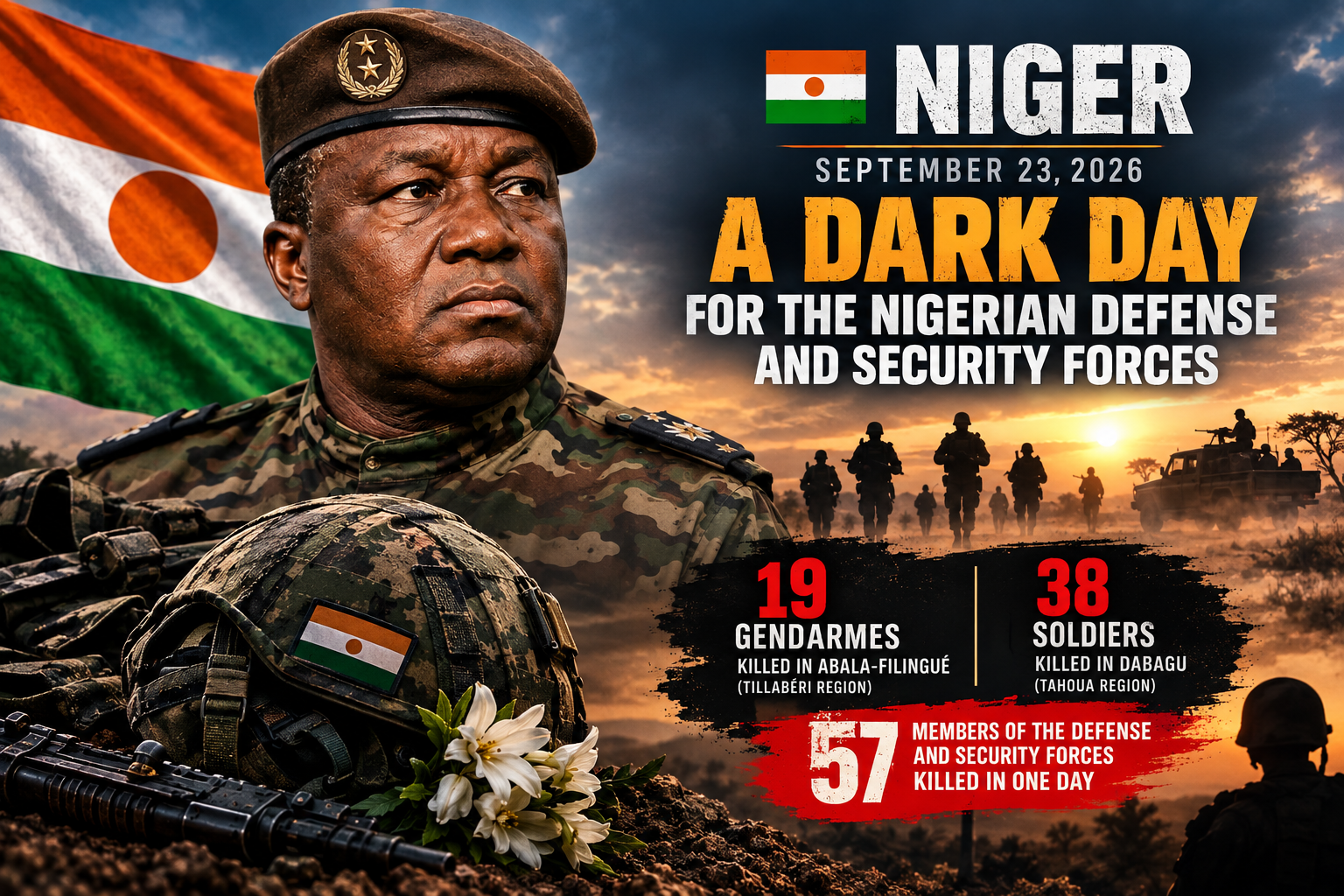
The events of September 23, 2026, marked a pivotal and devastating moment in Niger’s ongoing security struggles. Within hours, two coordinated assaults left deep scars on the nation’s defense forces, exposing critical vulnerabilities in the country’s counter-insurgency strategy.
Unprecedented losses in a single day
In the early hours of September 23, Niger’s armed forces faced simultaneous attacks that would result in the highest single-day death toll among security personnel in recent history. According to multiple field reports, at least 19 gendarmes were killed in an ambush near the border region between Abala and Filingué in Tillabéri. Hours later, a military outpost in Dabagu, Konni department within the Tahoua region, came under heavy assault, leaving at least 38 soldiers dead. Additional casualties, including missing personnel, were reported in both incidents.
While official confirmation from Nigerien defense authorities is still pending, preliminary estimates place the death toll at 57 members of the defense and security forces within a single 24-hour period. This staggering figure raises serious concerns about the operational effectiveness of Niger’s security apparatus, particularly as it struggles to protect its own personnel against increasingly sophisticated armed groups.
Behind the numbers: the operational realities on the ground
Investigations into the Abala-Filingué incident reveal that gendarmes were ambushed while intercepting a stolen cattle convoy. The attackers, believed to be affiliated with local militant factions, employed high-mobility tactics using motorcycles to encircle and overwhelm the security detail. The sheer speed and coordination of the assault left little time for reinforcements to arrive, despite the deployment of Nigerien troops in the area.
The Dabagu attack followed a similar pattern. Assailants targeted a remote military base, exploiting gaps in perimeter security and communication networks. Initial assessments indicate that delayed response times and inadequate aerial surveillance played a decisive role in the high casualty count. The attackers’ ability to strike swiftly and retreat before reinforcements could engage underscores systemic weaknesses in intelligence gathering and rapid deployment capabilities.
The strategic paradox: promises vs. performance
Since the National Council for the Safeguard of the Homeland (CNSP) assumed power in July 2023, Niger’s leadership has consistently framed security as a top national priority. The regime of General Abdourahamane Tiani has repeatedly emphasized efforts to bolster military capabilities, including increased troop deployments, improved equipment, and enhanced training programs. Yet, the events of September 23 challenge the narrative of progress being made on the ground.
The repeated successes of armed groups in targeting Nigerien forces raise fundamental questions about the implementation and efficacy of these initiatives. Despite substantial investments in defense infrastructure and personnel, certain regions particularly Tillabéri remain hotspots of insurgent activity. The inability to safeguard military personnel in these areas suggests that strategic decisions may be outpaced by the evolving tactics of militant organizations.
Political accountability in the face of tragedy
The staggering losses incurred on September 23 demand more than just tactical reassessment; they necessitate a broader examination of political accountability. The Tiani administration has framed its approach to security through a combination of military strength and national resilience. However, the human cost of these coordinated attacks places the regime under scrutiny to deliver tangible results beyond rhetoric.
Families across Niger are now grappling with the sudden loss of fathers, sons, and brothers who served in the defense forces. Each of the 57 fallen personnel represented not only a life lost but also a critical node in the nation’s security framework. Their absence leaves gaps that are not easily filled, particularly in regions where trust in state institutions remains fragile.
Looking ahead: lessons from a devastating day
As Niger grapples with the aftermath of September 23, the path forward requires a multifaceted response. Strengthening intelligence networks, improving early warning systems, and ensuring rapid mobilization of forces must become priorities. Additionally, a transparent review of operational strategies particularly in high-risk zones like Tillabéri and Tahoua is essential to prevent future catastrophes.
The events of that day serve as a stark reminder that military strength alone cannot guarantee security. Without addressing the root causes of insurgency, including local grievances, porous borders, and limited state presence in remote areas, Niger will continue to face the specter of coordinated attacks that claim the lives of its defenders.
For a nation already burdened by multiple security crises, September 23 demands not just mourning, but a fundamental reevaluation of how security is conceived, implemented, and sustained.
By Yacouba Boukari — Analyst