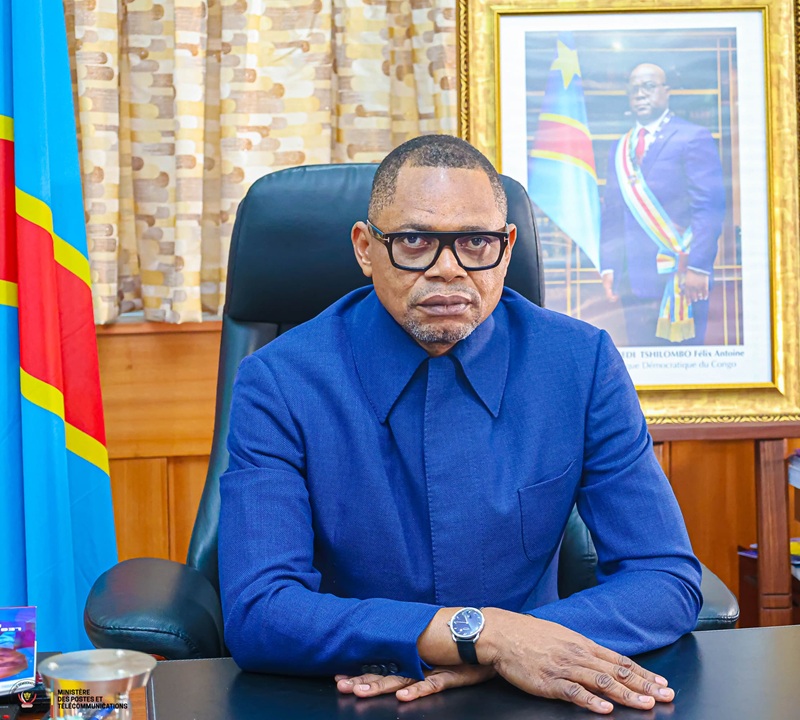
One year of Suminwa II: José Mpanda’s telecom milestones in the Democratic Republic of Congo


Me José Mpanda Kabangu marked his first year at the helm of the Democratic Republic of Congo’s Ministry of Posts, Telecommunications and Digital Technologies on August 12, 2026. Appointed through a presidential decree on August 8, 2025, he inherited a sector grappling with isolation from international institutions and administrative inefficiencies.
Upon taking office, Me José Mpanda immediately identified critical challenges: reinstating the DRC’s voting rights in global telecom bodies, enhancing working conditions for civil servants, and fostering a business-friendly environment for telecom operators to improve service delivery. His first major achievement came within weeks—restoring the DRC’s right to speak and vote in the Universal Postal Union (UPU), a privilege lost over three decades ago due to unpaid dues. His advocacy with the presidency and government secured prompt clearance of these arrears.
His second landmark accomplishment was even more significant. In October 2025, he spearheaded efforts to repatriate the African Telecommunications Union (ATU) headquarters from Nairobi, Kenya, back to Kinshasa, where it had been relocated following the 1992 looting incidents. This decision was formally validated during the 7th ATU Plenipotentiary Conference in Abuja, Nigeria, on July 23, 2026. The newly elected ATU Secretary-General, Mr. Kezias Kazuba Mwale of Zambia, will assume office in Kinshasa in January 2027.
The ATU, the only African Union institution currently based in the DRC, now occupies temporary offices along Boulevard du 30 Juin, near Ecobank, pending the construction of its permanent headquarters—a project funded by the Ministry of Posts, Telecommunications and Digital Technologies. This repatriation marks a historic milestone, as no previous minister had succeeded in bringing the ATU back to Kinshasa despite 17 predecessors attempting the feat over 34 years. Me José Mpanda settled over $1.4 million in arrears and penalties to make this possible, securing the DRC’s automatic seat on the ATU’s Administrative Council.
Looking ahead, Me José Mpanda is set to strengthen the DRC’s global standing further by securing a seat on the International Telecommunication Union (ITU) Administrative Council for the 2027–2030 term. He will formally submit the DRC’s candidacy in November 2026 during the ITU Plenipotentiary Conference in Doha, Qatar. The ITU, a UN specialized agency, shapes global telecom policies, sets frequency spectrum standards, and oversees international connectivity, digital infrastructure, and satellite communications.
Me José Mpanda’s ambitions align with President Félix-Antoine Tshisekedi’s vision of transforming the DRC into a digitally connected hub by 2030. Securing a seat on the ITU Council would unlock strategic advantages, including access to approximately $1.5 billion in funding earmarked for 2026–2030 to develop critical telecom infrastructures such as the national fiber-optic backbone, rural connectivity expansion, data centers, satellite systems, and high-speed broadband networks.
On the domestic front, he has revitalized the Ministry of Posts, Telecommunications and Digital Technologies. Within 144 days of assuming office, he equipped the General Secretariat with ten brand-new vehicles, including three large buses for staff and jeeps for senior officials—a first in the ministry’s history. Civil servants, many with over 30 years of service, praised this initiative during the handover ceremony.
Me José Mpanda also implemented administrative reforms, including revised pay scales, rehabilitation of ministry buildings, and a new organizational structure. Merit-based promotions were granted to staff, recognizing both seniority and performance. To address legal uncertainties faced by telecom operators, he converted the licenses of major providers—Airtel, Vodacom, Orange, and Africell—into more secure titles, resolving long-standing grievances.
Addressing inclusivity in the telecom sector, he reduced by half—with retroactive effect—the decade-long moratorium that had exempted operators from complying with the 25% Congolese ownership requirement under the Telecommunications Act. Additionally, he halved the 5% employee shareholding requirement, ensuring broader participation in telecom ventures.
Guided by recommendations from the National Postal and Telecommunications Stakeholders’ Conference held in April 2026, Me José Mpanda outlined a robust roadmap to bridge the digital divide. Key targets include laying 54,000 kilometers of fiber-optic cables and erecting 30,000 towers or antennas to connect all 145 territories, modernize the postal service, and accelerate digital transformation by 2030. The Digital Transformation Program, backed by the World Bank and Agence Française de Développement, is already funding 10,000 kilometers of fiber-optic infrastructure. Meanwhile, the Universal Service Development Fund (FDSU) is financing tower construction using its own resources, with the Kimbanguist Holy City in Kongo Central selected as a pilot zone for the initial phase of 3,000 towers.
On August 8, 2026, the FDSU signed agreements with the four major mobile operators, each receiving funds to construct at least ten antennas in peri-urban and rural areas. Strengthening this infrastructure requires a sovereign satellite. Negotiations with China Unicom are underway to develop a dedicated DRC satellite.
With President Félix-Antoine Tshisekedi’s leadership, Me José Mpanda remains confident in achieving a fully digitalized DRC by 2030, positioning the country as a technological hub in Central Africa.
Related Posts

Burkina Faso : les premiers effets de la rupture diplomatique avec la France sur les citoyens
La décision de mettre fin aux relations diplomatiques entre le Burkina Faso et la France commence à avoir des répercussions tangibles, non seulement sur les […]
World cup 2026: why a draw suits Algeria and austria at the group stage
Under the hybrid format of the 2026 world cup, featuring 48 teams with 32 advancing to the round of 16, a draw is often the […]
Wilfried léandre houngbédji’s parting call: uphold Bénin’s honor
As Bénin prepares for a significant transition in its recent political history, Wilfried Léandre Houngbédji, the Deputy Secretary-General and government spokesperson, has addressed the impending […]