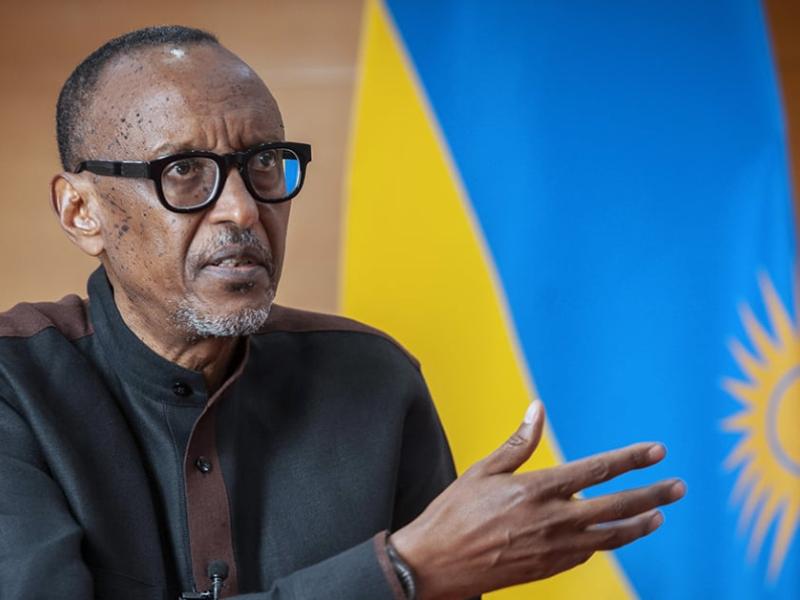
The political temperature in the Grands Lacs region remains volatile as President Paul Kagame of Rwanda delivered a resolute address to the Front Patriotique Rwandais (FPR) Political Bureau on Friday, July 17, 2026. His words carried an unmistakable message: any attempt to dismantle the M23 rebel group would be interpreted as an existential threat to Rwanda itself.
Kagame’s unyielding stance on Rwanda’s security
Addressing the nation’s top political leadership, President Kagame forcefully rejected what he described as efforts to silence Rwanda on regional security concerns. He framed these attempts as tantamount to advocating for the country’s destruction, stating in no uncertain terms that the only way to “silence” him would be through his death.
His remarks came in response to growing international pressure, including sanctions imposed on Rwandan officials and entities by the United States. Kagame dismissed these measures as misguided, emphasizing that Rwanda’s sovereignty cannot be compromised.
« The only way to silence me is when I am dead. That’s how difficult it is. If they want to silence us, they should be prepared to support those who come to kill us, just as they have done before. And we will handle it our way. »
He further underscored his commitment to equality, rejecting any notion that some lives are more valuable than others—a principle he tied directly to the FPR’s founding values.
« It is not in our policy, nor in the policy of the FPR, to believe that some lives are worth more than others. We are a small country. In many ways, insignificant. They can harm us, but wishing our disappearance is no small matter. »
M23 and the shadow over regional stability
Central to Kagame’s speech was the situation in the Democratic Republic of the Congo (DRC), where the M23 continues to control large swaths of the North Kivu and South Kivu provinces. The rebel group, accused by the United Nations and Western governments of receiving support from Rwanda—a claim Kigali has consistently denied—remains a flashpoint in the Grands Lacs crisis.
Kagame warned that declarations calling for the elimination of the M23 are not just aimed at the group but at Rwanda as a whole.
« When they say they will make the M23 disappear, they mean Rwanda will disappear too. I cannot wish for that. I cannot desire such a thing. But if it happens—and I cannot prevent it—I believe they will find us ready. »
A region at a crossroads
The president’s statements followed a week of diplomatic activity, including the Washington Agreement and ongoing Doha Process talks mediated by Qatar. Despite these efforts, the security and humanitarian situation in eastern DRC continues to deteriorate. The Montreux talks in Switzerland, intended to inject fresh momentum into the peace process, failed to yield significant breakthroughs. Meanwhile, the Middle East crisis has diverted global attention away from central Africa, further complicating mediation efforts.
Calls for compliance with peace agreements have grown louder across national, regional, and international platforms. Yet, tangible progress remains elusive as conflicting interpretations of these accords persist, deepening the divide between diplomatic commitments and ground realities.
As Rwanda stands firm in its position, the Grands Lacs region remains on edge, with the fate of the M23 and the broader stability of the area hanging in the balance.