
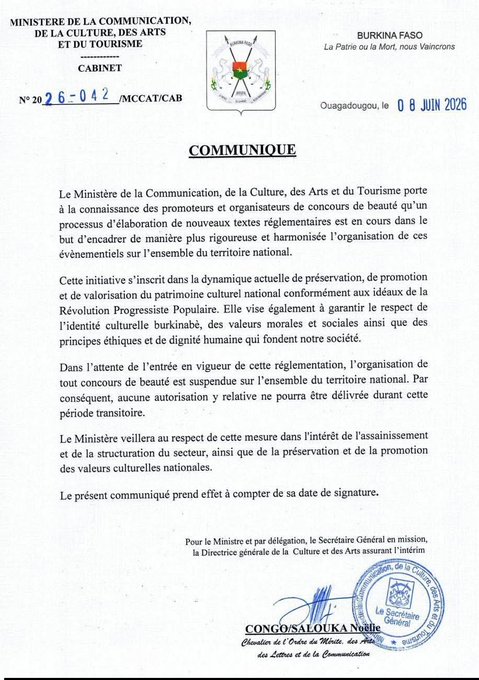
A recent administrative decree has sent shockwaves through the cultural landscape of Burkina Faso, as the government announced an indefinite suspension of all beauty pageants across the national territory. While the authorities justify this prohibition as a measure to safeguard traditional values and respect the gravity of the country’s ongoing security crisis, an analysis of the decision suggests a more concerning trend toward authoritarian governance.
Political diversion in a time of crisis
In a nation currently struggling with profound security threats and a persistent humanitarian emergency, the timing and focus of this ban are particularly noteworthy. The decision to target the cultural sector, specifically beauty competitions, raises questions about the administration’s priorities when the restoration of territorial integrity remains the most pressing challenge.
Observers within the region interpret this state interference in cultural entertainment as a calculated political maneuver designed to create a diversion. By shifting the national conversation toward matters of morality and social conduct, the transitional leadership may be attempting to redirect public scrutiny away from unfulfilled commitments regarding national stabilization and the restoration of constitutional order.
State puritanism as a mechanism of oversight
The prohibition of beauty contests is not an isolated event; rather, it represents a systematic expansion of state influence into the private lives and individual freedoms of citizens. Under the guise of “moral realignment,” the current regime is establishing the foundations of a rigid social order.
Human rights advocates have expressed deep concern over this trajectory, questioning what might be targeted next. The fear is that if a beauty pageant can be banned in the name of values today, tomorrow may bring restrictions on attire, artistic creation, or even freedom of thought. This inclination to regulate bodies, leisure activities, and cultural expressions is a hallmark of autocratic systems. The strategy is subtle, utilizing restrictive decrees to infantilize the population by dictating what is deemed worthy of public celebration.
The erosion of democratic space
The current situation in Burkina Faso signifies much more than the cancellation of fashion events; it reflects a continuous narrowing of the civic and democratic arena. Following the suspension of political organizations, the silencing of independent press outlets, and the detention of critical voices, the authorities have now turned their attention toward the cultural industries.
A regime of this nature is characterized by its ability to permeate every aspect of life, normalizing arbitrary rule and elevating puritanism to a state doctrine. By stripping the youth and cultural practitioners of their platforms for expression, the transitional government is sending an unambiguous message: total ideological conformity is required, and even aesthetic or symbolic dissent will no longer be permitted.
Beneath the rhetoric of sovereignty and moral duty, Burkina Faso is drifting toward a social monolith where the state assumes the power to decide all matters for all people. This progression, despite its protective framing, bears the clear hallmarks of rising authoritarianism.


More Stories
Mamadi Doumbouya de retour à Conakry après sa visite d’État en Côte d’Ivoire
Elversberg vs Bayern Munich: where to watch the Bundesliga clash
Mali: près de 80 soldats tués dans l’attaque de Dioura