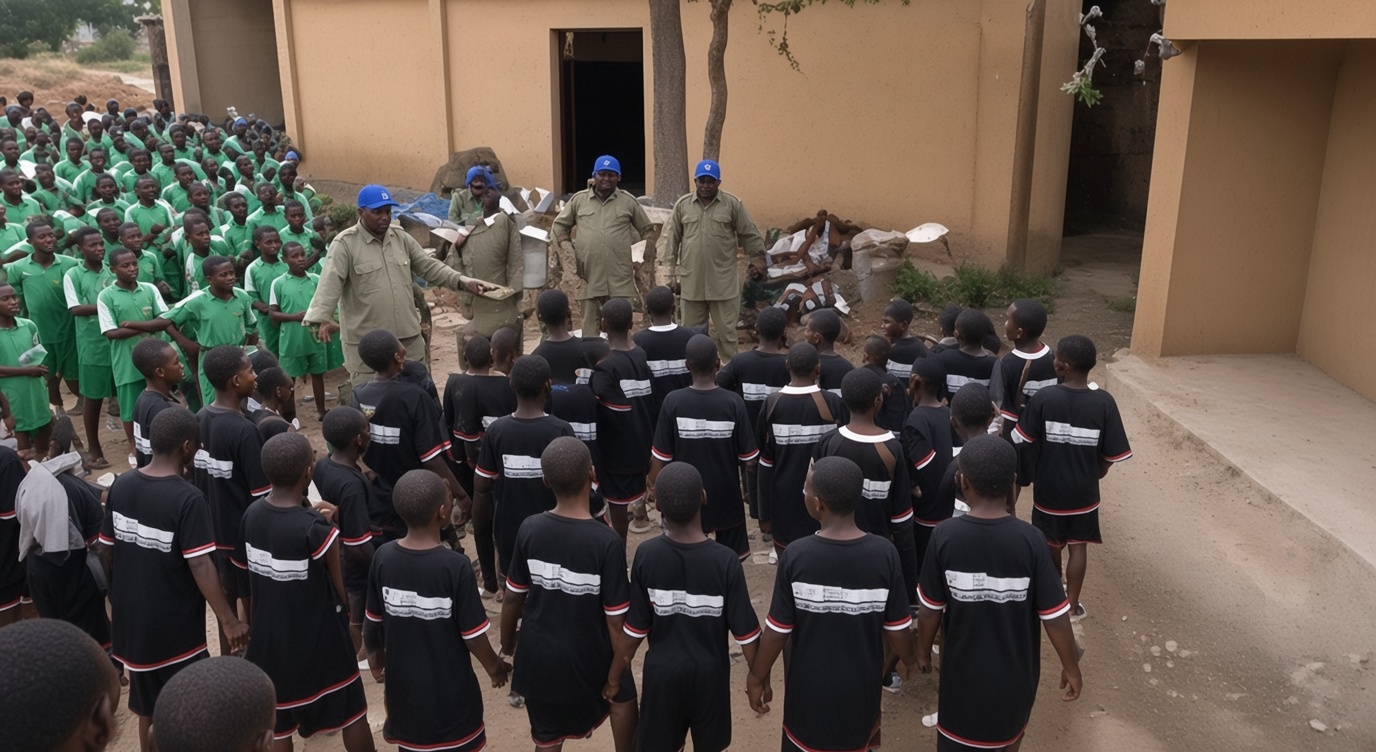
General Abdourahamane Tiani has inaugurated a new training camp, bringing together more than 300 young Nigériens. While presented as a commendable initiative focused on civic engagement, national resurgence, and societal refoundation, and overtly drawing inspiration from the Burkinabè model championed by Captain Ibrahim Traoré, a closer examination reveals potentially troubling implications. Beneath the meticulously crafted communication and the exaltation of ‘committed youth,’ the reality suggests that the military regime may be laying the groundwork for premature militarism, veiled under the guise of patriotism.
The inappropriateness of militarizing youth
Children and adolescents fundamentally do not belong in militarized or pre-militarized environments. At this critical stage of development, the emphasis should unequivocally be on education, vocational training, sports, cultural enrichment, and the foundational learning of citizenship. Shaping minds still in formation around concepts of military discipline, unquestioning obedience, and perpetual mobilization risks gradually normalizing the use of arms and confrontational ideologies.
The political implications of youth mobilization
The inherent danger extends beyond the mere nature of the camp itself; it lies significantly in the political message being conveyed to an entire generation. When a military authority frames youth mobilization as an obligatory patriotic duty, there is a distinct risk of prioritizing unquestioning loyalty to the regime over the cultivation of critical thinking. Authentic civism, however, transcends blind obedience to power; it inherently demands the capacity to scrutinize, to engage in debate, and to advocate for the collective good.
Distinguishing civic instruction from indoctrination
The boundary between genuine civic instruction and outright indoctrination becomes particularly tenuous when young individuals are consistently exposed to rhetoric centered on combat, sacrifice, and the unwavering defense of the homeland. While a mobilized youth can certainly serve the nation effectively, they must never be reduced to a human reserve solely intended to perpetually sustain a military authority.
Prioritizing genuine development over ideological campaigns
This particular approach also prompts a fundamental inquiry: why allocate substantial resources to the ideological mobilization of youth when thousands of young Nigériens are primarily in need of functional educational institutions, accredited vocational training, employment opportunities, essential infrastructure, and concrete prospects for their future? Patriotism, in itself, does not provide sustenance for families, nor does it substitute for a diploma, or automatically generate employment.
The ‘compulsory civism’ narrative as a diversion
The rhetoric of ‘compulsory civism’ can thus serve as an exceptionally convenient political smokescreen. By projecting an image of disciplined, enthusiastic, and self-sacrificing youth, the governing power potentially diverts public attention from pressing economic hardships, systemic weaknesses within the educational sector, pervasive youth unemployment, and the broader social ramifications of political instability.
Long-term societal normalization of militarization
It is also imperative to consider the long-term sustainability of such a strategy. A generation raised within a culture of perpetual mobilization risks internalizing and normalizing the militarization of society. What is currently presented as an exceptional initiative could, in time, become an institutionalized model for the political and paramilitary training of young people.
Reflecting on the Burkina Faso precedent
The comparison with Burkina Faso also warrants careful consideration. The proliferation of initiatives designed to mobilize young people around themes of patriotism and national defense should not lead Sahelian states into a competitive race to militarize their youth. While the security context is undeniably challenging, the comprehensive response to insecurity cannot logically involve the gradual transformation of an entire generation into potential combatants.
Empowering Niger’s youth for true national progress
The youth of Niger deserve far more than to be mere instruments in the communication strategy of a governing power. They merit access to quality education, the acquisition of valuable skills, meaningful employment, the fundamental freedom of thought, and the genuine opportunity to participate in public life without being conditioned by adherence to a specific political or military doctrine.
The enthusiasm of youth should therefore never be exploited as a moral shield to conceal governance deficiencies. A truly robust state is not one that instructs its children at the earliest possible age to obey and to fight. Rather, it is one that furnishes them with ample knowledge, fundamental freedoms, and diverse opportunities to independently construct the nation’s future.
Defining authentic patriotism and national service
Genuine patriotism involves preparing citizens who are capable of building, innovating, critical thinking, and defending their country when legally required, rather than prematurely shaping minds accustomed to military logic. Niger must remain vigilant to ensure that the imperative to combat insecurity does not inadvertently become a pretext for the enduring militarization of its children and youth.