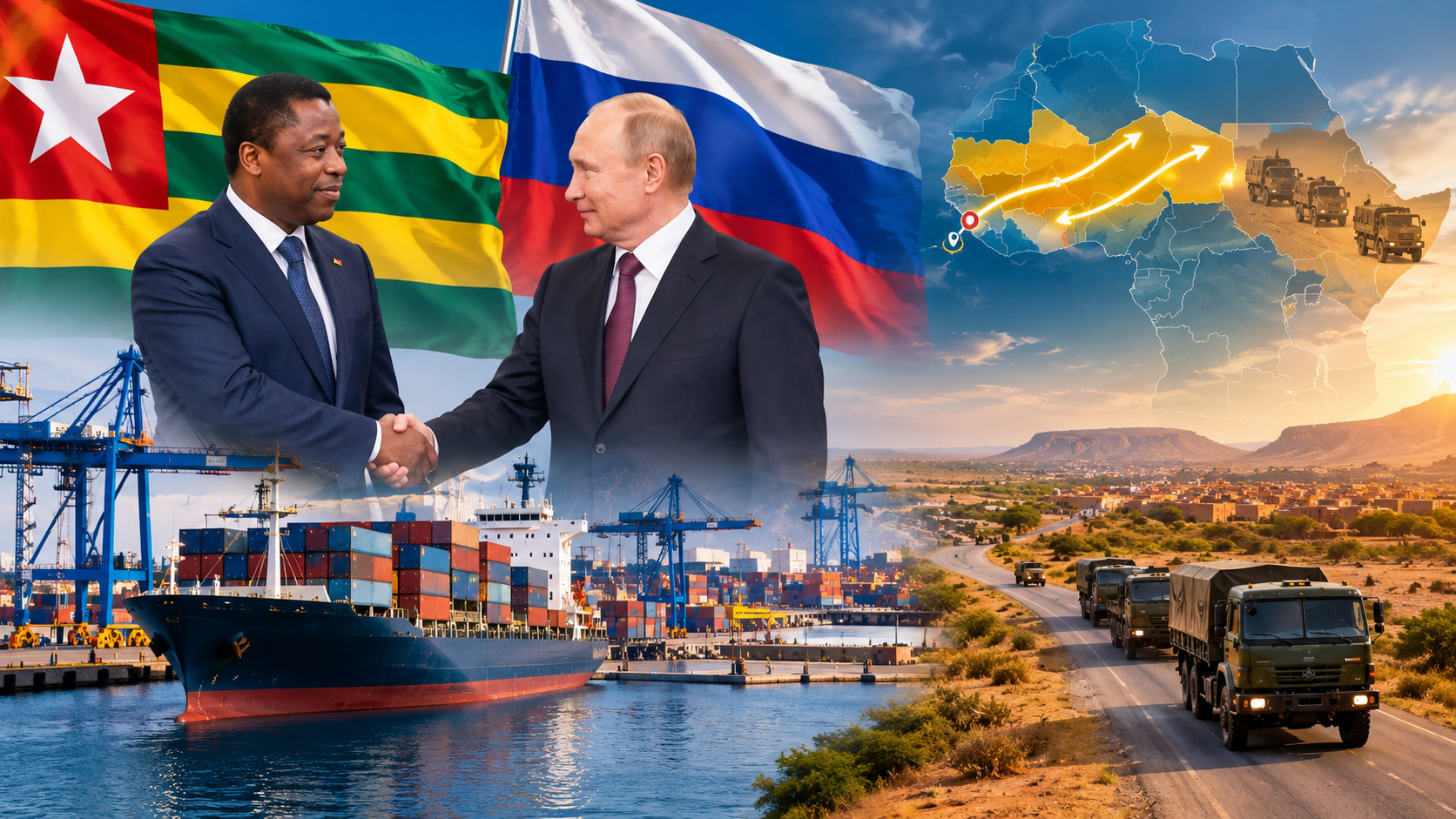
The deepening ties between Togo and Russia are gaining a new strategic dimension. At the heart of this shift is the proposed logistical corridor designed to facilitate the transport of Russian goods from the Port of Lomé to markets across West Africa and the Sahel. This initiative, presented by Russian Deputy Minister of Transport Alexei Chilo during the first session of the Togo-Russia intergovernmental commission (September 29–October 1, 2026), signals a broader realignment of regional trade and transport networks.
Togo’s strategic infrastructure under Moscow’s spotlight
A 29-member Russian delegation engaged in high-level discussions with Togolese officials and private sector representatives during the commission meeting. The agenda focused on maritime transit efficiency, cost optimization, infrastructure development, and strengthening bilateral trade ties. Delegates also toured key Togolese facilities, including the Port of Lomé, Gnassingbé Eyadéma International Airport, and the Adétikopé Industrial Platform (PIA).
While officially framed as a commercial venture, the project’s timing and geopolitical context suggest objectives that extend far beyond standard trade facilitation. The port’s growing role in facilitating Russian logistics to the Sahel has already been demonstrated this year, raising questions about its long-term strategic function.
From commercial transit to military logistics
The Russian cargo ship Mikhail Britnev made a controversial stop at the Port of Lomé on July 9, 2026. The vessel, sanctioned by the United States since 2024, was later linked to a military convoy observed in Bamako, Mali, days later. Satellite imagery and maritime tracking data suggest the ship transported armored personnel carriers and trucks destined for the Africa Corps, which were then transported via Togo and Burkina Faso toward Mali.
This precedent underscores the port’s dual-use potential capable of handling both civilian and strategic cargo. While the new corridor is not explicitly tied to military shipments, the Mikhail Britnev incident reveals that Lomé is already integrated into Russian logistical networks heading toward the Sahel.
Expanding Russian influence beyond diplomacy
The Togo-Russia relationship has evolved from political engagement to practical collaboration since Togolese President Faure Gnassingbé’s November 2025 meeting with Vladimir Putin in Moscow. Discussions then centered on economic, energy, and security cooperation, with a focus on stabilizing Sahel supply routes. The October 2026 commission reflects this shift, prioritizing infrastructure, transportation, and industrial projects over traditional diplomacy.
Togo’s role in this strategy is increasingly pivotal. The country’s geographic position, modern port facilities, and inland road connections make it an attractive hub for Russian goods en route to landlocked Sahelian markets. The Adétikopé Industrial Platform, visited by the Russian delegation, further enhances Lomé’s appeal by offering storage, processing, and redistribution capabilities transforming the port into a full-scale logistics center rather than a mere transit point.
Economic ambition or geopolitical leverage?
The corridor’s dual civilian-military potential complicates its assessment. While Russian officials emphasize trade diversification, the Mikhail Britnev case demonstrates that Lomé can support strategic supply chains. This ambiguity raises critical questions: Is Moscow seeking only commercial opportunities, or is it quietly establishing a logistical foothold in West Africa?
The Togo-Russia partnership also introduces political considerations. With reports of Russian military personnel reportedly stationed in Togo, the collaboration could reshape regional power dynamics. The extent of Togolese alignment with Moscow’s Sahel strategy remains a key uncertainty as the corridor’s implementation timeline remains unspecified.
Redrawing Sahel supply chains
The closure of the Benin-Niger border has disrupted traditional trade routes, forcing Sahelian nations to seek alternative corridors. In this shifting landscape, the Port of Lomé offers a viable alternative for accessing West African and Saharan markets. Russia’s interest in the route suggests a deliberate effort to bypass traditional trade lanes dominated by Western-aligned ports.
If operationalized, the corridor could redefine regional logistics by providing a Russian-backed alternative for Sahelian supply chains. This would position Lomé as a gateway not just for goods but for geopolitical influence, with implications for both economic partnerships and security alignments across the Sahel.
What lies ahead for Lomé?
While no definitive timeline has been set for the corridor’s full implementation, the trajectory is clear: Togo is transitioning from a diplomatic partner to a logistical ally of Moscow. In a Sahel where alliances are rapidly evolving, Lomé’s port could become a linchpin in Russia’s African strategy bridging maritime routes, inland transport networks, and Sahelian demand.
The critical question now is whether Togo will leverage this role to reinforce its regional position, or whether it will become an unwitting node in a larger geopolitical chess game. One thing is certain: the Port of Lomé is no longer just a transit hub it is a strategic asset in flux.
By Yacouba Boukari — Journalist