ECOWAS Court delivers decisive moment for Togo’s controversial constitutional reform
The Economic Community of West African States (ECOWAS) has reignited pressure on Togo’s government, marking a pivotal turning point in the standoff over its 2024 constitutional reforms. In a sharply worded letter dated October 23, the ECOWAS Court of Justice stepped up its scrutiny by formally requesting details on the measures taken to comply with its January 2026 ruling—a decision that challenges the legitimacy of Togo’s parliamentary system and the concentration of power under President Faure Gnassingbé.
This latest intervention comes nearly nine months after the regional court declared that Togo violated democratic principles by transferring executive authority to a newly created position: Prime Minister of the Council of Ministers. While the court did not annul the 2024 Constitution, it called for future reforms to align with international commitments—a call that the Togolese government has yet to formally address.
The communication from the ECOWAS Court, addressed to the Minister of Justice, signals a critical juncture in which Togo must demonstrate whether it intends to uphold regional democratic standards or double down on a model of governance that has drawn sharp criticism from civil society and opposition groups alike.
From presidential power to parliamentary control: How the 2024 Constitution reshaped Togo
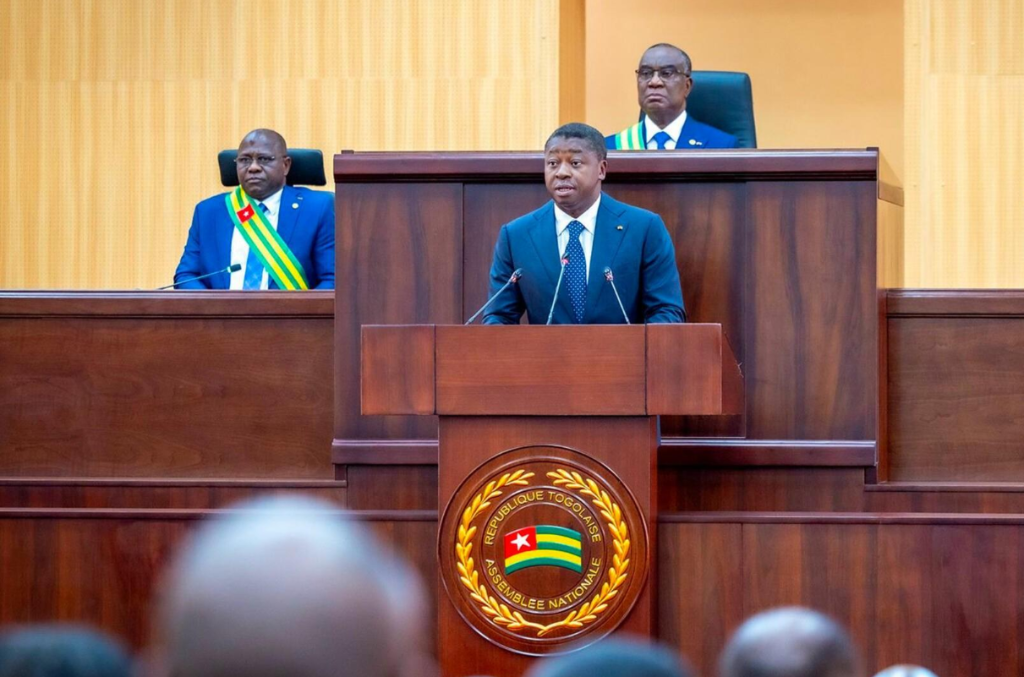
The constitutional overhaul approved by Togo’s National Assembly on March 25, 2024, represented a seismic shift in the country’s political architecture. Abolishing the presidential system, the reform replaced it with a parliamentary regime, stripping the presidency of many executive powers and transferring them to a newly established role: the Prime Minister of the Council of Ministers.
Yet the transition has done little to dilute perceptions of power centralization. Opposition figures and human rights advocates argue that the reform was a strategic maneuver to allow President Faure Gnassingbé—who has held office since 2005—to retain de facto control despite the change in governance structure. After nearly two decades in power, including the controversial 2020 amendment that paved the way for a fourth term, the new system enables him to guide the appointment of the prime minister through parliamentary majority, effectively perpetuating executive dominance.
The ECOWAS Court’s January 2026 ruling emphasized this concern. It found Togo in breach of Article 23 of the African Charter on Democracy, Elections, and Governance, citing failures to ensure transparency and democratic safeguards in institutional reforms. The court ordered the government to implement measures ensuring future constitutional changes respect international democratic norms—a directive that has now been formally reaffirmed through the October correspondence.
Lomé’s balancing act: Diplomacy with Sahel juntas raises new questions
Beyond the legal battle, Togo’s evolving foreign policy has added another layer of complexity to its democratic standing. Since early 2025, Lomé has deepened ties with the military-led governments of Mali, Burkina Faso, and Niger—nations that have suspended constitutional orders in the name of sovereignty and anti-Western rhetoric following recent coups.
In January 2025, Foreign Minister Robert Dussey publicly hinted at the possibility of Togo joining the Alliance of Sahel States (AES), a bloc formed by the three juntas. By April 2026, Lomé had unveiled a new cooperation strategy with Sahelian partners, emphasizing political dialogue, security collaboration, and economic integration. While officials cite regional stability as the rationale, the alignment with regimes that have systematically weakened checks and balances has fueled speculation about Togo’s long-term democratic trajectory.
Despite remaining a member of ECOWAS, Togo’s diplomatic drift toward the AES raises concerns. Both paths—Togolese governance and Sahelian military rule—share troubling similarities: entrenched executive power, erosion of independent institutions, and limited space for democratic alternation. Whether this convergence reflects a pragmatic regional strategy or a broader retreat from democratic accountability remains a pressing question.
What’s next for Togo? Accountability or further controversy
The ECOWAS Court’s renewed demand for accountability presents Faure Gnassingbé’s government with a clear choice. It must now respond not only with legal justifications but with concrete actions that address the court’s concerns about democratic backsliding. Failure to comply—or to offer meaningful explanations—could further erode Togo’s regional standing and intensify domestic political tensions.
Civil society groups, such as the Togolese Human Rights League, have long argued that the 2024 reforms were designed to preserve power rather than disperse it. The court’s insistence on compliance with democratic standards underscores a broader crisis across West Africa, where constitutional amendments and institutional restructuring are increasingly used to extend leaders’ tenures or consolidate authority.
As ECOWAS intensifies its oversight and regional dynamics shift under the influence of military-led states, Togo stands at a crossroads. Will it use this moment to reinforce democratic norms and rebuild trust with the international community? Or will it continue on a path that prioritizes political continuity over reform and accountability? The government’s response to the ECOWAS Court in the coming weeks could offer early clues.