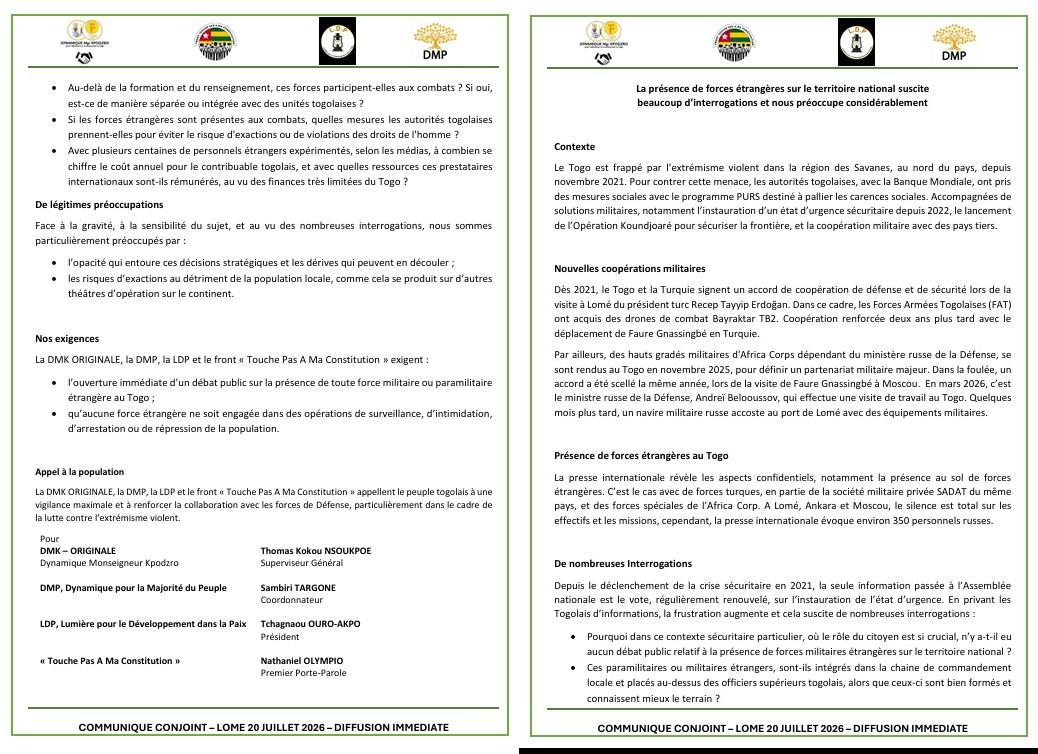
The presence of foreign military personnel in Togo has sparked debate about transparency and national sovereignty. While some level of confidentiality surrounds defense matters in any nation, persistent secrecy can erode public trust rather than strengthen it.
Unanswered questions about foreign military personnel
Observers and reports indicate that military personnel from Russia and Turkey may be operating within Togo’s borders. If confirmed, this development raises critical questions that demand clear responses from the government.
Security or political survival?
Beyond defense needs, the opacity surrounding these foreign forces has fueled speculation about their true purpose. Critics argue that the regime of President Faure Gnassingbé may be using these partnerships not to protect the nation but to ensure its own survival amid mounting socio-economic grievances and institutional constraints. The fear of popular uprisings or internal coups has intensified, and foreign military support is seen by some as a safeguard against such threats.
Lack of clarity on roles and responsibilities
The exact nature of these foreign personnel’s missions remains unclear. Are they trainers, advisors, or involved in more direct security operations? Do they participate in domestic policing, or is their role strictly limited to technical support? Without official explanations, public speculation fills the void, leaving many to wonder about the scope of these agreements.
The issue of legal and operational oversight is equally pressing. Most countries hosting foreign military personnel establish clear legal frameworks governing their activities. Has Togo implemented such measures? Are there mechanisms to prevent abuse and ensure compliance with national and international laws? These questions are essential to understanding the true nature of these partnerships.
The financial cost of secrecy
Transparency extends beyond operational details—it includes financial accountability. How many foreign personnel are stationed in Togo? What is the duration and cost of their deployment? Who bears the financial burden—Togo’s taxpayers, the partner countries, or a specific cooperation agreement? Citizens deserve clarity on these expenditures, especially when public funds are involved.
While military cooperation with foreign partners is not inherently problematic—especially in the face of regional threats like terrorism—such arrangements must be justified with transparency. The government’s silence only fuels mistrust, particularly when the timing coincides with domestic unrest and allegations of authoritarianism.
Why transparency matters
In a region plagued by political instability and shifting security alliances, public trust hinges on openness. Governments that clearly articulate the objectives, legal frameworks, and responsibilities of foreign military partnerships can mitigate rumors and speculation. This is not about undermining national security but about ensuring that such measures serve the public interest rather than political expediency.
For Togo, where governance challenges persist, the absence of answers only deepens concerns. A democracy cannot sustain itself on secrecy alone. If foreign military presence is about protecting the nation, the government must demonstrate how. If it is about preserving power, the public has every right to demand justification. In the end, transparency is not a luxury—it is the foundation of legitimacy.