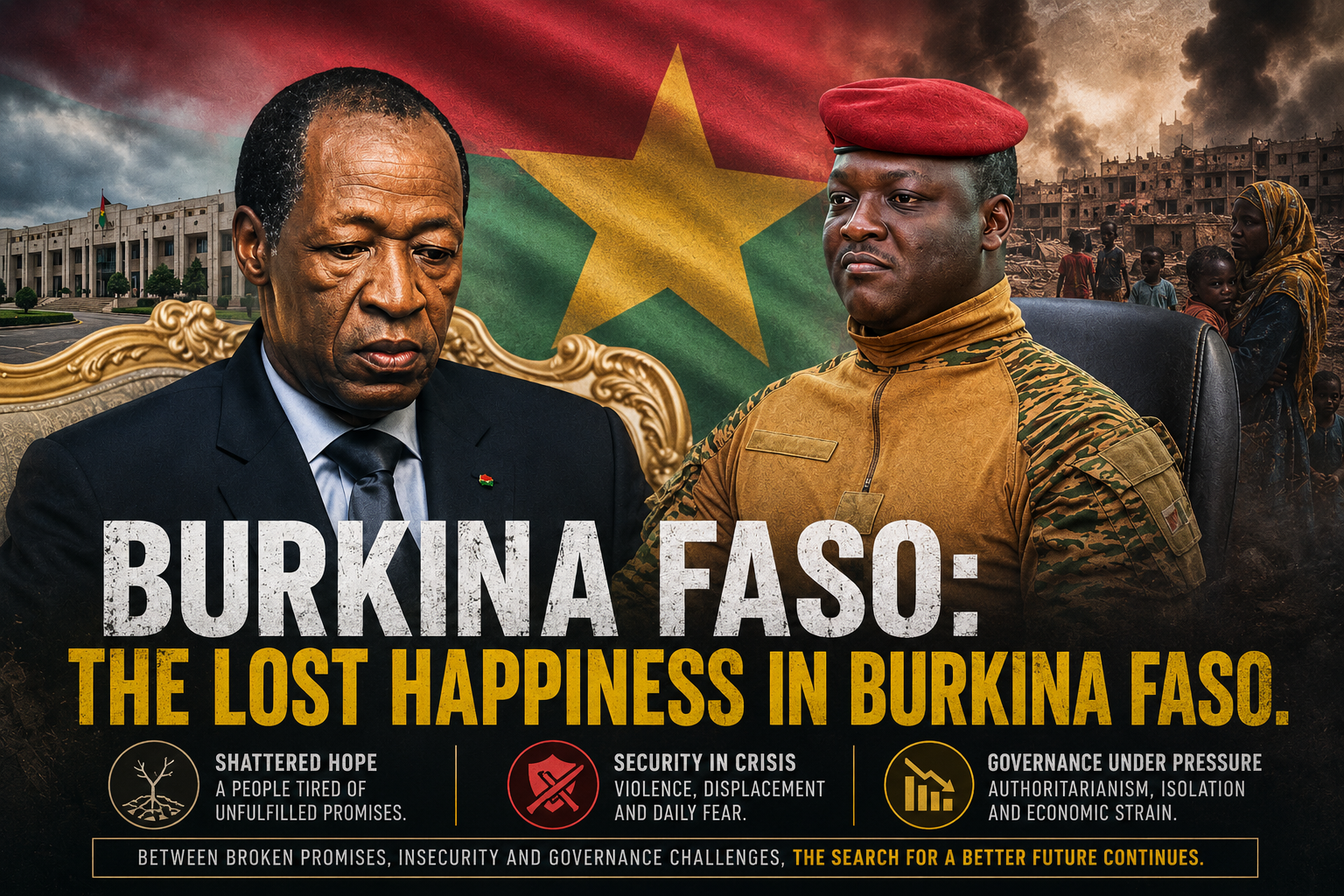
The Burkina Faso of yesterday was often praised for its stability rather than mired in conflict. While critics never ceased to challenge the governance of former President Blaise Compaoré—accusing him of monopolizing power, stifling political pluralism, and obstructing democratic transitions—his two-decade rule was undeniably marked by a level of security now long forgotten.
At that time, Burkinabè citizens moved freely between regions, farmers cultivated their land without fear, traders supplied markets without incident, and families traveled without dreading roadside ambushes or armed attacks. Terrorism, which would later engulf the Sahel, had not yet plunged the country into the deep security crisis it faces today.
This does not imply an endorsement of Compaoré’s regime or a dismissal of its shortcomings. Rather, it underscores a fundamental truth: the primary duty of any state is to protect its people. Without safety, political freedoms, reforms, and national ambitions lose much of their value and meaning.
From promises of change to persistent insecurity
When Captain Ibrahim Traoré assumed power through a military takeover, expectations ran high. The new leadership vowed to reclaim lost territory, strengthen national sovereignty, and deliver a decisive response to armed groups. Yet, nearly four years into his leadership, these promises continue to encounter harsh realities on the ground.
Official statements frequently highlight military operations and claimed victories, yet in many regions, violent attacks remain a daily threat. Entire communities remain cut off from essential services, and major roads remain perilous. For many citizens, the gap between announced successes and the ongoing hardship feels insurmountable.
A silent exodus speaks volumes
The most telling indicator of the current crisis may not be the frequency of attacks, but the growing number of Burkinabè who no longer feel safe in their own country. Each week, families abandon their homes, farms, and livelihoods—some to relocate within national borders, others to cross into neighboring countries. No people choose exile willingly when their homeland should provide the conditions for peace and dignity.
This silent flight represents the harshest judgment on the effectiveness of current security policies. When citizens prefer displacement or flight over staying in their villages, it signals a profound erosion of trust in the state’s ability to protect them.
Sovereignty beyond rhetoric
Captain Traoré’s leadership is framed around themes of national sovereignty, a break from former international partners, and patriotic mobilization. These messages resonate with a significant portion of the population. Yet sovereignty cannot be reduced to political slogans. It is measured by the government’s capacity to assert control across the entire territory and ensure the safety of all who live within its borders.
There is also a striking shift in public discourse. Many who once vocally criticized Compaoré’s governance now remain noticeably silent when evaluating Traoré’s performance. This asymmetry fuels perceptions of inconsistent standards—where some leaders face scrutiny while others are held to far lower account.
What does a nation’s happiness truly depend on?
Comparing the eras of Compaoré and Traoré is not about romanticizing the past or ignoring its flaws. It is about asking a simple but essential question: what is the highest priority of a state? For countless Burkinabè, the answer is clear. Before grand declarations of sovereignty or ideological posturing, a government is judged first by its ability to protect its people.
The true measure of a nation’s well-being lies not in political rhetoric or leadership popularity, but in the quiet stability of its villages, the safety of its roads, the functioning of its schools, the vibrancy of its markets, and the hope families hold for the future.
As long as Burkinabè continue to leave their homes and communities in search of safety elsewhere, the verdict on Ibrahim Traoré’s leadership will remain pending. History remembers not the speeches delivered, but the actions taken—and not the promises made, but the tangible security delivered to those who deserve it most: the people.