
The Western Sahara remains the African continent’s final unresolved decolonization issue. Designated a non-self-governing territory by the United Nations (UN), this region is a focal point where international law, intense regional rivalries, and critical energy security concerns converge.
This analysis highlights a striking paradox: while the military situation on the ground appears utterly static, international diplomatic activity surrounding the territory has never been more dynamic or intense.
1. Military stalemate contrasted with diplomatic flux
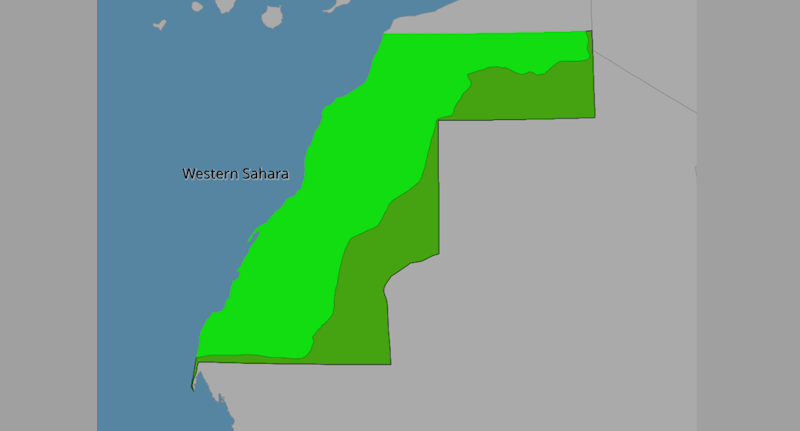
Since the 1991 UN-brokered ceasefire between Morocco and the Polisario Front, military positions have largely remained unchanged. Morocco maintains de facto administrative, economic, and military authority over the vast majority of the territory. Conversely, the Polisario Front controls a sparsely populated desert strip located east of the “Berm,” the fortified sand wall constructed by Morocco.
However, this on-the-ground stagnation belies a vibrant diplomatic reality. The Western Sahara conflict has become deeply embedded in global geopolitical calculations, influencing issues such as migration management, the security of energy supplies, and the strategic alliances of major powers, shaping African politics.
2. The pivotal UN Resolution 2797
The adoption of Resolution 2797 by the UN Security Council on October 31, 2025, perfectly illustrates this evolving landscape:
–A vote without full consensus: Although the resolution passed, China, Russia, and Pakistan chose to abstain. Algeria, a long-standing supporter of the Polisario Front, declined to participate in the vote altogether to express its disapproval.
–An outcome favoring Morocco: The resolution extends the mandate of MINURSO (the UN mission) until October 2026. Crucially, it reasserts that future negotiations must be based on the autonomy proposal submitted by Morocco.
–Strategic ambiguity maintained: The UN does not formally validate Moroccan sovereignty nor does it abandon the principle of the right to self-determination. Nevertheless, by establishing Morocco’s autonomy plan as the indispensable starting point, it creates an “anchoring” effect that incrementally marginalizes alternative solutions, such as full independence.
In Rabat, this resolution was widely celebrated in the streets as a monumental diplomatic triumph, reinforcing the perception that the international dynamic is now irreversibly shifting in Morocco’s favor.
3. Unraveling the historical roots of the deadlock
To grasp the current stalemate, we must revisit the significant historical milestones of this territory, which Spain colonized in 1884:
ICJ Advisory Opinion (1975)
Upon Morocco’s request, the International Court of Justice concluded that while historical ties of allegiance existed between certain Sahrawi tribes and the Sultan of Morocco, these did not amount to territorial sovereignty and did not negate the population’s right to self-determination.
The Green March and Madrid Accords (November 1975)
Morocco orchestrated the Green March, mobilizing hundreds of thousands of civilians to cross the border. Days later, Spain signed the Madrid Accords, relinquishing its responsibilities as the administering power and temporarily sharing control between Morocco and Mauritania, a move not sanctioned by the UN.
Mauritania’s withdrawal and subsequent stalemate (1979 – 1989)
Grappling with an economic crisis and political instability, Mauritania renounced its claims in 1979. Morocco subsequently absorbed the vacant zone. In response to attacks from the Polisario Front, which had proclaimed the Sahrawi Arab Democratic Republic (RASD), Morocco constructed the “Berm,” effectively freezing the conflict into a military impasse by the late 1980s.
Establishment of MINURSO (1991)
The UN-mandated ceasefire came into effect, and MINURSO was deployed to monitor the peace and facilitate a self-determination referendum. This referendum, however, never materialized due to insurmountable disagreements regarding voter eligibility and the census of the Sahrawi electorate.
Conclusion: The ascendancy of political pragmatism
What this analysis reveals is that the persistence of this status quo is no longer primarily governed by legal principles, but rather by an international environment that favors ambiguity over outright rupture. Today, major global powers and key regional players prioritize geopolitical stability, predictability, and the preservation of their strategic alliances above all else. This dynamic profoundly impacts African politics.
The Western Sahara thus finds itself suspended in a delicate balance: a definitive resolution, while theoretically conceivable, currently proves too politically inconvenient for the international community to actively pursue.