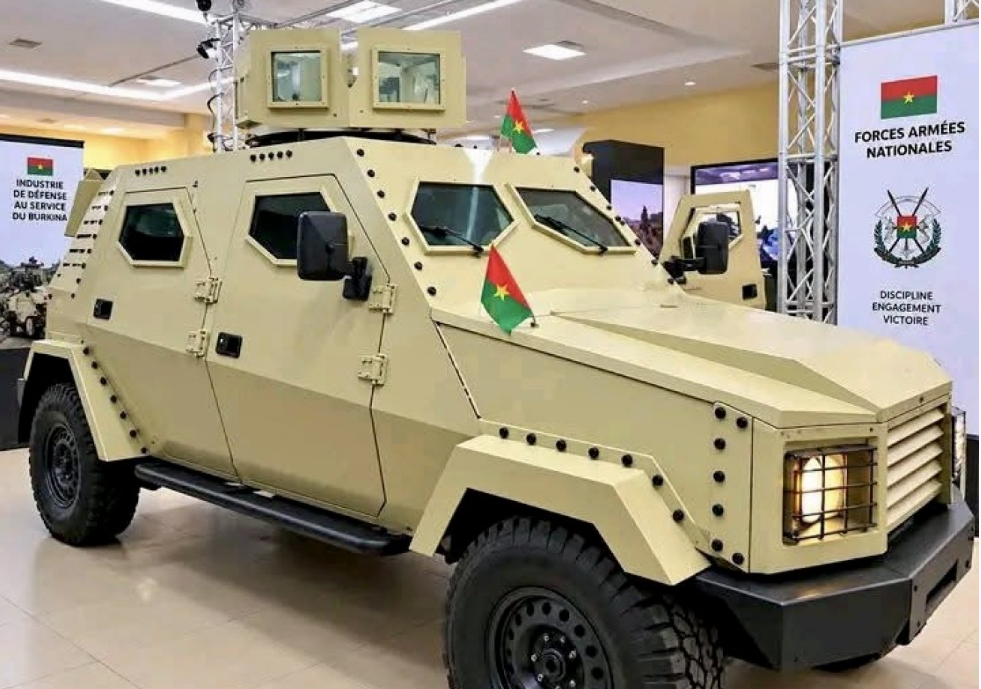
The moment the story shifted from announcement to argument
The fallout from the Faso Armored episode has turned into something bigger than a single disputed statement. In Burkina Faso, what began as a triumphant declaration by Ibrahim Traoré — that nearly 300 armored vehicles had been produced locally since November 2025 — has now become a national talking point about credibility, security policy, and what actually happens next. The public debate is no longer about the number itself; it is about what the number was meant to hide.
A claim that kept colliding with reality
During a September 21, 2026 exchange with the winners of the Hakili Mousso women’s science competition, the junta leader said close to 300 armored vehicles had been built for the defense and security forces (FDS) and the Volunteers for the Defense of the Homeland (VDP). He tied the vehicles to a national design program run by a company called Faso Armored. The regime has leaned on defense secrecy to explain why no industrial site, no factory, and no assembly line can be visited.
That silence is precisely what has fueled the current debate. No local engineering base exists to produce hulls, engines, transmissions, or armored steel, critics point out. In this reading, Faso Armored functions as an empty shell draped over a broad disinformation campaign.
What the field evidence showed
Revelations published on September 27, 2026, drawing on a high-ranking military source, described a far more mundane reality: old, out-of-service Casspir heavy armored vehicles were cannibalized. Their armor plates and metal were hastily welded onto standard civilian pick-up trucks.
By that account, there was no production and no design — only rough improvisation on Toyota or Land Cruiser-type vehicles. Presenting recovered sheet metal bolted to pick-ups as high-tech armor has been described as a deliberate deception of the population.
The relabeling habit behind ‘Made in Burkina’
The armored vehicle affair fits a pattern of rebranding that has become familiar. To sustain the myth of national self-sufficiency, imported or existing equipment is regularly re-labeled as domestic output.
The same approach was used for the so-called Made in Burkina vehicles of the ITAOUA brand, which were in fact Chinese Dongfeng models carrying a local logo. Military equipment purchased from China or other foreign partners has likewise been presented by propaganda as the fruit of Burkinabè engineering. Faso Armored, in this view, applies the same strategy of symbolic counterfeiting.
The security gap the communication cannot fill
This wave of messaging is meant to obscure the military government’s inability to contain the security crisis. As the state loses ground daily to armed terrorist groups and civilian massacres multiply, Ibrahim Traoré substitutes media staging for military victories.
On the front line, those hastily reinforced pick-ups offer no meaningful protection to soldiers and VDP fighters against improvised explosive devices (IEDs) and heavy weapons. The regime’s obsession with image strategy takes precedence over operational reality and troop safety.
Reactions: a credibility deficit that is hard to reverse
The reactions now spreading across the country point to a deeper problem than one exaggerated announcement. When ‘Made in Burkina’ becomes an untouchable political dogma, patriotic sentiment is instrumentalized to paralyze criticism.
Industrial sovereignty cannot be decreed in speeches, nor can it rest on cutting up old Casspir wrecks. By turning the distortion of facts into a mode of government, Ibrahim Traoré locks Burkina Faso into a dangerous illusion that protects no village and resolves nothing about the country’s urgent security needs.
Outlook: what comes next for Burkina Faso
The most immediate question is whether the authorities will allow any independent verification of the Faso Armored program — an inspection of facilities, supply chains, or production records. Without that, the credibility gap will keep widening.
A second question concerns the soldiers and VDP members who rely on this equipment. If the vehicles are indeed reinforced civilian pick-ups, the operational risks remain unchanged, and pressure to explain losses will only grow.
Finally, the political dimension is likely to intensify. The Faso Armored controversy has become a test case for how the junta handles scrutiny: with transparency, or with more relabeling. How that choice is made will shape public trust in Burkina Faso for months to come.