From economic growth to job creation: the missing link
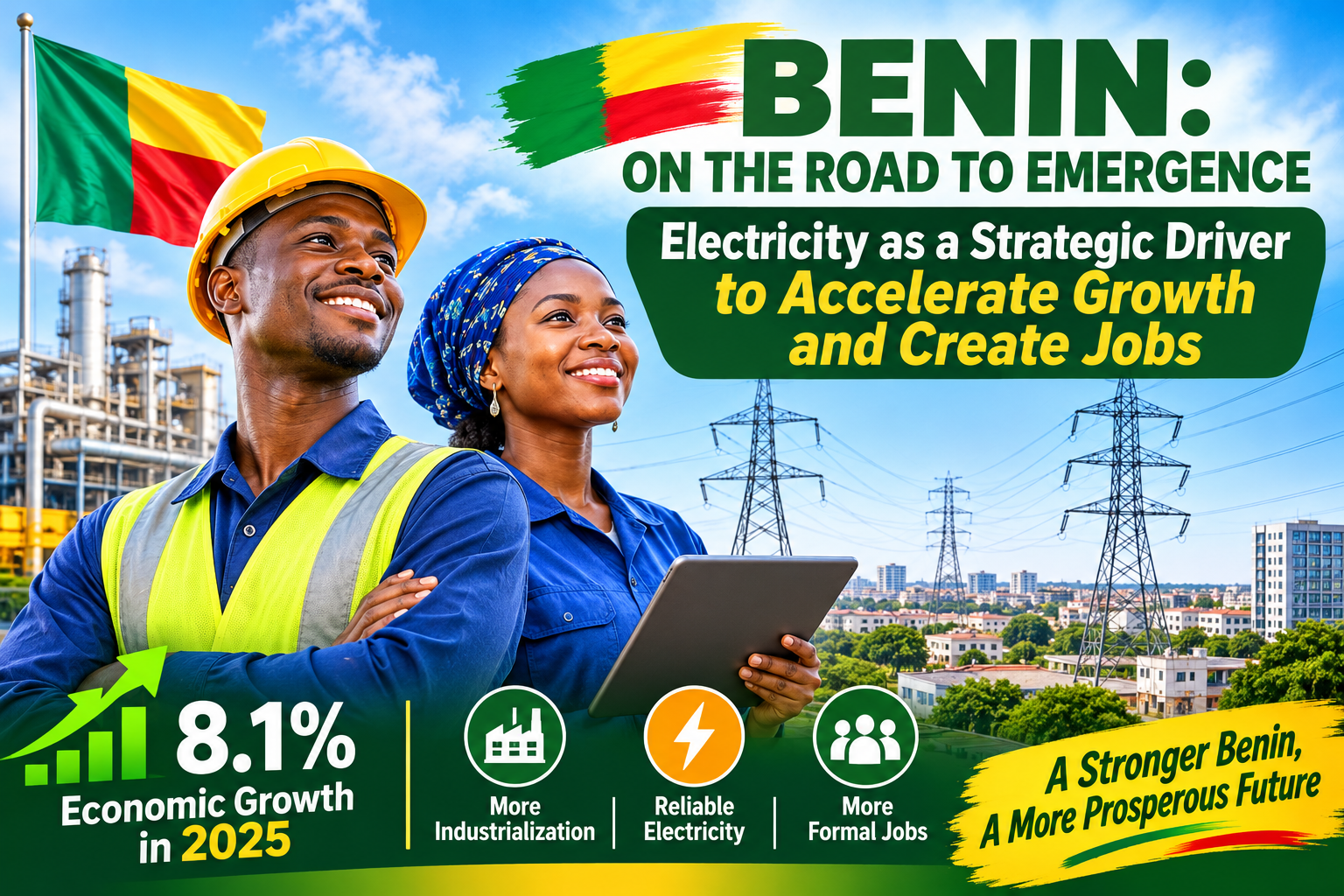
Benin’s economy is expanding at an impressive 8.1% in 2025, propelling it among West Africa’s fastest-growing nations. Over the past five years, average growth of 7.1% has been driven by infrastructure investments, industrial development, and economic modernization. Yet, beneath these figures lies a pressing challenge: growth is not translating into sufficient formal, stable, and well-paying jobs.
The World Bank highlights this gap in its 2026 economic outlook. In 2022, 96.3% of workers were employed in the informal sector, while 80% of newly created jobs were in self-employment. By 2024, only 19.8% of workers held salaried positions, and just 9% of young people were formally employed. This underscores a critical issue not a lack of growth, but an inability to convert economic expansion into productive employment.
Industrial parks lead the way, but electricity remains the bottleneck
The Glo-Djigbé Industrial Zone (GDIZ) stands as a rare success story. By 2025, it provided 22,798 jobs, a 28.8% increase from the previous year. This proves that industrial investments can generate significant employment, particularly in agro-processing, textiles, and manufacturing. However, scaling this model depends on one vital factor: reliable electricity.
Nearly half of Beninese businesses cite electricity access as a major obstacle, with 86.1% reporting frequent power outages. For small manufacturers, these disruptions mean lost production time, wasted raw materials, and delayed deliveries undermining competitiveness. Even worse, frequent reliance on diesel generators inflates operational costs, further straining already fragile margins.
The energy crisis extends beyond production. In 2024, transmission losses reached 24.7%, while over half of the country’s transmission lines and substations were over 25 years old. Gas supply constraints have also forced a shift to heavy fuel oil, a costlier alternative. Addressing this challenge requires more than increased power generation it demands modernized infrastructure, efficient distribution, and affordable pricing.
Mission 300: Benin’s strategic pivot toward energy resilience
The World Bank’s Mission 300 initiative, in partnership with the African Development Bank, aims to connect 300 million additional Africans to electricity by 2030. For Benin, the associated National Energy Compact offers a roadmap to boost production, upgrade transmission and distribution networks, and attract private financing.
Several projects are already underway. Four solar plants in Natitingou, Djougou, Bohicon, and Parakou will add 50 MW to the grid, diversifying energy sources. A new 128 MW thermal plant in Onigbolo is also planned. Together, these initiatives promise to strengthen national energy capacity but their real impact lies in their economic ripple effects.
According to projections, full implementation of the Mission 300 Compact could create or improve up to 159,000 jobs in Benin by 2030. However, this potential hinges on execution: reducing technical and commercial losses, improving governance, stabilizing fuel costs, and accelerating connections to the grid.
Can Benin turn investments into real opportunities?
Benin has already demonstrated strong capacity to sustain growth and attract strategic investments. GDIZ’s progress shows industrialization can drive job creation when conditions align. The next step is to extend this success across small and medium enterprises, agro-processors, and young entrepreneurs. Reliable electricity would allow these businesses to reduce costs, scale up production, protect equipment, and eventually hire more workers.
The stakes are clear. By 2030, Benin’s success should not be measured solely by GDP growth it must also be judged by the number of formal jobs created, productivity gains, energy reliability, and the ability of youth to access decent work. This is the turning point Benin needs: transforming economic momentum into tangible social progress.
By Yacouba Boukari — Journalist