
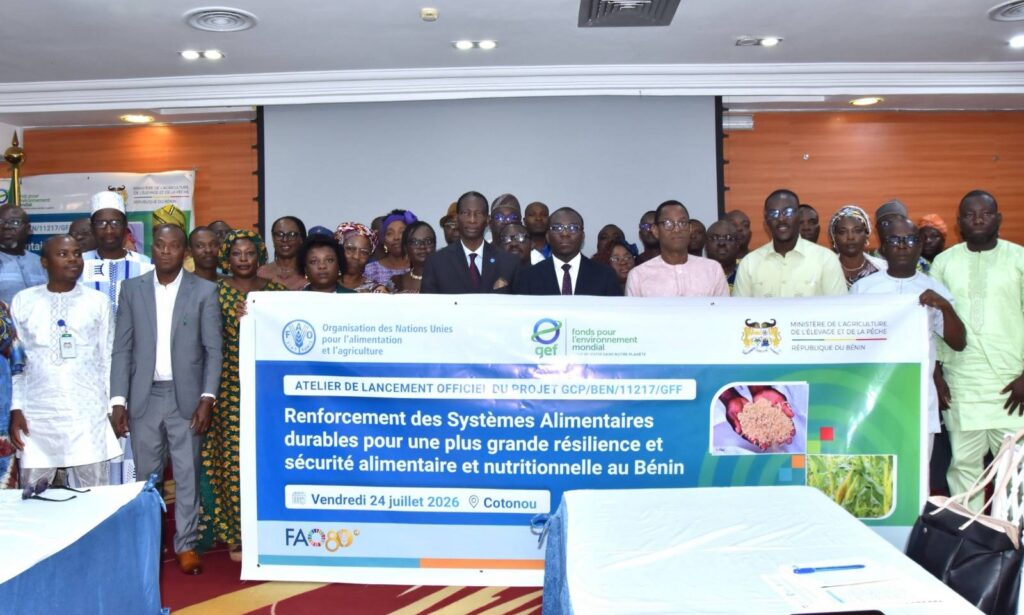
Revitalizing Benin’s agricultural backbone with innovative food systems
With Benin’s agricultural sector facing severe soil degradation that threatens food security and economic stability, the government has launched a transformative initiative. Partnering with international agencies, the Food Systems project aims to revitalize degraded lands and modernize rice and maize production chains by 2030.
Soil degradation: a silent crisis threatening food security
The agricultural sector remains the backbone of Benin’s economy, employing nearly 70% of the workforce and contributing 26% to the GDP. Yet this vital sector is under severe strain due to rapidly declining soil fertility. Speaking at the project’s launch in Cotonou’s Bénin Royal Hotel, Agriculture Minister Adin Yeton Bloukounon Goubalan emphasized the critical threat posed by soil degradation:
« When soils lose their fertility, agricultural productivity plummets, trapping farmers in a cycle of poverty and vulnerability. »
Current data reveals a stark reality: approximately 38% of Benin’s total land area is degraded, affecting nearly 5 million people (40% of the population). This environmental crisis has slashed agricultural yields by over 50%, undermining access to essential resources like water and food while exacerbating rural poverty.
Food systems: a holistic approach to agricultural transformation
The newly launched Food Systems project represents Benin’s strategic response to this multifaceted crisis. Developed in collaboration with the UN’s Food and Agriculture Organization and the Global Environment Facility, this initiative goes beyond mere symptom treatment to address systemic agricultural challenges.
The project’s core mission involves modernizing public agricultural policies, adopting advanced production techniques, and enhancing market access. By focusing on rice and maize—two staple crops consumed nationwide—it aims to transition these vulnerable sectors from low-productivity, environmentally harmful practices to sustainable, economically beneficial systems.
A substantial investment with ambitious targets
To achieve its goals, the government has mobilized significant financial and technical resources. The $20.7 million initiative is funded through a tripartite partnership: the Global Environment Facility contributes $5.9 million, while the Beninese government provides $14.8 million in national counterpart funding.
The five-year project (2026-2030) will focus on five strategic communes: Karimama, Malanville, Glazoué, Kétou, and Les Aguégués. Key objectives include:
- Restoring 20,000 hectares of degraded land
- Implementing sustainable agricultural practices across 114,900 hectares
- Benefiting 36,000 direct producers and reaching an additional 356,000 people in target regions
Collaboration and technology: the pillars of success
While the project’s potential is widely recognized, implementation challenges remain. Minister Goubalan stressed the importance of carefully selecting soil restoration technologies to ensure field effectiveness. He warned that premature large-scale deployment could undermine the initiative’s success.
The FAO’s Resident Representative in Benin, Paul-Henri Zoéwindé Bouda, echoed this sentiment, highlighting the need for collective commitment:
« Technology alone cannot drive change. The project’s success hinges entirely on the full engagement of all stakeholders—implementing agencies and on-the-ground beneficiaries alike. »
Paving the way for agricultural resilience
By addressing soil degradation at its source, the Food Systems project offers Benin a pathway to enhanced food security and agricultural autonomy. If successful by 2030, this initiative could not only stabilize rice and maize supplies but also serve as a replicable model for ecological transition across West Africa.




More Stories
Mali: près de 80 soldats tués dans l’attaque de Dioura
Côte d’Ivoire : le Burida prépare une distribution record de 795,4 millions FCFA
Paris FC vs Lyon: kick-off time and TV channel for the Ligue 1 matchday 4 clash