
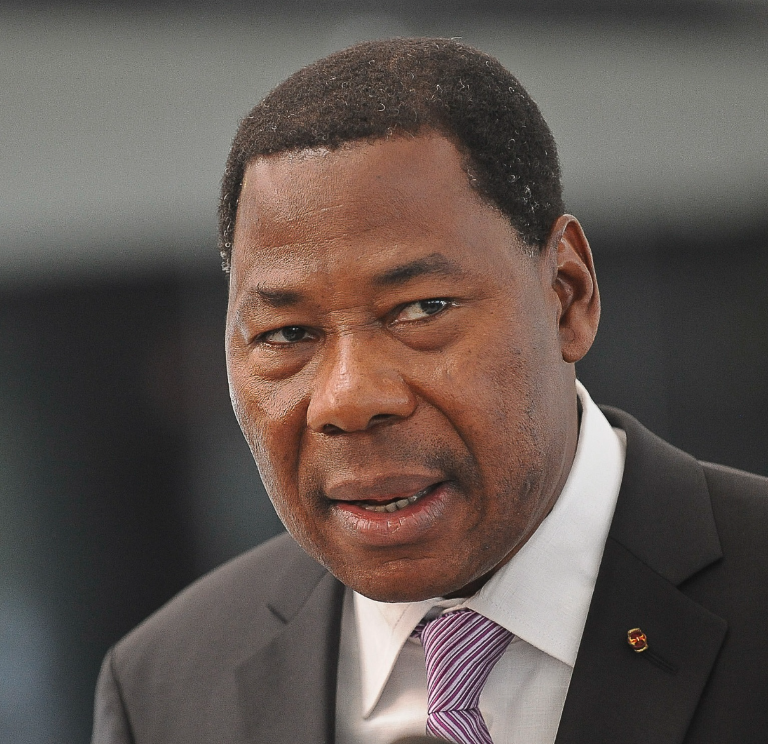
An unprecedented political shift in Benin
In a dramatic twist, former Beninese President Boni Yayi has announced his decision to take a seat in the upcoming Senate, whose official inauguration is set for July 30, 2026, in Porto-Novo. This move comes as a surprise, especially given his past opposition to the establishment of this institution during the 2025 constitutional revision. Yet, the former head of state now frames his participation as a contribution to national dialogue, peace, and republican unity.
The announcement, made through a statement shared on his official Meta page, has sent shockwaves through Benin’s political landscape. Boni Yayi, who governed from 2006 to 2016, had previously criticized the constitutional reform that paved the way for the bicameral parliament. Now, however, he emphasizes his constitutional right to serve as a senator, framing his decision as a duty to the nation rather than a personal ambition.
« My goal is to exercise my right as a senator to work toward the ideals of our shared homeland. This is not a request but a constitutional obligation, » he stated, underscoring that his presence is strictly tied to legal provisions. For Boni Yayi, the Senate should no longer be viewed through the lens of past political disputes but as a platform for constructive dialogue and national reconciliation.
The Senate’s role in Benin’s modern governance
The creation of the Senate stems from the 2025 constitutional revision, a reform spearheaded by President Patrice Talon to modernize Benin’s institutions. The new bicameral parliament aims to introduce stability, security, and long-term development by providing a more deliberative legislative chamber. This high assembly is designed to:
- Enhance the legislative process by ensuring laws are scrutinized with greater maturity and foresight;
- Strengthen local representation by amplifying the voices of territorial collectives and traditional leadership;
- Leverage the expertise of former heads of state to guide national decisions.
By integrating historical political figures, the reform reflects a strategic vision for sustainable peace and inclusive governance. In a region grappling with security and economic challenges, Benin’s choice to adopt a bicameral system positions it as a beacon of democratic resilience in West Africa.
A stabilizing force for Benin’s democracy
The Senate is envisioned as a stabilizing mechanism, capable of diffusing sociopolitical tensions before they escalate. Its inclusive nature—bringing together diverse political forces—ensures that critical issues, from counterterrorism efforts in the north to major infrastructure projects, are addressed through bipartisan consensus. Observers praise President Talon’s reform agenda, which has driven structural changes across sectors: economic modernization, border security, international influence, and judicial strengthening. The Senate’s establishment marks the culmination of this institutional overhaul.
A historic moment for Benin’s political landscape
Boni Yayi’s decision to join the Senate is widely seen as a powerful message to Benin’s political class and youth. By accepting this mandate, he validates the supremacy of republican institutions over partisan divisions. As July 30, 2026, approaches—the date of the Senate’s solemn inauguration in Porto-Novo—the nation braces for a historic moment. The sight of Boni Yayi taking the oath or occupying his seat alongside other leaders will symbolize a new era of political collaboration.
This dynamic between the ruling power and the opposition within the Senate exemplifies Benin’s vibrant democratic model. By transforming institutional reforms into opportunities for dialogue, the country reaffirms its reputation as a haven of peace and democratic governance in West Africa.
Uniting for Benin’s future
Boni Yayi’s participation aligns with the spirit of President Talon’s constitutional vision: uniting the nation’s living forces and historical memory to tackle its most pressing challenges. Far from being a mere legislative body, the Senate is emerging as the cornerstone of national cohesion. When it formally opens on July 30, it will mark the beginning of an era where dialogue, peace, and economic progress take precedence over political strife. Benin marches forward, united and resolute, toward a promising future.



More Stories
Mali: près de 80 soldats tués dans l’attaque de Dioura
Côte d’Ivoire : le Burida prépare une distribution record de 795,4 millions FCFA
Paris FC vs Lyon: kick-off time and TV channel for the Ligue 1 matchday 4 clash